When Does a High Cortisol Test Need Follow-Up?
An elevated cortisol result may need another look, but the test used and the circumstances around it determine what comes next.
A high cortisol result is a reason to review the test, not a diagnosis on its own. Follow-up is more compelling when you have progressive or unusual symptoms or an adrenal mass. A clinician may repeat testing or choose a different test after considering collection timing, medicines, and pregnancy. The next step depends on which test was abnormal and why it was ordered. 1 5 8
Start with the test, not the number
“High cortisol” can refer to different tests that measure cortisol in different ways. Common initial tests include late-night saliva, a 24-hour urine collection, and a dexamethasone suppression test. These results aren’t interchangeable, and an abnormal screening result means more evaluation may be warranted, not that Cushing syndrome has been diagnosed. 1 3
Before interpreting the result, check the report for the test name, collection time, and any instructions. Tell the clinician about medicines you take, including any glucocorticoid (steroid) treatment. Oral estrogen-containing medicines, including some contraceptives and hormone therapy, can raise the total cortisol measured in blood and make a dexamethasone suppression test appear abnormal even when free cortisol hasn’t risen. Other medicines, including phenytoin, carbamazepine, and rifampin, can affect how the body processes dexamethasone. Ask whether a medicine could have changed this particular result before assuming it reflects excess cortisol production. 1 2
Why an abnormal result may need checking
Cortisol test interpretation can be affected by the circumstances of testing. A review focused on older adults identifies diabetes, sleep disturbance, and acute illness as reasons to interpret late-night saliva testing cautiously and repeat it when appropriate. Urinary free cortisol may be falsely low with chronic kidney disease. These circumstances, rather than age alone, are the reason for that caution. 2
Some conditions can also activate the body’s cortisol-regulating system without a cortisol-producing tumor. Reviews describe this non-neoplastic hypercortisolism in association with conditions including major depression, chronic alcohol use, obesity, and eating disorders. That overlap is one reason a symptom or one abnormal result can’t settle the diagnosis; a careful assessment and, when needed, further testing help distinguish causes. 4 6
When follow-up is more compelling
Testing is more useful when there are several progressive or unusual features, rather than one common symptom on its own. Examples that can raise concern include muscle weakness, easy bruising, or osteoporosis that is unusual for your age. Difficult-to-control diabetes or hypertension may also contribute to the decision when they occur alongside other concerning features. Routine cortisol screening for everyone with diabetes or hypertension isn’t recommended. 1 7 8
An adrenal mass found incidentally is another reason a clinician may assess cortisol production. Even in selected groups, a positive screening test alone isn’t enough to establish mild autonomous cortisol secretion; further evaluation is needed. 1
What repeat or confirmatory testing may involve
The next test depends on what the first one was trying to find. For example, after an abnormal dexamethasone suppression test in someone with an adrenal mass, a clinician may first check whether timing or a medicine made the result unreliable. Follow-up may include repeating that test and measuring morning ACTH, a hormone that helps clarify whether cortisol production is acting independently. Late-night saliva or 24-hour urine testing may help answer other questions about cortisol excess, but they cannot reliably rule out mild autonomous cortisol secretion in someone with an adrenal mass. 1 3
An older adult whose late-night saliva result is hard to interpret because of diabetes, disrupted sleep, or acute illness may need that test repeated. When findings remain uncertain, particularly where a mood disorder could also affect cortisol regulation, specialist evaluation may include follow-up over time or second-line tests such as a combined dexamethasone-CRH test or a desmopressin test. These aren’t automatic next steps after every high result. The aim is to find out whether appropriate testing consistently supports cortisol excess and whether the findings fit the clinical picture. 2 4 6
Pregnancy and test interpretation
If you’re pregnant, say so before testing. Pregnancy itself changes cortisol physiology: urinary free cortisol and late-night salivary cortisol can rise substantially, while the daily rhythm is usually preserved. Results therefore need to be interpreted in the context of pregnancy rather than by applying a nonpregnant expectation without adjustment. 5
If testing confirms excess cortisol
Further evaluation needs to distinguish endogenous cortisol production from other explanations, including exposure to glucocorticoid medicines and non-neoplastic activation of the cortisol system. 2 4 7
Determining the source of confirmed endogenous excess is a separate step. It may involve ACTH testing and imaging, rather than assuming the first abnormal result identifies a cause. 1 3
Useful questions to ask
- Which cortisol test was abnormal, and what time or collection instructions matter for interpreting it?
- Could pregnancy or a medicine, including an oral estrogen-containing medicine, affect this test?
- Should this test be repeated, or would a different type of test answer the question better?
- What features in my health history make further evaluation appropriate?
- If testing confirms excess cortisol, how will you determine its cause?
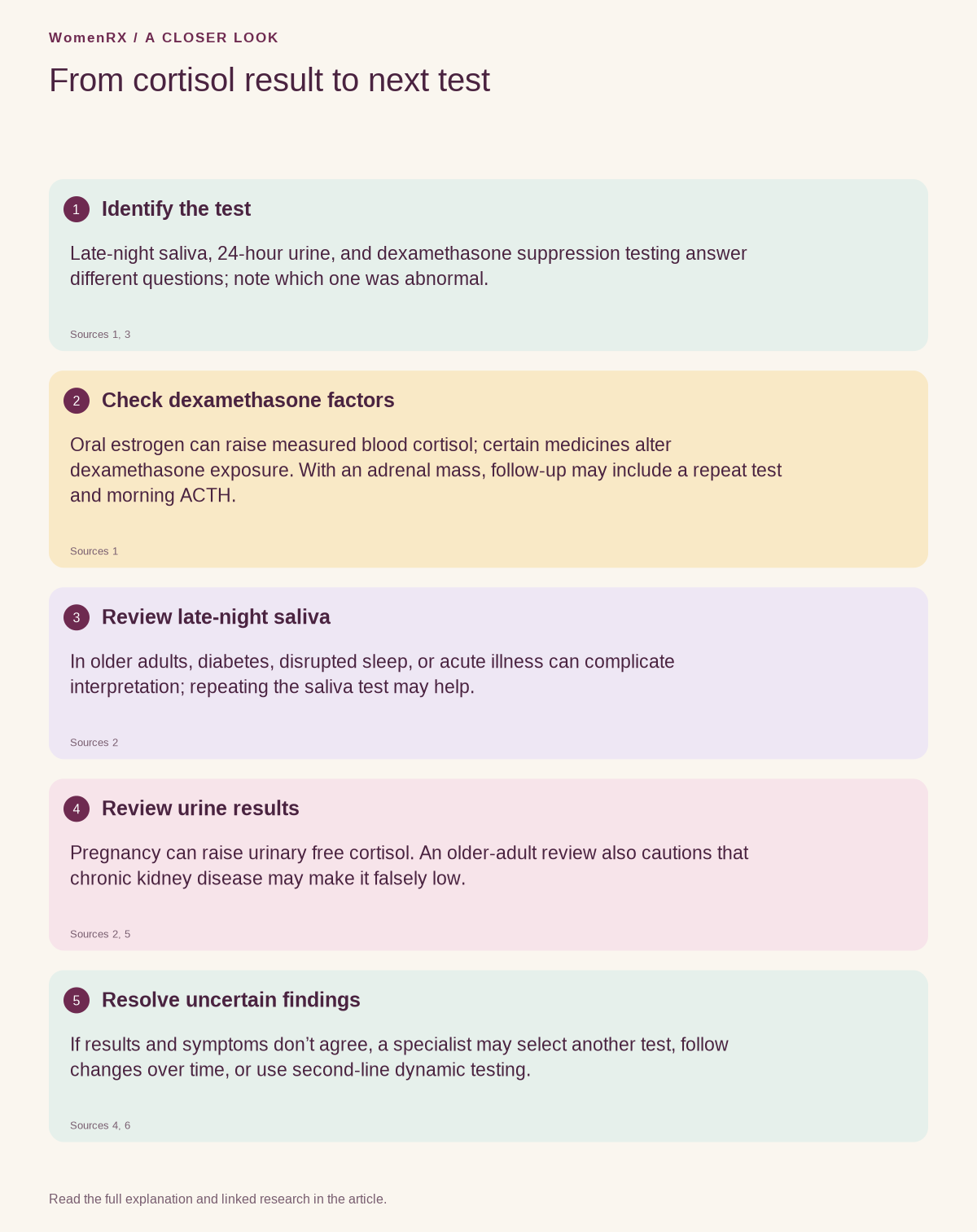
From cortisol result to next test
Identify the test: Late-night saliva, 24-hour urine, and dexamethasone suppression testing answer different questions; note which one was abnormal.13
Check dexamethasone factors: Oral estrogen can raise measured blood cortisol; certain medicines alter dexamethasone exposure. With an adrenal mass, follow-up may include a repeat test and morning ACTH.1
Review late-night saliva: In older adults, diabetes, disrupted sleep, or acute illness can complicate interpretation; repeating the saliva test may help.2
Review urine results: Pregnancy can raise urinary free cortisol. An older-adult review also cautions that chronic kidney disease may make it falsely low.25
Resolve uncertain findings: If results and symptoms don’t agree, a specialist may select another test, follow changes over time, or use second-line dynamic testing.46
Read the figure as text
The first result points to a question, not a diagnosis. Its test-specific limitations help determine what comes next.- Identify the test: Late-night saliva, 24-hour urine, and dexamethasone suppression testing answer different questions; note which one was abnormal.13
- Check dexamethasone factors: Oral estrogen can raise measured blood cortisol; certain medicines alter dexamethasone exposure. With an adrenal mass, follow-up may include a repeat test and morning ACTH.1
- Review late-night saliva: In older adults, diabetes, disrupted sleep, or acute illness can complicate interpretation; repeating the saliva test may help.2
- Review urine results: Pregnancy can raise urinary free cortisol. An older-adult review also cautions that chronic kidney disease may make it falsely low.25
- Resolve uncertain findings: If results and symptoms don’t agree, a specialist may select another test, follow changes over time, or use second-line dynamic testing.46
Sources you can check
- Is Hypercortisolism Treatable? Which Patients Should Be Treated and How-A Practical Guide for Clinicians.Frias JP. · Diabetes, obesity & metabolism · 2026Return to first citation
- Approach to the Patient: Diagnosis and Management of Cushing's Syndrome in the Elderly - How Different Is It?Liu Y, Yi L, Tan H. · The Journal of clinical endocrinology and metabolism · 2026Return to first citation
- Differential diagnosis of ACTH-dependent Cushing's syndrome: Biochemical, imaging, and predictive approaches.Rivera-Martínez WA, Builes-Montaño CE, Román-González A, Builes-Barrera CA, Ramírez-Castaño MJ, Gutiérrez-Restrepo J. · Vitamins and hormones · 2026Return to first citation
- Differential diagnosis between endogenous Cushing´s syndrome and pseudo-Cushing.Abdul-Aziz AA. · Vitamins and hormones · 2026Return to first citation
- Cushing's syndrome and pregnancy: Clinical presentation and diagnosis.Biagetti B. · Vitamins and hormones · 2026Return to first citation
- Who and how to screen for endogenous hypercortisolism in patients with mood disorders.Ferrante E, Simeoli C, Mantovani G, Pivonello R. · Journal of endocrinological investigation · 2025Return to first citation
- Cushing Syndrome | Hypercortisolism | MedlinePlusAccessed 2026-09-25Return to first citation
- Whom Should We Screen for Cushing Syndrome? The Endocrine Society Practice Guideline Recommendations 2008 Revisited.Braun LT, Vogel F, Zopp S, Marchant Seiter T, Rubinstein G, Berr CM, Künzel H, Beuschlein F, Reincke M. · The Journal of clinical endocrinology and metabolism · 2022Return to first citation