Which Cortisol Test Might a Clinician Use?
The right cortisol test depends on whether the concern is excess cortisol or how the body responds to a hormone signal.
For suspected cortisol excess, clinicians may use late-night saliva, a 24-hour urine collection, or a dexamethasone suppression test. These assess different patterns and aren’t interchangeable. In people receiving immune-checkpoint inhibitor cancer treatment, morning blood cortisol and ACTH stimulation may help investigate possible cortisol deficiency. Timing, collection quality, pregnancy, and estrogen-containing medicines affect how some results are interpreted. 2 3 5
Start with the question the test is meant to answer
Cortisol changes over the day, and different tests look at different parts of that pattern. When a clinician is checking for Cushing syndrome, or sustained excess cortisol, commonly used initial tests include late-night salivary cortisol, 24-hour urinary free cortisol, and a dexamethasone suppression test. A random blood cortisol isn’t a reliable way to screen for Cushing syndrome. 2 3
Testing for too little cortisol asks a different question. In people receiving immune-checkpoint inhibitor cancer treatment, clinicians may assess morning blood cortisol and use an ACTH stimulation test when more information is needed. ACTH is a signal that prompts the adrenal glands to produce cortisol; the test checks the blood cortisol response after that signal. A study of 30 people examined this approach specifically during immune-checkpoint inhibitor treatment, so its findings don’t establish a testing rule for everyone with possible cortisol deficiency. 5
What each test can show
| Test | What it measures | Why timing or collection matters |
|---|---|---|
| Blood cortisol | Cortisol in a blood sample. In the immune-checkpoint inhibitor setting, clinicians may assess a morning result for possible deficiency. Blood cortisol is also measured after a dexamethasone test. | Cortisol varies with time of day. Most blood cortisol is bound to proteins, so a total blood result can be affected by changes in those proteins. 3 5 |
| Late-night saliva | Free cortisol in saliva near the time cortisol would usually reach a low point. A high result can point to loss of the usual daily rhythm. | The sample needs to match the instructed late-night collection time. This test looks at a particular time of day, not a daily total. 3 |
| 24-hour urine | Free cortisol excreted across a full day. | It depends on collecting the full 24-hour sample. An incomplete collection, high fluid intake, or reduced kidney function can make the result less reliable. 3 |
| Dexamethasone suppression | Whether cortisol falls after dexamethasone, which normally provides feedback that reduces hormone signaling. | The medicine and follow-up blood draw are timed as directed by the clinician or lab. This checks whether cortisol is suppressed, not just its level at one moment. 2 3 |
| ACTH stimulation | How blood cortisol responds after ACTH is given. In the immune-checkpoint inhibitor setting, this can add information when morning cortisol doesn’t settle a question about possible deficiency. | It requires blood sampling to assess the stimulated response. Unlike dexamethasone suppression, it checks whether cortisol rises after a signal rather than falls after feedback. 5 |
Tests for suspected cortisol excess can disagree without one automatically being “wrong.” They assess different features: the late-night low point, the day’s urinary free cortisol, or the response to dexamethasone. A retrospective study of 137 people evaluated for possible Cushing syndrome compared these tests and found different sensitivity and specificity depending on the test and cutoff used. Its results illustrate why a single number or cutoff shouldn’t be treated as universal. 4
Collection details are part of the result
For saliva, ask which night and time to collect, and follow the lab’s directions for storing and returning the sample. For urine, clarify when the 24-hour collection starts and ends and what to do if a collection is missed. The collection itself matters: incomplete urine collection and high fluid intake can affect urinary cortisol results. 3
For a dexamethasone test, follow the specific timing provided for the medicine and blood draw. Don’t substitute a random cortisol test or change the timing on your own; the comparison depends on the planned sequence. Clinical reviews describe dexamethasone suppression as one of several initial tests for suspected cortisol excess, not a stand-alone diagnosis. 2 3
Pregnancy and estrogen can change the picture
Pregnancy and estrogen-containing medicines can raise corticosteroid-binding globulin, a protein that carries much of the cortisol in blood. That can make a total blood cortisol harder to interpret. Saliva and urine measure free cortisol and are less affected by changes in this binding protein, but the clinician still needs to know about pregnancy or estrogen use when choosing and interpreting tests. Don’t stop a prescribed medicine to prepare for a test unless the prescriber specifically directs you to. 3
What a result can and can’t tell you
An abnormal screening result usually leads to a closer look, not an immediate diagnosis or a conclusion about which gland is responsible. Clinicians interpret the result alongside symptoms, medications, collection quality, and sometimes another test. In a prospective German registry of 377 people referred for possible Cushing syndrome, clinicians used urinary, salivary, and dexamethasone tests as part of the overall assessment; final diagnoses also drew on clinical follow-up and, when needed, further testing. 1
A useful question to ask is: “What condition is this test checking for, and what should I do if the collection timing or instructions go wrong?” That helps you understand whether the test is assessing a daily pattern, a full-day amount, or the body’s response to a signal.
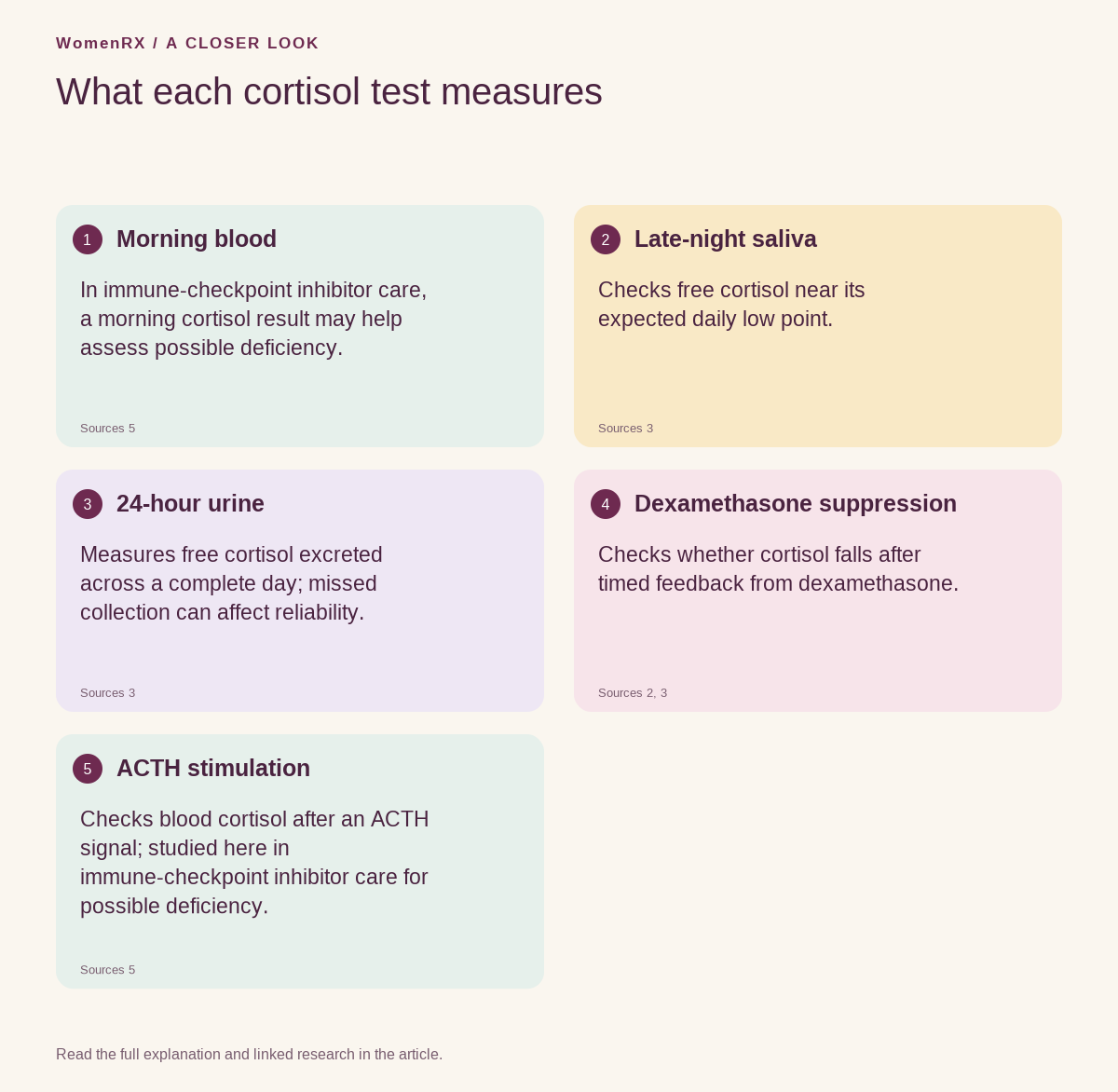
What each cortisol test measures
Morning blood: In immune-checkpoint inhibitor care, a morning cortisol result may help assess possible deficiency.5
Late-night saliva: Checks free cortisol near its expected daily low point.3
24-hour urine: Measures free cortisol excreted across a complete day; missed collection can affect reliability.3
Dexamethasone suppression: Checks whether cortisol falls after timed feedback from dexamethasone.23
ACTH stimulation: Checks blood cortisol after an ACTH signal; studied here in immune-checkpoint inhibitor care for possible deficiency.5
Read the figure as text
The sample, timing, and signal determine whether a test assesses cortisol excess or, in a different clinical setting, the response to ACTH.- Morning blood: In immune-checkpoint inhibitor care, a morning cortisol result may help assess possible deficiency.5
- Late-night saliva: Checks free cortisol near its expected daily low point.3
- 24-hour urine: Measures free cortisol excreted across a complete day; missed collection can affect reliability.3
- Dexamethasone suppression: Checks whether cortisol falls after timed feedback from dexamethasone.23
- ACTH stimulation: Checks blood cortisol after an ACTH signal; studied here in immune-checkpoint inhibitor care for possible deficiency.5
More questions, answered
Does a high cortisol result mean I have Cushing syndrome?
Not by itself. A screening result needs interpretation in context, and clinicians may use additional biochemical tests and follow-up before confirming a diagnosis or looking for its cause. 1 2
Can I use a home cortisol test to diagnose a hormone condition?
A single result without the right timing, collection, and clinical context can mislead. Tests for suspected cortisol excess are designed around specific collection windows or a planned response to dexamethasone, so ask the clinician who ordered the test how the result will be interpreted. 3
Sources you can check
- Whom Should We Screen for Cushing Syndrome? The Endocrine Society Practice Guideline Recommendations 2008 Revisited.Braun LT, Vogel F, Zopp S, Marchant Seiter T, Rubinstein G, Berr CM, Künzel H, Beuschlein F, Reincke M. · The Journal of clinical endocrinology and metabolism · 2022Return to first citation
- Cushing's syndrome: a practical approach to diagnosis and differential diagnoses.Pappachan JM, Hariman C, Edavalath M, Waldron J, Hanna FW. · Journal of clinical pathology · 2017Return to first citation
- Screening for Cushing Syndrome at the Primary Care Level: What Every General Practitioner Must Know.Yorke E, Atiase Y, Akpalu J, Sarfo-Kantanka O. · International journal of endocrinology · 2017Return to first citation
- Screening Tests for Cushing's Syndrome: Urinary Free Cortisol Role Measured by LC-MS/MS.Ceccato F, Barbot M, Zilio M, Frigo AC, Albiger N, Camozzi V, Antonelli G, Plebani M, Mantero F, Boscaro M, Scaroni C. · The Journal of clinical endocrinology and metabolism · 2015Return to first citation
- Adrenal Insufficiency During Treatment With Immune-Checkpoint Inhibitors: How to Simplify the Diagnostic Pathway?Nervo A, Gruosso G, Marino M, Migliore E, Rubiolo M, Vaccaro E, Arvat E. · Clinical endocrinology · 2026Return to first citation