High Testosterone in Women: What to Test Before Considering Treatment
A high result needs context: the test method, your symptoms, and your stage of life can all change what it means.
One testosterone result doesn’t identify the cause or determine treatment. It needs to be interpreted alongside your symptoms, menstrual or menopause history, and the assay used. New changes that progress quickly, especially after menopause, deserve prompt assessment even if you don’t yet have a testosterone result. Follow-up may include confirming testosterone, measuring DHEAS, or considering imaging when the pattern raises a specific concern. 1 2 3
A lab result is one part of the picture
A testosterone value needs context: the laboratory’s reference range, the test method, your age and life stage, and any changes in your body. A result that appears high doesn’t identify the cause on its own. Symptoms matter, too, but they don’t tell you exactly what your blood level is.
The test method can make a difference. In a prospective study of 906 infertile women with PCOS, total testosterone measured by an immunoassay averaged higher than when measured by liquid chromatography-tandem mass spectrometry (LC-MS/MS). Using that study’s definition of biochemical hyperandrogenism, 44% were classified that way by immunoassay, compared with 24% by LC-MS/MS. These findings apply to that specific group and definition, not to all women. If a result is unexpected, ask which method was used and whether it should be confirmed. 1
When a change needs prompt attention
New androgen-related changes that are progressing quickly deserve prompt medical assessment, particularly after menopause. Don’t wait for a testosterone test, a repeat result, or a particular number before raising the change with a clinician. The reason for assessment is the speed and pattern of change, not a conclusion that a tumor is present.
Concerning changes include rapidly increasing facial or body hair, or signs of virilization, meaning masculinizing changes such as clitoral enlargement. In a menopause-focused review, abrupt, severe symptoms with virilization and testosterone in the male range were identified as a reason to rule out a tumoral cause. The review does not say that a tumor is the only explanation, or that you must already have a lab result before reporting rapidly progressing symptoms. 3 4
How life stage shapes the evaluation
During reproductive years, menstrual history helps put androgen-related symptoms and results in context. PCOS is one possible explanation, but a testosterone result alone does not establish PCOS. The assay study, for example, included women already diagnosed with PCOS; it did not test testosterone as a stand-alone way to diagnose the condition. 1
After menopause, facial hair or hair loss may occur alongside age-related hormonal changes. A menopause-focused review describes estrogen declining more quickly than androgen secretion, along with a physiological decrease in sex hormone-binding globulin. But a new, abrupt, or severe change is different from a gradual pattern and calls for assessment. 3
Match follow-up tests to the question
Confirm the testosterone result. If a result is unexpected or does not fit the clinical picture, ask whether it should be confirmed and whether the method is suitable for measuring testosterone at that level. The PCOS assay study shows that methods can classify results differently, but it does not establish one testing approach or threshold for every woman. 1
Consider DHEAS when an adrenal source is part of the question. DHEAS is another androgen that can contribute information alongside total testosterone. A systematic review of published cases of benign androgen-producing adrenal tumors found elevated total testosterone in 93.4% of the women and elevated DHEAS in 69.4%. Some reported cases did not exceed hormone thresholds commonly used to suggest a tumor. These are findings from published case reports and case series, not estimates of how common these tumors are or how accurately a test works in the general population. A single result or cutoff is not the whole evaluation. 2
Consider other causes when the pattern is severe. Congenital adrenal hyperplasia is one possible alternative to consider in some evaluations. In a selected South Indian group of women with PCOS and high testosterone, three of the 120 women who completed stimulated steroid profiling were diagnosed with congenital adrenal hyperplasia; all three had severe hirsutism, clitoral enlargement, and severe hyperandrogenemia. This study does not estimate how often the condition occurs in the United States, but it illustrates why a markedly severe pattern may prompt focused testing for another cause. 4
Use imaging selectively. Imaging is not implied by every high result. The menopause review describes reliable total testosterone measurement and imaging as tools that may help when there is diagnostic uncertainty, particularly when symptoms are abrupt and severe or include virilization. 3
Before choosing treatment
Bring the full lab report if you have it, including the units, reference range, and test method. Describe when the symptoms began and how quickly they have changed, and share relevant menstrual or menopause history. Useful questions include: Does this result fit the pattern of symptoms? Should the testosterone measurement be confirmed? Would DHEAS or testing for a specific alternative cause help answer the question? What findings, if any, would make imaging appropriate?
The goal is to understand what the result and symptoms mean before deciding what to do about them. Lowering testosterone alone would not explain why the level or symptoms changed.
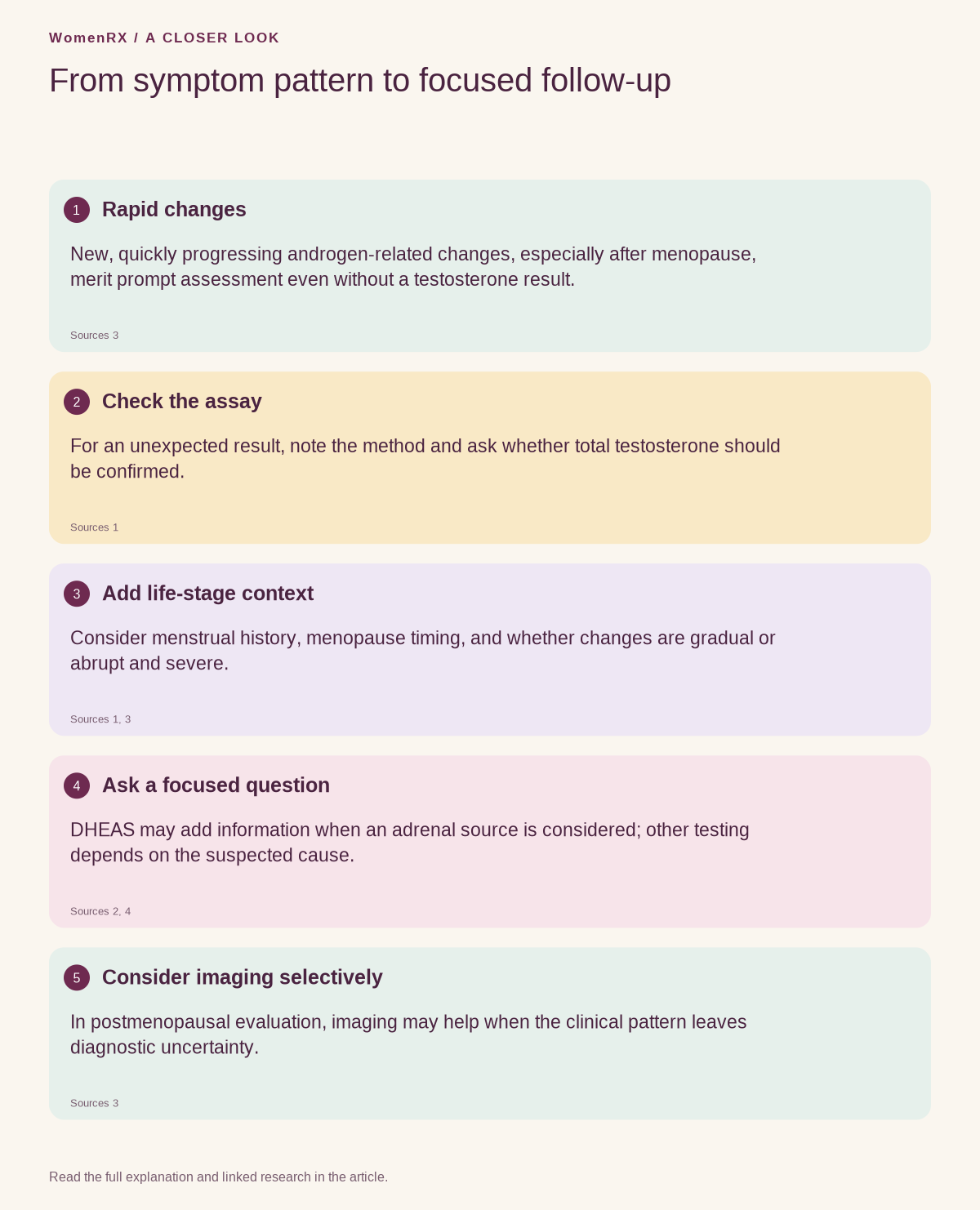
From symptom pattern to focused follow-up
Rapid changes: New, quickly progressing androgen-related changes, especially after menopause, merit prompt assessment even without a testosterone result.3
Check the assay: For an unexpected result, note the method and ask whether total testosterone should be confirmed.1
Add life-stage context: Consider menstrual history, menopause timing, and whether changes are gradual or abrupt and severe.13
Ask a focused question: DHEAS may add information when an adrenal source is considered; other testing depends on the suspected cause.24
Consider imaging selectively: In postmenopausal evaluation, imaging may help when the clinical pattern leaves diagnostic uncertainty.3
Read the figure as text
Separate changes that need prompt assessment from a lab result that needs confirmation, then connect follow-up to the clinical question.- Rapid changes: New, quickly progressing androgen-related changes, especially after menopause, merit prompt assessment even without a testosterone result.3
- Check the assay: For an unexpected result, note the method and ask whether total testosterone should be confirmed.1
- Add life-stage context: Consider menstrual history, menopause timing, and whether changes are gradual or abrupt and severe.13
- Ask a focused question: DHEAS may add information when an adrenal source is considered; other testing depends on the suspected cause.24
- Consider imaging selectively: In postmenopausal evaluation, imaging may help when the clinical pattern leaves diagnostic uncertainty.3
More questions, answered
Does a high testosterone result mean I have PCOS?
No. PCOS is one possible context, but a testosterone result alone does not establish the diagnosis. The assay and clinical pattern need to be considered together. 1
Should I wait for a blood test before reporting rapidly changing symptoms?
No. New androgen-related changes that progress quickly, especially after menopause, deserve prompt assessment even if you do not yet have a testosterone result. 3
Sources you can check
- Total Testosterone Measured by Liquid Chromatograph-Tandem Mass Spectrometry Refines Diagnosis of Biochemical Hyperandrogenism and Better Identifies Subgroup at Genuine Risk of Adverse Fertility Outcomes in Women With Polycystic Ovary Syndrome.Li J, Wu Q, Cong J, Chang H, Ma HL, Zhang DJ, Wang Y, Zhang RZ, Kam RKT, Ho CS, Chan MHM, Ma RCW, Ng EHY, Mol BWJ, Stener-Victorin E, Legro RS, Wang CC, Wu XK, PCOSAct Study Group. · Reproductive medicine and biology · 2026Return to first citation
- Benign androgen-producing adrenal tumors: A systematic review of cases and case series.García-Pérez M, Fernández-Trujillo-Moujir C, Boronat M. · Endocrine · 2026Return to first citation
- Hyperandrogenism after menopause: diagnostic evaluation.Fux-Otta C, Torre D, Chedraui P, Melgarejo B, Ramos N, Carlo MD, Benzi M, Banús V, Estario ME, Leiderman S, Gecchelin R, Bartolacci I, Tarletta M, Ziperovich C, Lella SD, Aramayo C... · Climacteric : the journal of the International Menopause Society · 2025Return to first citation
- Prevalence of Congenital Adrenal Hyperplasia in South Indian Polycystic Ovarian Syndrome Women.Gadda A, Tirupati S, Ravindra S, Karlekar M, Lila A, Sarathi V. · Indian journal of endocrinology and metabolism · 2026Return to first citation