What a Low Testosterone Result Can, and Can’t, Tell You
A low flag is a measurement, not a diagnosis: the assay, symptoms, and life stage all affect what the result can mean.
A low testosterone result shows that the measured value fell below that lab’s reference range; it does not, by itself, establish a testosterone-deficiency diagnosis or explain symptoms. In women, there is no established androgen-deficiency diagnosis based on a universal cutoff. Assay methods can also produce meaningfully different readings, so the result needs clinical context. 2 3 4
Start with what the test actually says
A testosterone test reports a measured concentration. If the lab flags it as low, that means the number fell outside the reference range used for that test. It does not prove that low testosterone caused a symptom, or that treatment is needed. A 2025 review states that there is no androgen-deficiency diagnosis for women. 4
Low desire does not point to one cause on its own. Sexual health can also be affected by medicines and chronic health conditions. 1 Evidence does not support testosterone treatment to improve energy or cognition in women. 4
The measurement method can change the number
Testosterone is present at low concentrations in women, which can make accurate measurement challenging. Mass spectrometry methods such as LC-MS/MS are used as reference methods, while immunoassays are more convenient but may be less accurate at low concentrations. 2
A study of 906 infertile women with PCOS illustrates why the method matters. On average, the immunoassay used in that study reported total testosterone 23.8% higher than LC-MS/MS. The difference between methods varied widely between individuals, so that average does not predict how much any one person’s result might differ. The study population also matters: these findings do not establish the size of assay differences in all women or set a cutoff for low testosterone. 3
If a result seems unexpected or is driving a major decision, it is reasonable to ask which method measured it, whether the lab’s reference range is appropriate for that method, and whether the result needs to be interpreted alongside other findings. A value from one method should not be treated as interchangeable with a value from another. 2 3
What life stage can, and can’t, tell you
There is no established androgen-deficiency diagnosis for women, and a low result is not a diagnostic cutoff for reproductive, perimenopausal, or postmenopausal women. 4 A low result alone cannot establish the cause of symptoms. Nor can one reading show whether your testosterone has changed with age or the menopausal transition. Before treating a low flag as meaningful for your life stage, ask which population the lab used for its comparison range.
What does differ by life stage is the evidence for treatment, which is not the same as evidence for a diagnosis. A review reports modest benefit from testosterone treatment for appropriately selected postmenopausal women with distressing low sexual desire, while research in women of late reproductive age is limited. That finding does not mean a low blood level identifies who has the condition or who would benefit. 4
Make the next step about the question behind the test
If the test was ordered because of a symptom, clarify what the result is meant to help assess. For low desire, for example, a blood value alone does not establish why desire has changed. Medicines and chronic conditions can affect sexual health too, so those may be relevant parts of the discussion. 1 4
Useful questions include: Which testosterone measure was tested? Which assay method was used? What reference range did the lab apply? What other explanations for the symptom are being considered? These questions help put the number in context without turning a single result into a diagnosis.
The practical takeaway is simple: take a low flag seriously enough to understand how it was measured, but not as proof that testosterone is the cause or that treatment is needed.
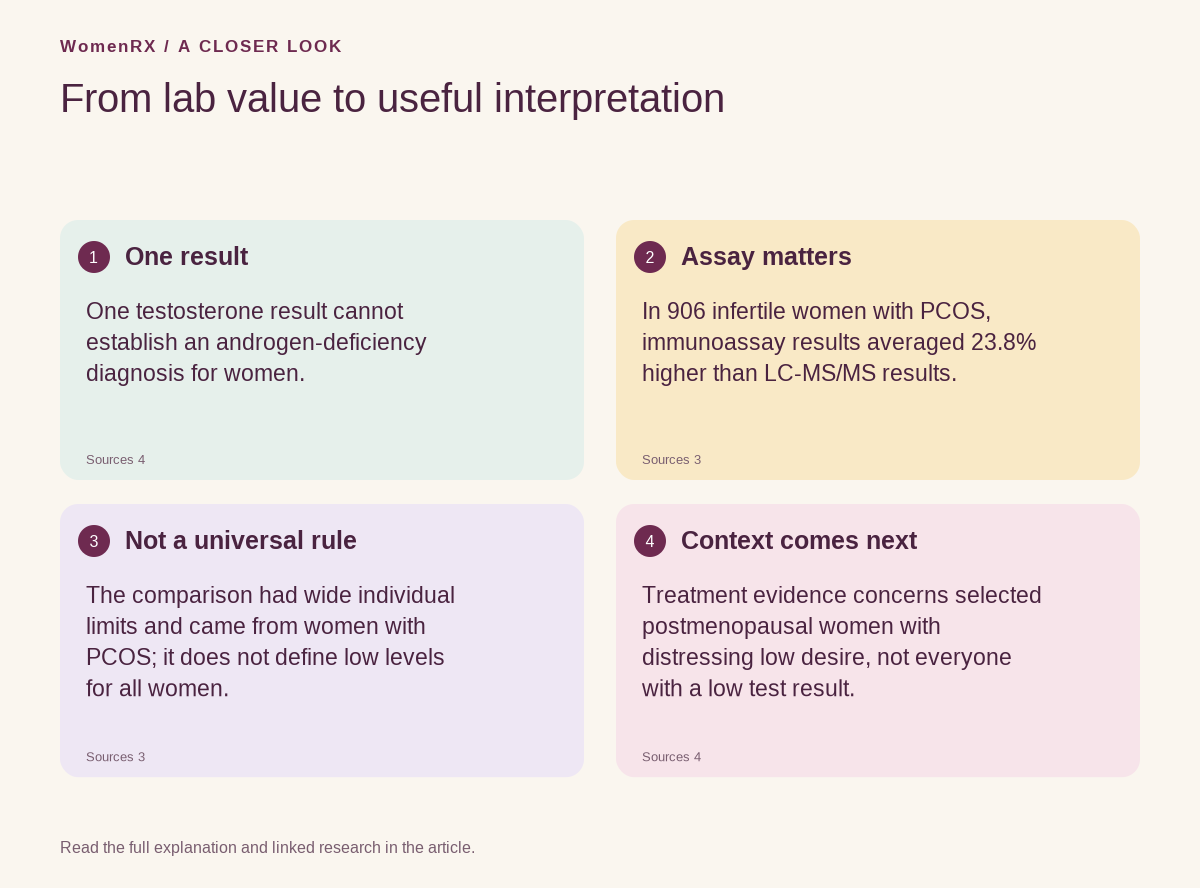
From lab value to useful interpretation
One result: One testosterone result cannot establish an androgen-deficiency diagnosis for women.4
Assay matters: In 906 infertile women with PCOS, immunoassay results averaged 23.8% higher than LC-MS/MS results.3
Not a universal rule: The comparison had wide individual limits and came from women with PCOS; it does not define low levels for all women.3
Context comes next: Treatment evidence concerns selected postmenopausal women with distressing low desire, not everyone with a low test result.4
Read the figure as text
A testosterone result is one piece of evidence. This map shows what the assay comparison can tell you, and where it cannot supply a diagnosis or treatment decision.- One result: One testosterone result cannot establish an androgen-deficiency diagnosis for women.4
- Assay matters: In 906 infertile women with PCOS, immunoassay results averaged 23.8% higher than LC-MS/MS results.3
- Not a universal rule: The comparison had wide individual limits and came from women with PCOS; it does not define low levels for all women.3
- Context comes next: Treatment evidence concerns selected postmenopausal women with distressing low desire, not everyone with a low test result.4
More questions, answered
Does a low testosterone result explain low sexual desire?
Not by itself. A blood result does not establish the cause of low desire. A review reports modest benefit from testosterone treatment in appropriately selected postmenopausal women with distressing low desire, while research in women of late reproductive age is limited; it does not show that a low test result identifies who will benefit. 4
Sources you can check
- Sexual Health | MedlinePlusAccessed 2026-09-25Return to first citation
- Development of an Anti-Immunocomplex Antibody and Non-competitive Immunoassay for the Detection of Testosterone.Bäckström I, Lamminmäki U, Juntunen E, Leivo J. · Analytical chemistry · 2026Return to first citation
- Total Testosterone Measured by Liquid Chromatograph-Tandem Mass Spectrometry Refines Diagnosis of Biochemical Hyperandrogenism and Better Identifies Subgroup at Genuine Risk of Adverse Fertility Outcomes in Women With Polycystic Ovary Syndrome.Li J, Wu Q, Cong J, Chang H, Ma HL, Zhang DJ, Wang Y, Zhang RZ, Kam RKT, Ho CS, Chan MHM, Ma RCW, Ng EHY, Mol BWJ, Stener-Victorin E, Legro RS, Wang CC, Wu XK, PCOSAct Study Group. · Reproductive medicine and biology · 2026Return to first citation
- Testosterone for the Treatment of Hypoactive Sexual Desire Disorder in Perimenopausal and Postmenopausal Women.Kling JM. · Obstetrics and gynecology · 2025Return to first citation