Does Tirzepatide Raise Your Heart Rate?
Tirzepatide is linked with a small average heart-rate increase in adult trials, but a persistent or symptomatic racing pulse deserves separate attention.
Yes. In placebo-controlled adult trials, US Mounjaro prescribing information reports an average heart-rate increase of 2 to 4 beats per minute with tirzepatide, compared with 1 beat per minute with placebo. Larger increases from a person’s own baseline were also reported in some participants, and the clinical significance is uncertain. A sustained or symptomatic change shouldn’t be judged by the trial average alone. 3
What the trial numbers do, and don’t, tell you
US prescribing information for Mounjaro reports a mean heart-rate increase of 2 to 4 beats per minute in adults taking tirzepatide in pooled placebo-controlled trials, compared with 1 beat per minute with placebo. The information also reports episodes of sinus tachycardia associated with a heart-rate increase of at least 15 beats per minute from baseline. These episodes were reported in 4.3% of placebo participants and 4.6%, 5.9%, and 10% of participants taking 5 mg, 10 mg, and 15 mg, respectively. The label says the clinical relevance of the increases is uncertain. 3
Those are group results, not a prediction of what will happen to you. The cited trial figures are not identified as resting-heart-rate measurements, so they don’t quantify a change in resting heart rate specifically. 3 They also don’t establish that every noticeable fast pulse is caused by tirzepatide, or that the average increase proves heart damage. They do show why it’s reasonable to take a new change seriously without assuming the worst.
When your own symptoms matter more than the average
A brief, mild change and a pulse that stays faster than usual, keeps returning, or comes with other symptoms are different situations. If you notice a racing, fluttering, or irregular heartbeat that recurs or lasts more than a few minutes, arrange medical assessment, especially if you have a heart condition or a family history of heart problems. Palpitations with chest pain, shortness of breath, feeling faint, or fainting need urgent attention. 12
When you speak with the clinician who manages your medication, describe what the heartbeat feels like, when it started, whether it keeps happening, and any symptoms that occur with it. If the change followed a dose adjustment, mention that too.
Other causes can overlap with medication effects
Tirzepatide is one possible explanation, not the only one. Palpitations can also occur with iron-deficiency anemia or an overactive thyroid, and some people notice them during pregnancy or menopause. Caffeine, alcohol, nicotine, stress, and some heart-rhythm or other heart conditions can also contribute. That makes the timing and the rest of your symptoms useful context, rather than proof of a medication effect. 2
The practical takeaway: tirzepatide can raise heart rate slightly on average, but your symptoms and their pattern matter more than the average. A persistent or recurring change is worth discussing; palpitations with chest pain, breathlessness, or fainting shouldn’t wait.
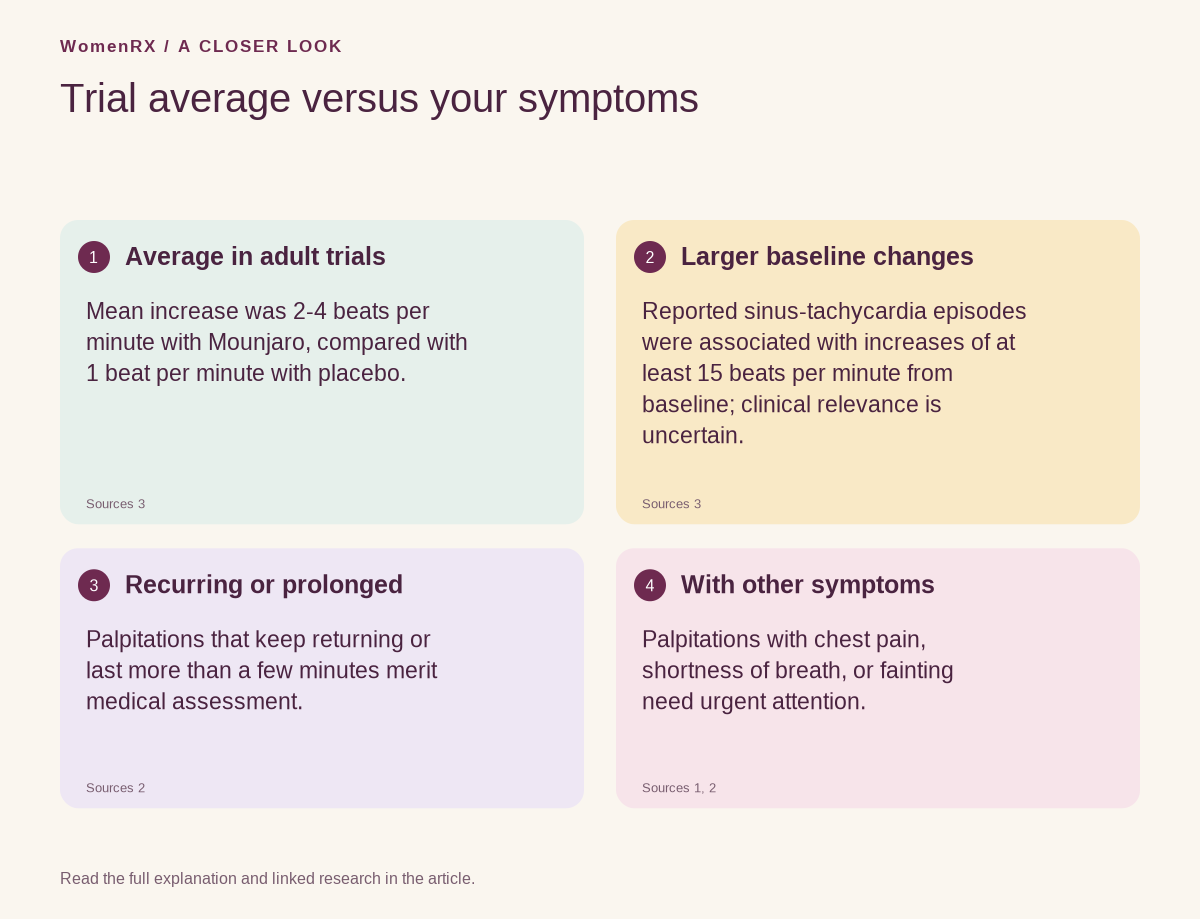
Trial average versus your symptoms
Average in adult trials: Mean increase was 2-4 beats per minute with Mounjaro, compared with 1 beat per minute with placebo.3
Larger baseline changes: Reported sinus-tachycardia episodes were associated with increases of at least 15 beats per minute from baseline; clinical relevance is uncertain.3
Recurring or prolonged: Palpitations that keep returning or last more than a few minutes merit medical assessment.2
With other symptoms: Palpitations with chest pain, shortness of breath, or fainting need urgent attention.12
Read the figure as text
The average change in trials is useful context, but it cannot tell you whether a particular pulse change is persistent or needs assessment.- Average in adult trials: Mean increase was 2-4 beats per minute with Mounjaro, compared with 1 beat per minute with placebo.3
- Larger baseline changes: Reported sinus-tachycardia episodes were associated with increases of at least 15 beats per minute from baseline; clinical relevance is uncertain.3
- Recurring or prolonged: Palpitations that keep returning or last more than a few minutes merit medical assessment.2
- With other symptoms: Palpitations with chest pain, shortness of breath, or fainting need urgent attention.12
More questions, answered
Does a faster pulse mean tirzepatide has damaged my heart?
A faster pulse alone doesn’t establish heart damage. Trial information reports a small average increase and says its clinical relevance is uncertain. But recurring or sustained palpitations, and especially palpitations with chest pain, shortness of breath, or fainting, need medical assessment. 123
Could menopause, pregnancy, or anemia also cause palpitations?
Yes. Palpitations can occur during pregnancy or menopause, and iron-deficiency anemia is another possible cause. A clinician can help sort out the cause rather than assuming it’s tirzepatide. 2
Sources you can check
- Shortness of breath - NHSAccessed 2026-09-25Return to first citation
- Heart palpitations - NHSAccessed 2026-09-25Return to first citation
- MOUNJARO (TIRZEPATIDE) INJECTION, SOLUTION MOUNJARO KWIKPEN (TIRZEPATIDE) INJECTION, SOLUTION [ELI LILLY AND COMPANY] | US prescribing information and patient instructionsAccessed 2026-09-25Return to first citation