Can Zepbound Make Your Heart Beat Faster?
Tirzepatide has been linked to a small average rise in heart rate, but a faster pulse or a fluttering sensation can have other causes too.
Yes. Studies of tirzepatide, the medicine in Zepbound, have found a small average increase in heart rate compared with placebo, though that doesn’t mean everyone will notice it or that every palpitation is caused by the medicine. Note when the change happens, what else you’re feeling, and contact your prescriber about recurring or persistent symptoms. Chest pain, trouble breathing, or fainting calls for emergency care. 3 4 2
A small average rise isn’t the same as a noticeable symptom
Zepbound contains tirzepatide, which can raise heart rate on average in clinical studies. In one systematic review of randomized trials among adults with overweight or obesity who did not have diabetes, heart rate with tirzepatide was about 2 beats per minute higher than with placebo on average. That’s a group average, not a prediction of what will happen to your pulse. 4
The U.S. prescribing information for Mounjaro, another product containing tirzepatide, reports a mean heart-rate increase of 2 to 4 beats per minute in adults, compared with 1 beat per minute with placebo. It also reports episodes of sinus tachycardia with a rise of at least 15 beats per minute from a participant’s baseline. These episodes were reported in 4.6%, 5.9%, and 10% of participants receiving 5, 10, and 15 mg, respectively, versus 4.3% receiving placebo. The label says the clinical importance of these increases is uncertain. These results describe trial groups; they don’t establish what caused a particular person’s symptoms. 3
A faster pulse and palpitations aren’t the same thing
Heart rate is the number of times your heart beats in a given period. Palpitations describe a heartbeat that feels unusually noticeable or uncomfortable, such as fluttering or pounding. You can have palpitations without knowing whether your pulse is actually faster, and a faster pulse doesn’t by itself identify the cause. 2
If you notice a change, make a brief log to help your prescriber see the pattern. Record:
- Your pulse reading, if you’ve measured it, and whether you were resting or active.
- What the sensation felt like and how long it lasted.
- When it happened in relation to starting Zepbound or a dose change.
- Other symptoms, including nausea, vomiting, diarrhea, dizziness, or feeling faint.
- Possible contributors around that time, such as caffeine, alcohol, nicotine, or a stressful situation.
The log isn’t a way to diagnose yourself. It gives your prescriber useful context, especially if the episodes come back or are getting more frequent. 2
Don’t assume Zepbound is the only explanation
Palpitations can have several causes. Caffeine, alcohol, nicotine, and stress may contribute; so can some health conditions, including iron-deficiency anemia, an overactive thyroid, or a heart rhythm problem. Pregnancy and menopause can also be associated with palpitations. 2
Zepbound can cause gastrointestinal symptoms, and its U.S. prescribing information warns that nausea, vomiting, or diarrhea can lead to dehydration and volume depletion. If those symptoms are happening alongside a pulse change, mention both when you contact your prescriber. The information here doesn’t show that dehydration explains a particular pulse change. 1
Heart-rate studies of tirzepatide have examined groups with type 2 diabetes or with overweight or obesity, but the reported results don’t establish a different heart-rate effect for women. They also don’t answer whether the effect differs during pregnancy or postpartum. If you’re pregnant, recently postpartum, or planning a pregnancy, include that context when discussing your medication and symptoms with your prescriber. 4 5
When to contact your prescriber
Contact your prescriber if palpitations keep returning, become more frequent, last more than a few minutes, or occur alongside a known heart condition or a family history of heart problems. Share your log and ask whether the timing or pattern calls for evaluation. 2
Get emergency care if palpitations are happening now and don’t go away, or if they come with chest pain, shortness of breath, feeling faint, or fainting. If those symptoms have stopped, seek urgent medical advice rather than waiting for a routine follow-up. 2
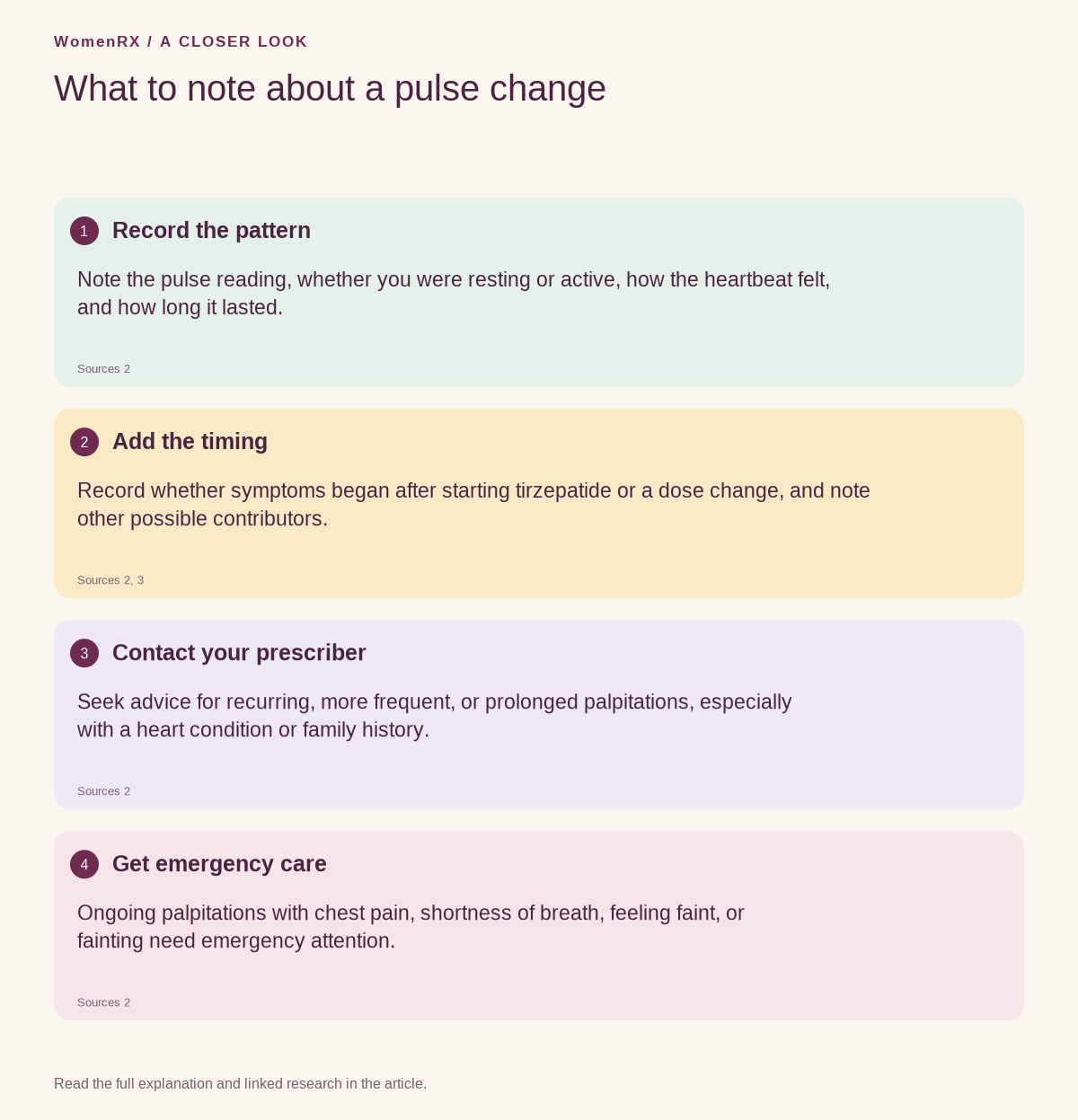
What to note about a pulse change
Record the pattern: Note the pulse reading, whether you were resting or active, how the heartbeat felt, and how long it lasted.2
Add the timing: Record whether symptoms began after starting tirzepatide or a dose change, and note other possible contributors.23
Contact your prescriber: Seek advice for recurring, more frequent, or prolonged palpitations, especially with a heart condition or family history.2
Get emergency care: Ongoing palpitations with chest pain, shortness of breath, feeling faint, or fainting need emergency attention.2
Read the figure as text
Separate what you measured from what you felt, and note symptoms that change how quickly you should seek care.- Record the pattern: Note the pulse reading, whether you were resting or active, how the heartbeat felt, and how long it lasted.2
- Add the timing: Record whether symptoms began after starting tirzepatide or a dose change, and note other possible contributors.23
- Contact your prescriber: Seek advice for recurring, more frequent, or prolonged palpitations, especially with a heart condition or family history.2
- Get emergency care: Ongoing palpitations with chest pain, shortness of breath, feeling faint, or fainting need emergency attention.2
More questions, answered
Should I stop Zepbound if my pulse feels faster?
A single reading or brief sensation doesn’t tell you what caused the change. Record what happened and contact your prescriber if symptoms recur or persist; get emergency care for ongoing palpitations with chest pain, shortness of breath, or fainting. 2
Do studies show a different heart-rate effect in women?
The reported heart-rate results don’t establish a different effect for women, or whether the effect changes during pregnancy or postpartum. Share that context with your prescriber if it applies to you. 4 5
Sources you can check
- ZEPBOUND (TIRZEPATIDE) INJECTION, SOLUTION ZEPBOUND (TIRZEPATIDE) INJECTION, SOLUTION ZEPBOUND KWIKPEN (TIRZEPATIDE) INJECTION, SOLUTION [ELI LILLY AND COMPANY] | US prescribing information and patient instructionsAccessed 2026-09-25Return to first citation
- Heart palpitations - NHSAccessed 2026-09-25Return to first citation
- MOUNJARO (TIRZEPATIDE) INJECTION, SOLUTION MOUNJARO KWIKPEN (TIRZEPATIDE) INJECTION, SOLUTION [ELI LILLY AND COMPANY] | US prescribing information and patient instructionsAccessed 2026-09-25Return to first citation
- Effect of glucagon-like peptide-1 receptor agonists on heart rate in non-diabetic individuals with overweight or obesity: a systematic review and pairwise and network meta-analysis of randomized controlled trials.Zhang Y, Zhang C, Gong X, Cheng P, Fu H, Diao L, Song C. · European journal of medical research · 2026Return to first citation
- Impact of a dual glucose-dependent insulinotropic peptide/glucagon-like peptide-1 receptor agonist tirzepatide on heart rate among patients with type 2 diabetes: A systematic review and pairwise and network meta-analysis.Yang Y, He L, Liu P, Wang J, Yang N, Li Z, Ping F, Xu L, Li W, Zhang H, Li Y. · Diabetes, obesity & metabolism · 2024Return to first citation