When Tirzepatide Can Raise Low Blood Sugar Concerns
The other diabetes medicines you take matter when you’re assessing a possible low while using tirzepatide.
Tirzepatide can lower blood glucose, but low blood sugar is a bigger concern when your treatment also includes insulin or a sulfonylurea such as glimepiride. If you feel shaky, sweaty, hungry, or confused, check your glucose if you can: symptoms are clues, not a confirmed reading. Repeated lows call for a review of your treatment plan. 1 2 6
Why your other medicines change the picture
Insulin lowers blood glucose, and sulfonylureas such as glimepiride can cause lows too. Tirzepatide improves glucose control, so the question isn’t simply whether you take tirzepatide. It’s what else is lowering your glucose and what your readings are showing. A UK cost-to-target analysis characterizes tirzepatide’s hypoglycemia risk as low when it isn’t used with insulin or medicines that stimulate insulin release. Low risk doesn’t mean no risk. 1 6
Treatment context also matters when you hear that tirzepatide caused less hypoglycemia than insulin in a study. A network meta-analysis of 13 randomized trials involving 14,007 adults with type 2 diabetes and/or obesity reported less hypoglycemia with tirzepatide than with insulin. That comparison does not tell you the chance of a low when you take the two together. 4
Researchers have also studied tirzepatide added to basal insulin in adults with type 2 diabetes. In a pooled, exploratory analysis of two trials, clinically significant hypoglycemia was reported at a low incidence across the groups examined, while insulin was adjusted within the studies’ treatment plans. Those findings are reassuring about the studied settings, but they aren’t instructions for changing your own insulin. 5
A feeling of a low isn’t the same as a reading
Low glucose can come on quickly. Shaking, hunger, sweating, a fast heartbeat, or confusion may be signs. If you have diabetes and can check your glucose when symptoms appear, do so. For many people with diabetes, below 70 mg/dL is considered low, though the threshold in your care plan may differ. A meter or continuous glucose monitor can help you see whether symptoms coincide with a low reading. 1 2 3
If your reading is low, follow your agreed low-glucose plan. Fast-acting carbohydrates, such as glucose tablets or juice, can help with a mild or moderate low. If you have symptoms but can’t get a reading, don’t dismiss them while waiting for a number: the NHS advises people with diabetes who have symptoms of a low to treat it promptly. Ask your diabetes team in advance what your plan should be when you can’t check. 1 3
Someone who has a seizure, is unconscious, or isn’t responding normally needs emergency help immediately. Severe hypoglycemia may require glucagon. 1 3
What to review before lows become a pattern
If you use tirzepatide with insulin or a sulfonylurea, ask the team managing your diabetes whether your glucose checks and other medicines still fit your treatment plan. This is especially worth doing if lows are recurring, happen at night, or you no longer reliably notice their symptoms. Bring readings from around the episodes if you have them, along with the names of the medicines you take. 1 2
Follow an insulin-adjustment plan you’ve already agreed on with your diabetes team; don’t make an unplanned change to insulin or a sulfonylurea based on a general article or someone else’s trial results. In the basal-insulin studies, insulin changes took place within study treatment plans. 1 5
Pregnancy calls for a different plan
The basal-insulin analysis studied adults with type 2 diabetes, not treatment of gestational diabetes. Its reported subgroup results were organized by factors such as age, diabetes duration, and starting glucose measures, so they don’t establish whether hypoglycemia risk differs between women and men. If you’re pregnant or being treated for gestational diabetes, ask the team managing your pregnancy about your own glucose targets, medicines, and low-glucose plan rather than applying type 2 diabetes trial results to your care. 2 5
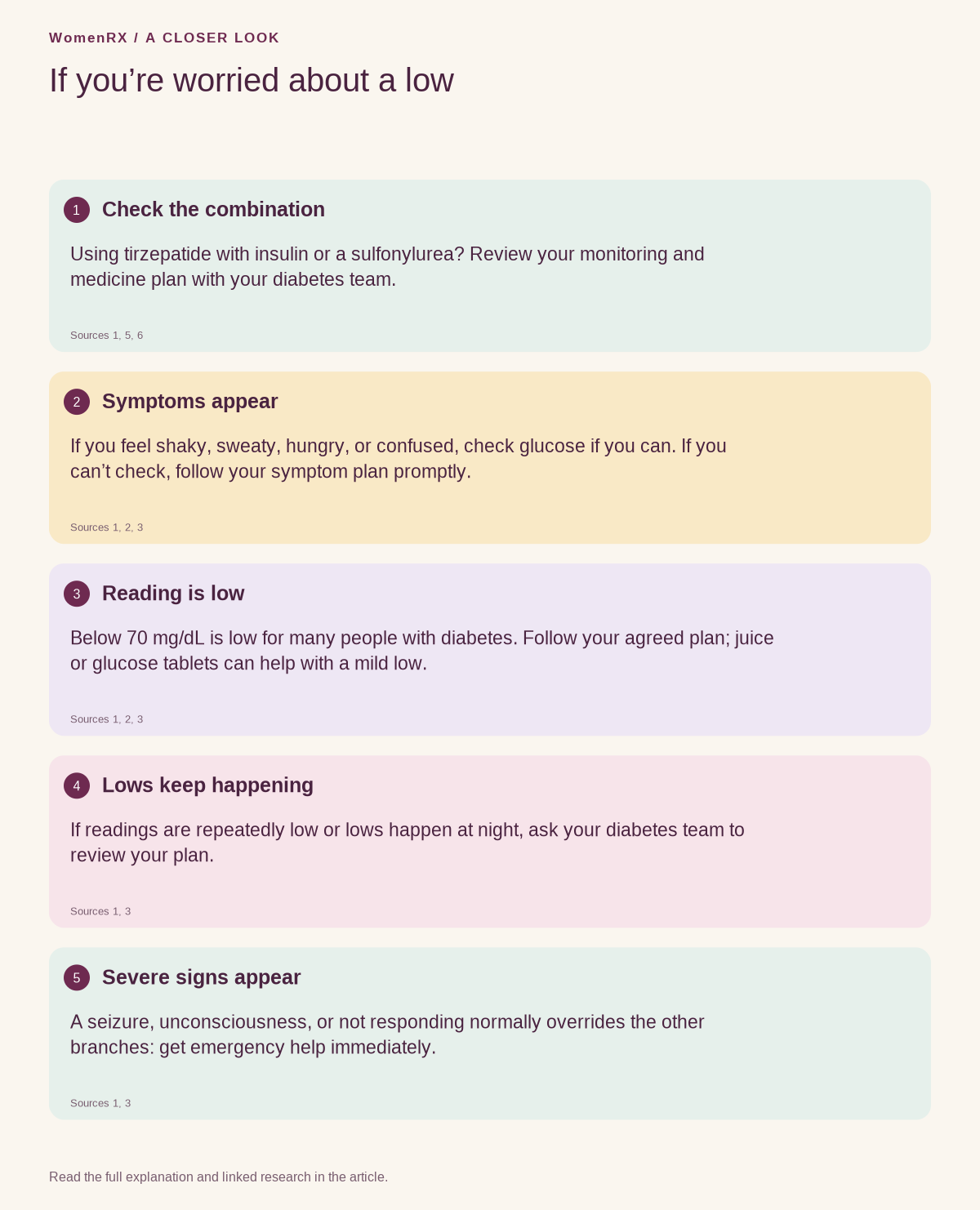
If you’re worried about a low
Check the combination: Using tirzepatide with insulin or a sulfonylurea? Review your monitoring and medicine plan with your diabetes team.156
Symptoms appear: If you feel shaky, sweaty, hungry, or confused, check glucose if you can. If you can’t check, follow your symptom plan promptly.123
Reading is low: Below 70 mg/dL is low for many people with diabetes. Follow your agreed plan; juice or glucose tablets can help with a mild low.123
Lows keep happening: If readings are repeatedly low or lows happen at night, ask your diabetes team to review your plan.13
Severe signs appear: A seizure, unconsciousness, or not responding normally overrides the other branches: get emergency help immediately.13
Read the figure as text
Start with the medicine combination, then use symptoms and a reading, when possible, to choose the next step.- Check the combination: Using tirzepatide with insulin or a sulfonylurea? Review your monitoring and medicine plan with your diabetes team.156
- Symptoms appear: If you feel shaky, sweaty, hungry, or confused, check glucose if you can. If you can’t check, follow your symptom plan promptly.123
- Reading is low: Below 70 mg/dL is low for many people with diabetes. Follow your agreed plan; juice or glucose tablets can help with a mild low.123
- Lows keep happening: If readings are repeatedly low or lows happen at night, ask your diabetes team to review your plan.13
- Severe signs appear: A seizure, unconsciousness, or not responding normally overrides the other branches: get emergency help immediately.13
Sources you can check
- Low blood sugar (hypoglycaemia) - NHSAccessed 2026-09-25Return to first citation
- Blood Glucose | Blood Sugar | Diabetes | MedlinePlusAccessed 2026-09-25Return to first citation
- Hypoglycemia: MedlinePlusAccessed 2026-09-25Return to first citation
- The efficacy and safety of dual GIP/GLP1 receptor agonists (tirzepatide) in diabetes and obesity: a systematic review and network meta-analysis.Hoffmann K, Michalak M, Rizzo M, Maggio V, Paczkowska A. · Expert opinion on drug safety · 2026Return to first citation
- Tirzepatide as an Add-on for Participants with Inadequate Glycemic Control Using Basal Insulin: Pooled Subgroup Analysis of SURPASS-5 and -6.Bajaj HS, Billings LK, Sharma P, Levine JA, Rodriguez A, Patel H. · Diabetes therapy : research, treatment and education of diabetes and related disorders · 2026Return to first citation
- Annual pharmacy cost per patient achieving composite treatment endpoints: a cost to target analysis of tirzepatide versus subcutaneous semaglutide 1 mg in patients with type 2 diabetes in the UK.Kanumilli N, Osumili B, Evans J, Webb J, Buckingham M, Debackere N, Nowakowski P, Cattin J, Hunt B. · Journal of medical economics · 2026Return to first citation