Semaglutide and Low Blood Sugar: Who Is at Risk?
Semaglutide can lower glucose, but insulin and certain other diabetes medicines are the bigger clues when a low reading occurs.
Semaglutide lowers blood glucose, but in trials of adults with type 2 diabetes who weren’t using insulin at the outset, hypoglycemia risk was lower with semaglutide than with insulin glargine. That comparison doesn’t tell us the risk of combining semaglutide with insulin or a sulfonylurea. A reading below 70 mg/dL is low for many people with diabetes, though your target may differ. 7 2
The other medicines matter
A low reading while taking semaglutide doesn’t by itself show that semaglutide caused it. Insulin commonly causes low blood sugar, and some other diabetes medicines, including glimepiride and gliclazide, can also do so. 1
A comparison can help put semaglutide’s role in context, with an important limit. A systematic review of trials in adults with type 2 diabetes who were not using insulin at the start found a lower risk of hypoglycemia with semaglutide than with insulin glargine. This does not establish the risk when semaglutide is used alongside insulin or a sulfonylurea. 7
If you do use insulin, changes in appetite or food intake may be relevant to a low. In a small post-hoc analysis of a randomized crossover trial, 26 adults with type 1 diabetes using insulin pumps had lower carbohydrate intake and lower insulin requirements during semaglutide use. A related study’s interviews described nausea making it harder for some participants to predict how much they would eat before mealtime insulin. These findings apply to a specific group, not to every person taking semaglutide, but they make changing food intake worth mentioning when lows occur. 5 6
Symptoms can prompt a check, not a diagnosis
Shaking, sweating, a fast heartbeat, and confusion can be signs of low blood glucose. Symptoms can come on quickly, but they don’t confirm a low or identify which medicine caused it. If you have diabetes and can check your glucose when symptoms appear, check it. 1 2
For many people with diabetes, a reading below 70 mg/dL is considered low. Your own threshold may be different, so use the one in your diabetes care plan if it differs. Low glucose is less common in people without diabetes, and repeated symptoms shouldn’t automatically be blamed on semaglutide. 2 3
If you have diabetes and feel symptoms of a low but can’t check your glucose, follow your agreed plan for a possible low rather than waiting for a reading. 1
Match the next step to what’s happening
If you’re awake and responsive and your reading is below your usual low threshold, a fast-acting carbohydrate, such as glucose tablets, juice, or a sugary drink, can help raise glucose. 1 3
If someone passes out or isn’t responding normally, get emergency help. Severe hypoglycemia can lead to loss of consciousness or coma. Glucagon is a treatment for severe lows when it has been prescribed and is available. 1 3
If lows recur, share the pattern with the team managing your diabetes medicines. This is especially relevant if you use insulin or a sulfonylurea, or if nausea or reduced food intake has changed how much you’re eating. People with type 1 diabetes need insulin, and the small pump study found that insulin needs changed during semaglutide use; it reported that insulin adjustments were still needed in that study group. Don’t change insulin or other diabetes medicines based on this article. 1 3 4 5
What the research can and can’t say about women
The reported study results don’t provide a women-specific estimate of hypoglycemia risk. So there isn’t a sound basis here for saying that women have a different risk from men. For an individual reader, whether insulin or a medicine such as glimepiride is also being used is a more useful distinction in the evidence discussed above. 1 5 7
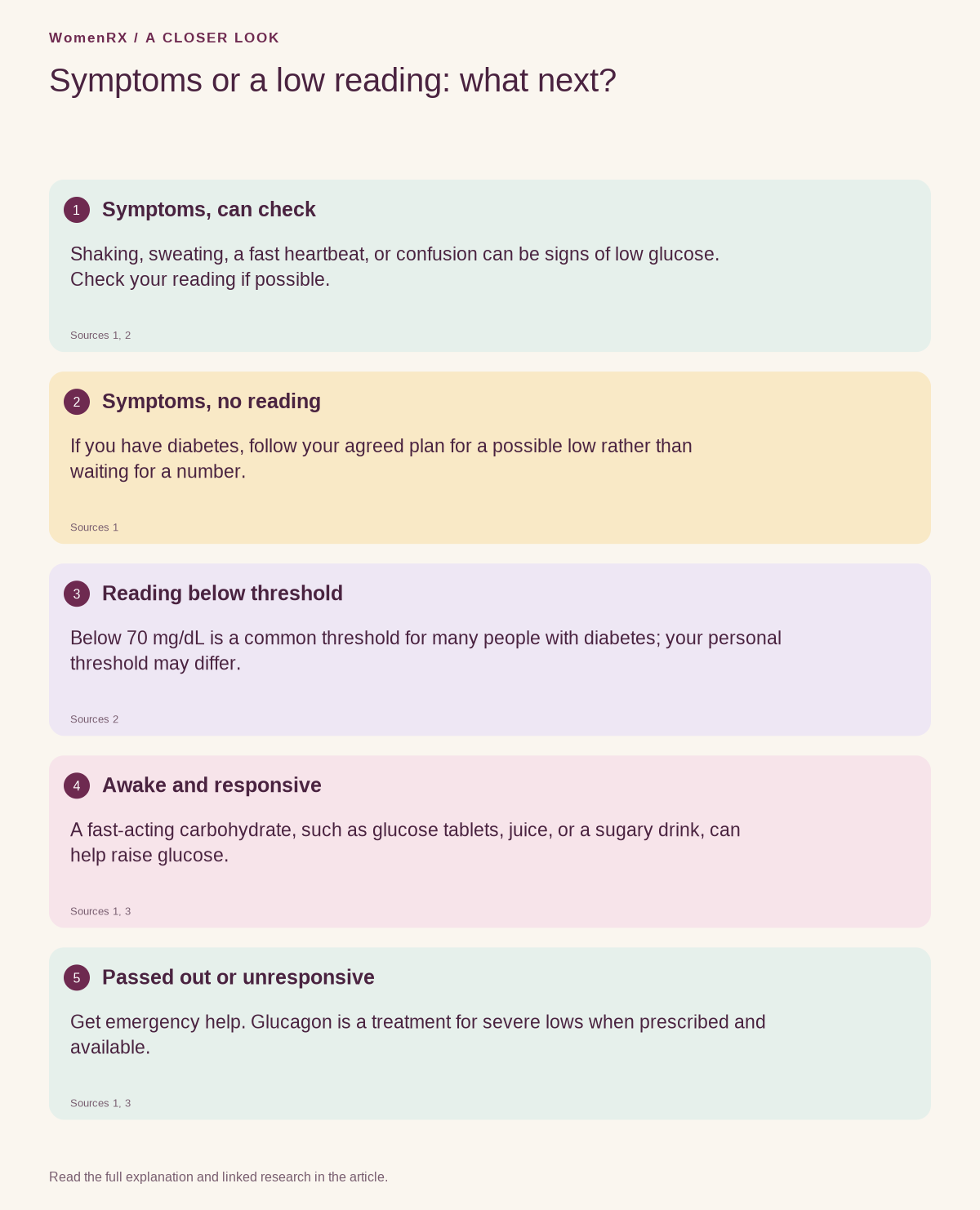
Symptoms or a low reading: what next?
Symptoms, can check: Shaking, sweating, a fast heartbeat, or confusion can be signs of low glucose. Check your reading if possible.12
Symptoms, no reading: If you have diabetes, follow your agreed plan for a possible low rather than waiting for a number.1
Reading below threshold: Below 70 mg/dL is a common threshold for many people with diabetes; your personal threshold may differ.2
Awake and responsive: A fast-acting carbohydrate, such as glucose tablets, juice, or a sugary drink, can help raise glucose.13
Passed out or unresponsive: Get emergency help. Glucagon is a treatment for severe lows when prescribed and available.13
Read the figure as text
Use symptoms, a glucose reading, and the situation’s urgency to distinguish a possible low from an emergency.- Symptoms, can check: Shaking, sweating, a fast heartbeat, or confusion can be signs of low glucose. Check your reading if possible.12
- Symptoms, no reading: If you have diabetes, follow your agreed plan for a possible low rather than waiting for a number.1
- Reading below threshold: Below 70 mg/dL is a common threshold for many people with diabetes; your personal threshold may differ.2
- Awake and responsive: A fast-acting carbohydrate, such as glucose tablets, juice, or a sugary drink, can help raise glucose.13
- Passed out or unresponsive: Get emergency help. Glucagon is a treatment for severe lows when prescribed and available.13
More questions, answered
Does every reading below 70 mg/dL mean the same thing?
No. Below 70 mg/dL is a common low-glucose threshold for many people with diabetes, but your personal threshold may differ. Follow the target in your diabetes care plan if it’s different. 2
Can symptoms tell me semaglutide caused a low?
No. Shaking, sweating, a fast heartbeat, or confusion can be signs of low glucose, but they don’t identify its cause. Check your glucose if you can, and consider whether insulin or another glucose-lowering medicine is also part of your treatment. 1 2
Sources you can check
- Low blood sugar (hypoglycaemia) - NHSAccessed 2026-09-25Return to first citation
- Blood Glucose | Blood Sugar | Diabetes | MedlinePlusAccessed 2026-09-25Return to first citation
- Hypoglycemia: MedlinePlusAccessed 2026-09-25Return to first citation
- Diabetes Medicine | Insulin | MedlinePlusAccessed 2026-09-25Return to first citation
- Changes to insulin requirements over time with semaglutide in adults with type 1 diabetes on insulin pump therapy: A post-hoc analysis of a double-blinded, randomised, crossover trial.Pasqua MR, Tsoukas MA, Haidar A. · Diabetes, obesity & metabolism · 2026Return to first citation
- Semaglutide Use With Automated Insulin Delivery in Adults With Type 1 Diabetes: Qualitative Analyses and Patient-reported Outcomes From a Randomized Controlled Trial.Pasqua MR, Doumat J, Tsoukas MA, Haidar A. · Canadian journal of diabetes · 2026Return to first citation
- Efficacy and Safety of Once-Weekly Semaglutide Versus Basal Insulin and Other GLP-1 Receptor Agonists in Adults With Type 2 Diabetes Uncontrolled on Oral Antidiabetic Drugs: A Systematic Review and Pairwise Meta-Analysis.Aljulajil FA, Rabbani U. · Cureus · 2026Return to first citation