Low Blood Sugar on a GLP-1: What Changes Your Risk
Insulin or a sulfonylurea can change your low-blood-sugar risk when you start a GLP-1 medicine.
Low blood sugar isn’t something to dismiss as a normal GLP-1 side effect. The risk depends heavily on your other medicines, especially insulin or a sulfonylurea. If you feel shaky, sweaty, dizzy or confused, check your glucose if you can and follow your low-glucose plan. For many people with diabetes, a reading below 70 mg/dL is low.125
First, look at the whole medicine combination
A GLP-1 medicine may be only one part of your treatment. Insulin lowers blood glucose, while sulfonylureas help your pancreas release insulin. Either can cause glucose to fall too low. That makes your full medicine list more useful than the name of your GLP-1 when you’re trying to understand a possible low.14
This difference shows up in research on combined treatment. An umbrella review of trials in people with type 2 diabetes found more hypoglycemia when a GLP-1 receptor agonist was added to insulin plus oral diabetes medicine than with placebo added to that existing treatment. It does not tell us the risk for someone taking a GLP-1 alone for weight loss.6
A separate 26-week trial compared a combination of insulin degludec and liraglutide with continued GLP-1 treatment in adults with type 2 diabetes. Both groups continued their existing oral medicines, which could include a sulfonylurea. Confirmed low-glucose events were uncommon but higher in the insulin-and-liraglutide group. This was a comparison of treatment regimens, not a clean test of adding insulin to GLP-1 treatment alone.7
These reported treatment findings don’t break out hypoglycemia outcomes for women, so they don’t give a women-specific risk estimate.67
If your medicine list includes insulin or a sulfonylurea such as glimepiride or gliclazide, make sure you know the low-glucose plan that goes with that combination. Follow any adjustment instructions you’ve already been given rather than guessing at a change to your prescribed medicines.13
A symptom is a reason to check, not proof of a low
Shakiness, sweating and dizziness were reported by people with type 2 diabetes who had hypoglycemia in an observational study; confusion is another possible sign. Symptoms deserve attention, but a glucose reading helps distinguish a suspected low from a confirmed one. Low glucose can also occur without noticeable symptoms.15
If you have diabetes and can check with a glucose meter or continuous glucose monitor, check when you suspect a low. For many people with diabetes, below 70 mg/dL is considered low, though your care team may set a different threshold for you. If you have symptoms and cannot check, use the low-glucose instructions you were given rather than waiting for a number before acting.12
What if you take a GLP-1 for weight loss and don’t have diabetes? Don’t assume repeated symptoms are an expected part of treatment. Low glucose is uncommon without diabetes, and its causes can differ. Recurrent suspected or measured lows need an assessment of what’s happening, including your medicines and whether you’ve been able to eat.4
What to do when glucose is low
If you have diabetes and your reading is low, follow your personal treatment plan promptly. Quick-acting carbohydrate, such as glucose tablets or juice, is a usual first step for a low you can treat yourself. Being unable to eat enough or keep food down can also contribute to a low, so tell your care team if that’s part of the picture.14
If someone may have very low glucose and is unconscious or isn’t responding normally, follow their emergency glucagon plan if one is available. If glucagon isn’t available or no one knows how to use it, call emergency services immediately. Severe hypoglycemia may require glucagon; if you’ve been prescribed it, the people around you should know where it is and how to use it.14
Once the immediate low is addressed, repeated episodes deserve a review of the treatment plan, particularly if they happen at night or you no longer reliably notice symptoms. Your care team may need to revisit your food, activity or diabetes medicines. A GLP-1 prescription doesn’t make those lows routine or harmless.14
If you’re pregnant, planning pregnancy or breastfeeding, bring the entire medicine and low-glucose plan into the treatment discussion rather than assuming it stays the same. Diabetes medicine choices depend on individual circumstances, and pregnancy can change treatment needs. That is a reason for an individualized review, not a reason to change a medicine on your own.3
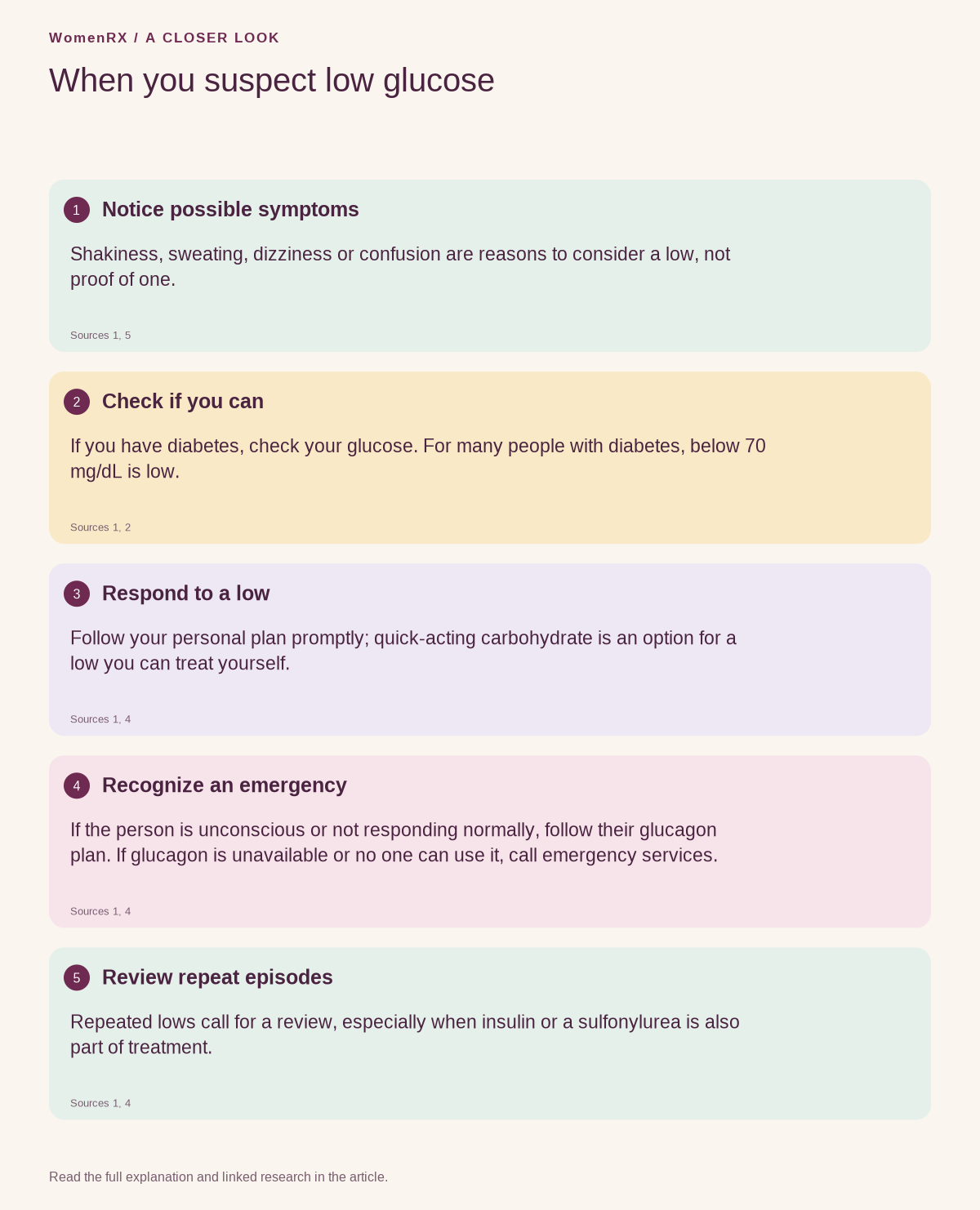
When you suspect low glucose
Notice possible symptoms: Shakiness, sweating, dizziness or confusion are reasons to consider a low, not proof of one.15
Check if you can: If you have diabetes, check your glucose. For many people with diabetes, below 70 mg/dL is low.12
Respond to a low: Follow your personal plan promptly; quick-acting carbohydrate is an option for a low you can treat yourself.14
Recognize an emergency: If the person is unconscious or not responding normally, follow their glucagon plan. If glucagon is unavailable or no one can use it, call emergency services.14
Review repeat episodes: Repeated lows call for a review, especially when insulin or a sulfonylurea is also part of treatment.14
Read the figure as text
Use symptoms and a reading, if available, to decide what needs attention now and what needs a treatment review afterward.- Notice possible symptoms: Shakiness, sweating, dizziness or confusion are reasons to consider a low, not proof of one.15
- Check if you can: If you have diabetes, check your glucose. For many people with diabetes, below 70 mg/dL is low.12
- Respond to a low: Follow your personal plan promptly; quick-acting carbohydrate is an option for a low you can treat yourself.14
- Recognize an emergency: If the person is unconscious or not responding normally, follow their glucagon plan. If glucagon is unavailable or no one can use it, call emergency services.14
- Review repeat episodes: Repeated lows call for a review, especially when insulin or a sulfonylurea is also part of treatment.14
More questions, answered
Does a normal reading rule out why I feel shaky?
A reading helps you tell whether glucose is low at the time you check; symptoms alone can’t confirm it. If the feeling keeps happening, note when it occurs and what you’re taking or eating so your care team can assess it rather than treating every episode as confirmed hypoglycemia.25
Sources you can check
- Low blood sugar (hypoglycaemia) - NHSAccessed 2026-09-25Return to first citation
- Blood Glucose | Blood Sugar | Diabetes | MedlinePlusAccessed 2026-09-25Return to first citation
- Diabetes Medicine | Insulin | MedlinePlusAccessed 2026-09-25Return to first citation
- Hypoglycemia: MedlinePlusAccessed 2026-09-25Return to first citation
- Prevalence and Associated Factors of Hypoglycemia Among Patients With Type 2 Diabetes Mellitus: A Cross-Sectional Study.Nabi N, Khan MN, Raza S, Tariq MO, Tahir AB, Ifunanya OV, Ibadin S, Yousaf F. · Cureus · 2025Return to first citation
- Comparison of GLP-1 Receptor Agonists, SGLT-2 Inhibitors, and DPP-4 Inhibitors as an Add-On Drug to Insulin Combined With Oral Hypoglycemic Drugs: Umbrella Review.Chai S, Niu Y, Liu F, Wu S, Yang Z, Sun F. · Journal of diabetes research · 2024Return to first citation
- The Efficacy of IDegLira (Insulin Degludec/Liraglutide Combination) in Adults with Type 2 Diabetes Inadequately Controlled with a GLP-1 Receptor Agonist and Oral Therapy: DUAL III Randomized Clinical Trial.Linjawi S, Bode BW, Chaykin LB, Courrèges JP, Handelsman Y, Lehmann LM, Mishra A, Simpson RW. · Diabetes therapy : research, treatment and education of diabetes and related disorders · 2017Return to first citation