Low Blood Sugar on GLP-1 Treatment: What to Do
Insulin, sulfonylureas, and difficulty eating can change your risk of a low, so your response plan needs to fit your medicines.
If you have symptoms of low blood sugar while taking a GLP-1 medicine, check your glucose if you can. If you have diabetes, are alert, and can swallow, follow your prescribed plan for a low. No plan yet? Take a fast-acting carbohydrate, such as glucose tablets or juice, and contact your diabetes care team afterward. Don’t change medication doses on your own. 1 3
First, consider the whole medication combination
GLP-1 receptor agonists affect blood sugar differently from insulin. Exenatide and liraglutide stimulate insulin release in a glucose-dependent way, and a review of these medicines describes a low risk of hypoglycemia. That finding doesn’t establish the risk for every GLP-1 medicine or treatment combination, and a lower risk isn’t a guarantee that a low can’t happen. 6
The other medicines in your regimen matter. Insulin can lower glucose directly, and some diabetes medicines, including sulfonylureas such as gliclazide and glimepiride, can also cause lows. 1 3 In an umbrella review of studies in people with type 2 diabetes taking basal insulin along with oral diabetes medicines, adding a GLP-1 receptor agonist was associated with more hypoglycemia than placebo. Some of those oral medicines were sulfonylureas, but the review doesn’t isolate their contribution to the risk. 4 A separate 26-week trial in adults with type 2 diabetes found low rates of confirmed hypoglycemia, but higher rates with insulin degludec plus liraglutide than with unchanged liraglutide or exenatide treatment. Both groups continued their oral diabetes medicines. These findings concern particular treatment combinations, not every person taking a GLP-1 medicine. 5
Being sick and unable to eat enough or keep food down can also contribute to low glucose in people taking diabetes medicines. If illness has made it hard to eat or keep food down, include that when describing a low to your care team. 3
Match your response to your symptoms and reading
For many people with diabetes, a blood glucose reading below 70 mg/dL is considered low, but your own threshold or treatment plan may differ. Shaking, hunger, sweating, a fast heartbeat, or confusion can be warning signs. Symptoms vary, so check your glucose if you can and use the response plan you’ve agreed on with your care team. 1 2
If you have diabetes, are alert and able to swallow, and your glucose is low, follow your prescribed plan. If you don’t have a plan yet, eat or drink something that raises glucose quickly, such as glucose tablets or juice. Don’t wait for a call before treating a low. Contact your diabetes care team afterward to make a plan that fits your medicines and circumstances. 1 3
A severe low can lead to passing out or a seizure. Severe hypoglycemia may require glucagon, which is available as a nasal spray or injection; follow the prescribed glucagon plan for the person experiencing the low. 3 If someone is not responding normally or is unconscious, and glucagon isn’t available or you don’t know how to use it, seek emergency help. 1
Don’t adjust insulin or other medicines by guesswork
Repeated lows are a reason to review the full medication combination, illness, and ability to eat with the treating team. Your team may adjust diabetes medicines or your meal or activity plan, but the right change depends on which medicines you take and why. Don’t stop or change insulin, a sulfonylurea, or a GLP-1 medicine on your own. If you use insulin, ask whether a glucose meter or continuous glucose monitor fits your monitoring plan; MedlinePlus notes that CGM can be especially useful for people taking insulin who have low glucose. 2 3
If you don’t have diabetes and have repeated symptoms that seem like low glucose, don’t assume a GLP-1 medicine is the cause. Hypoglycemia is uncommon without diabetes, and it can have other causes that may need evaluation. 2 3
What these findings tell us about women
The results presented in the clinical reports discussed here don’t give hypoglycemia rates separately for women and men, so they can’t tell you whether rates differ by sex. They also don’t answer questions about GLP-1 medicines or glucose targets during pregnancy or breastfeeding. 4 5 If you’re pregnant or breastfeeding and having lows, ask your treating team to review your medicines and individual glucose target with you rather than relying on these general findings. Glucose targets can differ between people, and recurring lows may call for a review of the treatment plan. 2 3
After a low, tell your care team which medicines you take, what your reading was if you have one, and whether illness made it hard to eat or keep food down. That gives them a clearer basis for reviewing your personal plan without you having to guess at dose changes.
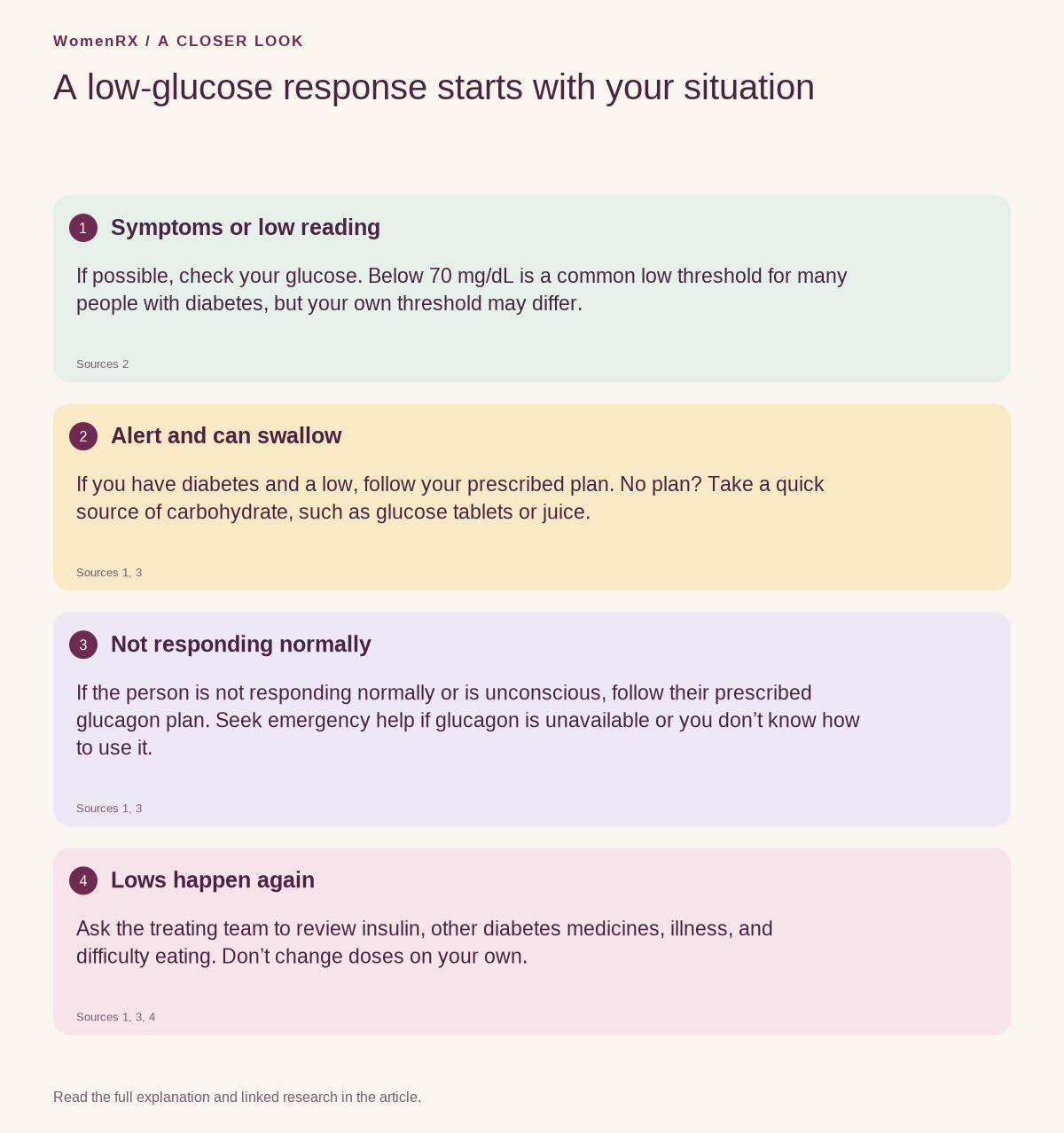
A low-glucose response starts with your situation
Symptoms or low reading: If possible, check your glucose. Below 70 mg/dL is a common low threshold for many people with diabetes, but your own threshold may differ.2
Alert and can swallow: If you have diabetes and a low, follow your prescribed plan. No plan? Take a quick source of carbohydrate, such as glucose tablets or juice.13
Not responding normally: If the person is not responding normally or is unconscious, follow their prescribed glucagon plan. Seek emergency help if glucagon is unavailable or you don’t know how to use it.13
Lows happen again: Ask the treating team to review insulin, other diabetes medicines, illness, and difficulty eating. Don’t change doses on your own.134
Read the figure as text
Use this as a map to your prescribed plan. If you don’t have one yet, an alert person with diabetes can still act promptly on a low.- Symptoms or low reading: If possible, check your glucose. Below 70 mg/dL is a common low threshold for many people with diabetes, but your own threshold may differ.2
- Alert and can swallow: If you have diabetes and a low, follow your prescribed plan. No plan? Take a quick source of carbohydrate, such as glucose tablets or juice.13
- Not responding normally: If the person is not responding normally or is unconscious, follow their prescribed glucagon plan. Seek emergency help if glucagon is unavailable or you don’t know how to use it.13
- Lows happen again: Ask the treating team to review insulin, other diabetes medicines, illness, and difficulty eating. Don’t change doses on your own.134
More questions, answered
Can symptoms alone tell me that my glucose is low?
Not reliably. Low-glucose symptoms can vary, so checking your level when possible and following your personal plan is more useful than relying on one symptom. 1 2
What if I don’t have diabetes but think I’m having lows?
Low glucose is uncommon in people without diabetes. If symptoms keep happening, seek an evaluation rather than assuming the GLP-1 medicine is the cause; other conditions and medicines can also be involved. 2 3
Sources you can check
- Low blood sugar (hypoglycaemia) - NHSAccessed 2026-09-25Return to first citation
- Blood Glucose | Blood Sugar | Diabetes | MedlinePlusAccessed 2026-09-25Return to first citation
- Hypoglycemia: MedlinePlusAccessed 2026-09-25Return to first citation
- Comparison of GLP-1 Receptor Agonists, SGLT-2 Inhibitors, and DPP-4 Inhibitors as an Add-On Drug to Insulin Combined With Oral Hypoglycemic Drugs: Umbrella Review.Chai S, Niu Y, Liu F, Wu S, Yang Z, Sun F. · Journal of diabetes research · 2024Return to first citation
- The Efficacy of IDegLira (Insulin Degludec/Liraglutide Combination) in Adults with Type 2 Diabetes Inadequately Controlled with a GLP-1 Receptor Agonist and Oral Therapy: DUAL III Randomized Clinical Trial.Linjawi S, Bode BW, Chaykin LB, Courrèges JP, Handelsman Y, Lehmann LM, Mishra A, Simpson RW. · Diabetes therapy : research, treatment and education of diabetes and related disorders · 2017Return to first citation
- GLP-1 agonists exenatide and liraglutide: a review about their safety and efficacy.Derosa G, Maffioli P. · Current clinical pharmacology · 2012Return to first citation