Tirzepatide and Low Blood Sugar: What Raises the Risk?
A low reading matters most in the context of your other diabetes medicines, especially insulin or a sulfonylurea.
Tirzepatide lowers blood glucose, but the low-glucose risk isn’t the same with every medication combination. Insulin and medicines that prompt insulin release can cause lows, so those medicines deserve particular attention if you take them alongside tirzepatide. For many people with diabetes, a reading below 70 mg/dL is low. Treat a low according to your care plan, and have repeated, nighttime, or severe episodes reviewed. 2 3 7
The combination matters more than the injection alone
If you take tirzepatide with insulin, look at both medicines when a low reading appears. Insulin can lower glucose, and tirzepatide improves glucose control. Some other diabetes medicines, including sulfonylureas such as glimepiride, also belong in the low-glucose discussion because they prompt insulin release. A low reading doesn’t, by itself, tell you which medicine contributed or whether your treatment needs changing. 1 3 4
The distinction shows up in research, though the comparisons need care. A review of 13 randomized trials found less hypoglycemia with tirzepatide than with insulin. That compares treatments; it doesn’t tell you the risk when you use them together. In a separate exploratory analysis of 1,072 participants with type 2 diabetes who received tirzepatide alongside basal insulin, researchers described a low incidence of clinically significant hypoglycemia. Insulin was adjusted during those trials, so their findings aren’t a reason to dismiss lows in your own readings. 4 5
Evidence specific to taking tirzepatide with a sulfonylurea is less precise. An observational study of older adults with type 2 diabetes included people taking insulin, sulfonylureas, or related medicines. Their clinicians adjusted those medicines for some participants, and the study reported no severe hypoglycemia. Because the medicine groups were considered together and the study wasn’t a randomized comparison of adjustments, it can’t give you a sulfonylurea-specific risk estimate or show that the adjustments prevented lows. 6
Start with the reading and how you feel
For many people with diabetes, a glucose reading below 70 mg/dL is low; your care team may have given you a different threshold. Low glucose can come on quickly. Shaking and hunger are possible signs, but symptoms vary, and a low reading matters even if you feel fine. If you suspect a low, check your glucose if you can and use the low-glucose plan you’ve been given. 2 3
Mild or moderate low glucose can be treated with a fast-acting source of carbohydrate, such as glucose tablets or juice. Severe low glucose is different: someone who has passed out or can’t swallow safely needs immediate help, not food or drink by mouth. Glucagon may be needed if it’s available and someone knows how to use it. 1 3
Repeated lows, lows during sleep, a severe episode, or warning signs you don’t reliably notice all warrant a conversation with your diabetes care team. Those patterns matter even when a single reading improves after treatment. 1
What makes a medication review useful
Bring the actual glucose readings, including when they happened and whether you had symptoms. Add the names and timing of tirzepatide, insulin, and any sulfonylurea or other diabetes medicine. For example, say whether a low followed a day when you ate less than usual, couldn’t keep food down, or were more active. Too little carbohydrate and illness that limits eating can contribute to low glucose; activity can affect how you plan to avoid it. 3
If you use a continuous glucose monitor, its day-and-night pattern can add context beyond one number. This may be especially useful for someone taking insulin who has trouble with lows. Your care team can assess the pattern alongside your medicines and decide whether the plan needs to change. 2 3
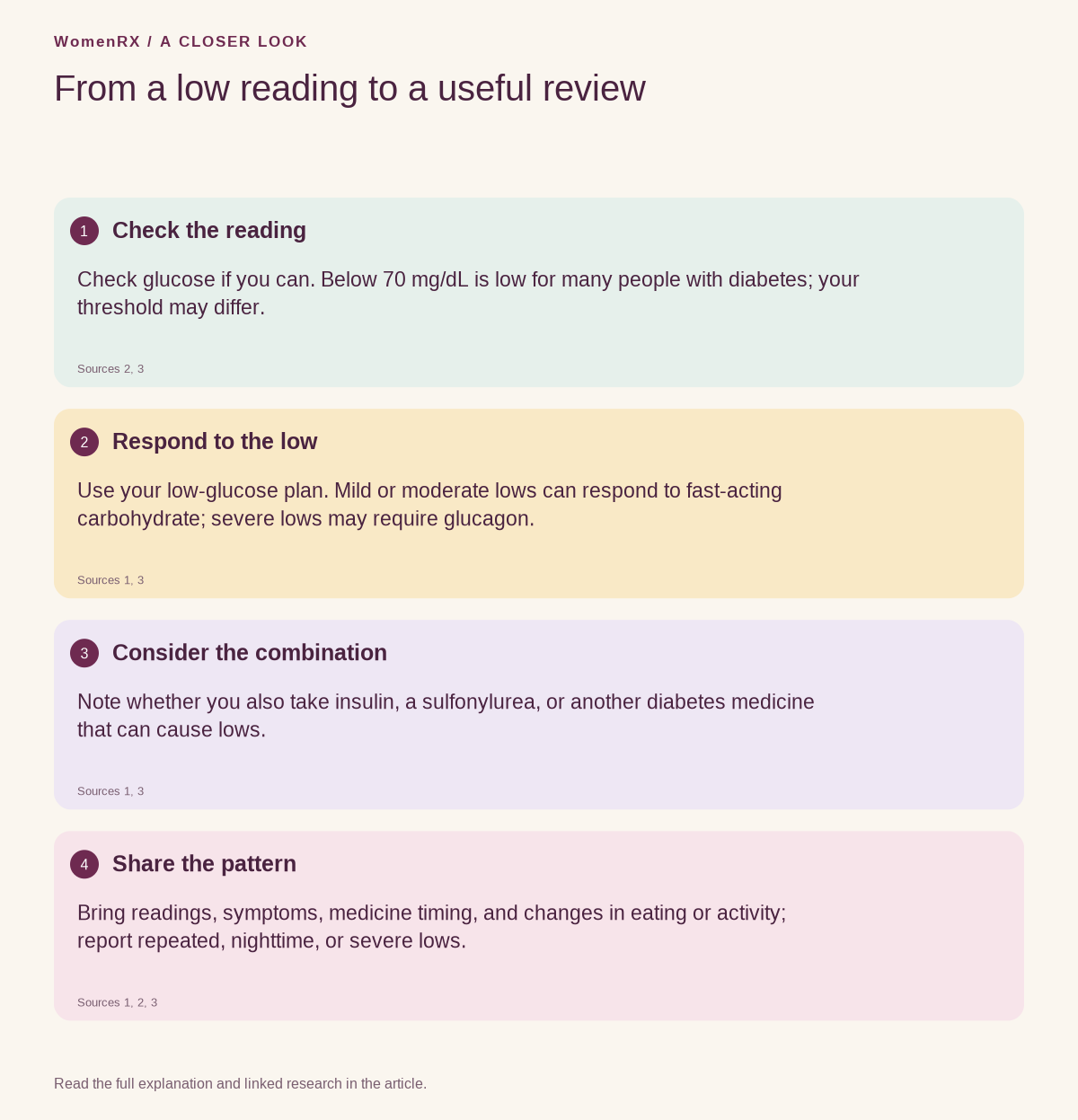
From a low reading to a useful review
Check the reading: Check glucose if you can. Below 70 mg/dL is low for many people with diabetes; your threshold may differ.23
Respond to the low: Use your low-glucose plan. Mild or moderate lows can respond to fast-acting carbohydrate; severe lows may require glucagon.13
Consider the combination: Note whether you also take insulin, a sulfonylurea, or another diabetes medicine that can cause lows.13
Share the pattern: Bring readings, symptoms, medicine timing, and changes in eating or activity; report repeated, nighttime, or severe lows.123
Read the figure as text
The flow separates what to do about a possible low from the details that help explain a recurring pattern.- Check the reading: Check glucose if you can. Below 70 mg/dL is low for many people with diabetes; your threshold may differ.23
- Respond to the low: Use your low-glucose plan. Mild or moderate lows can respond to fast-acting carbohydrate; severe lows may require glucagon.13
- Consider the combination: Note whether you also take insulin, a sulfonylurea, or another diabetes medicine that can cause lows.13
- Share the pattern: Bring readings, symptoms, medicine timing, and changes in eating or activity; report repeated, nighttime, or severe lows.123
More questions, answered
Does tirzepatide research show a different low-glucose risk for women?
The tirzepatide hypoglycemia findings discussed here don’t report results separately for women. They can inform a medication review, but they don’t establish whether the risk differs by sex. 4 5 6
Sources you can check
- Low blood sugar (hypoglycaemia) - NHSAccessed 2026-09-25Return to first citation
- Blood Glucose | Blood Sugar | Diabetes | MedlinePlusAccessed 2026-09-25Return to first citation
- Hypoglycemia: MedlinePlusAccessed 2026-09-25Return to first citation
- The efficacy and safety of dual GIP/GLP1 receptor agonists (tirzepatide) in diabetes and obesity: a systematic review and network meta-analysis.Hoffmann K, Michalak M, Rizzo M, Maggio V, Paczkowska A. · Expert opinion on drug safety · 2026Return to first citation
- Tirzepatide as an Add-on for Participants with Inadequate Glycemic Control Using Basal Insulin: Pooled Subgroup Analysis of SURPASS-5 and -6.Bajaj HS, Billings LK, Sharma P, Levine JA, Rodriguez A, Patel H. · Diabetes therapy : research, treatment and education of diabetes and related disorders · 2026Return to first citation
- Real-world clinical outcomes of tirzepatide administration in older patients with type 2 diabetes, with a focus on the risk of hypoglycemia and weight loss-related parameters.Kitsunai H, Maruyama F, Miyano Y, Abe T, Kurihara H, Tsuji K, Abiko A, Miyamoto Y, Homma R, Nakamura A, Nomoto H, Hokkaido-TZP Study Group. · Endocrine journal · 2026Return to first citation
- Annual pharmacy cost per patient achieving composite treatment endpoints: a cost to target analysis of tirzepatide versus subcutaneous semaglutide 1 mg in patients with type 2 diabetes in the UK.Kanumilli N, Osumili B, Evans J, Webb J, Buckingham M, Debackere N, Nowakowski P, Cattin J, Hunt B. · Journal of medical economics · 2026Return to first citation