Preventing Low Blood Sugar During GLP-1 Treatment
The biggest concern is often the full diabetes regimen, especially when a GLP-1 medicine is used with insulin or a sulfonylurea.
Low blood sugar risk depends on your whole treatment plan, not just the GLP-1 medicine. Insulin and sulfonylureas such as glimepiride can cause hypoglycemia. In one 26-week trial, confirmed lows were more frequent with insulin degludec/liraglutide plus continued oral medicines than with unchanged GLP-1 therapy plus continued oral medicines. 5 Know your personal low-glucose threshold. If you have symptoms of a low or a low reading, promptly have something that raises blood sugar quickly, such as a small glass of fruit juice or glucose tablets, and follow your agreed response plan. Do not wait for a reading if you have symptoms but cannot check. 1 2
Look at the whole medication list
GLP-1 medicines generally carry a low risk of hypoglycemia, but lows are still possible. 5 The practical question is what else you take for diabetes. Insulin can cause low blood sugar, as can some sulfonylureas, including glimepiride and gliclazide. A systematic review also found hypoglycemia was more frequent with sulfonylureas than with several other diabetes medicines. 1 4
That matters if you take a GLP-1 medicine alongside one of these drugs. In a 26-week trial of adults with type 2 diabetes who were not reaching their goals on a GLP-1 medicine and oral medicines, confirmed lows were more frequent after participants switched to a combination of liraglutide and insulin degludec than among those who continued their GLP-1 medicine. This is a finding about that specific treatment change, not proof that every GLP-1 combination carries the same risk. 5
So don’t assume that every medicine added to a GLP-1 has the same effect on low blood sugar. The relevant details include the exact medicines you use and any recent changes to the regimen. Follow your agreed treatment plan rather than changing insulin or a sulfonylurea outside it. Ask the prescriber whether your plan needs adjusting and how to check your glucose during a change. 1 3
Recognize a possible low and check if you can
Low blood sugar can come on quickly. Possible signs include hunger or confusion, but symptoms can vary. If you have diabetes and notice symptoms, check your blood glucose if you can. For many people with diabetes, a reading below 70 mg/dL is considered low, though your own threshold may differ. 1 2
If you have symptoms of a low or a reading that is low for you, act promptly: eat or drink something that raises blood sugar quickly, such as a small glass of fruit juice or glucose tablets, and follow the response plan you’ve agreed with your care team. If you have symptoms but cannot check right away, do not wait for a reading before treating them. Make sure the people around you know how to help if you become severely unwell. 1 3
If you think someone has very low blood sugar and they are unconscious or not responding normally, call emergency services if glucagon is unavailable or nobody knows how to use it. If you have a prescribed glucagon kit, make sure someone close to you knows where it is and how to use it. 1
Make a medication-review checklist
At your next conversation with the person managing your diabetes, have your complete medication list in front of you. Include insulin, sulfonylureas, and any recent changes, not just the GLP-1 medicine. Ask:
- Which of my medicines can cause low blood sugar?
- What glucose reading counts as low for me, and when should I check?
- What should I do if I get a low reading or feel symptoms but can’t check?
- If my regimen changes, who should tell me whether my insulin or sulfonylurea plan needs to change?
- What should family or friends do if I’m confused or unable to respond?
If you’re pregnant or planning pregnancy, bring that up during the medication review. Diabetes treatment may need to change during pregnancy; insulin may be needed even if you don’t usually take it. 3
This review can be specific to your situation. The cited trial comparison is not a women-specific estimate of low-blood-sugar risk. 5
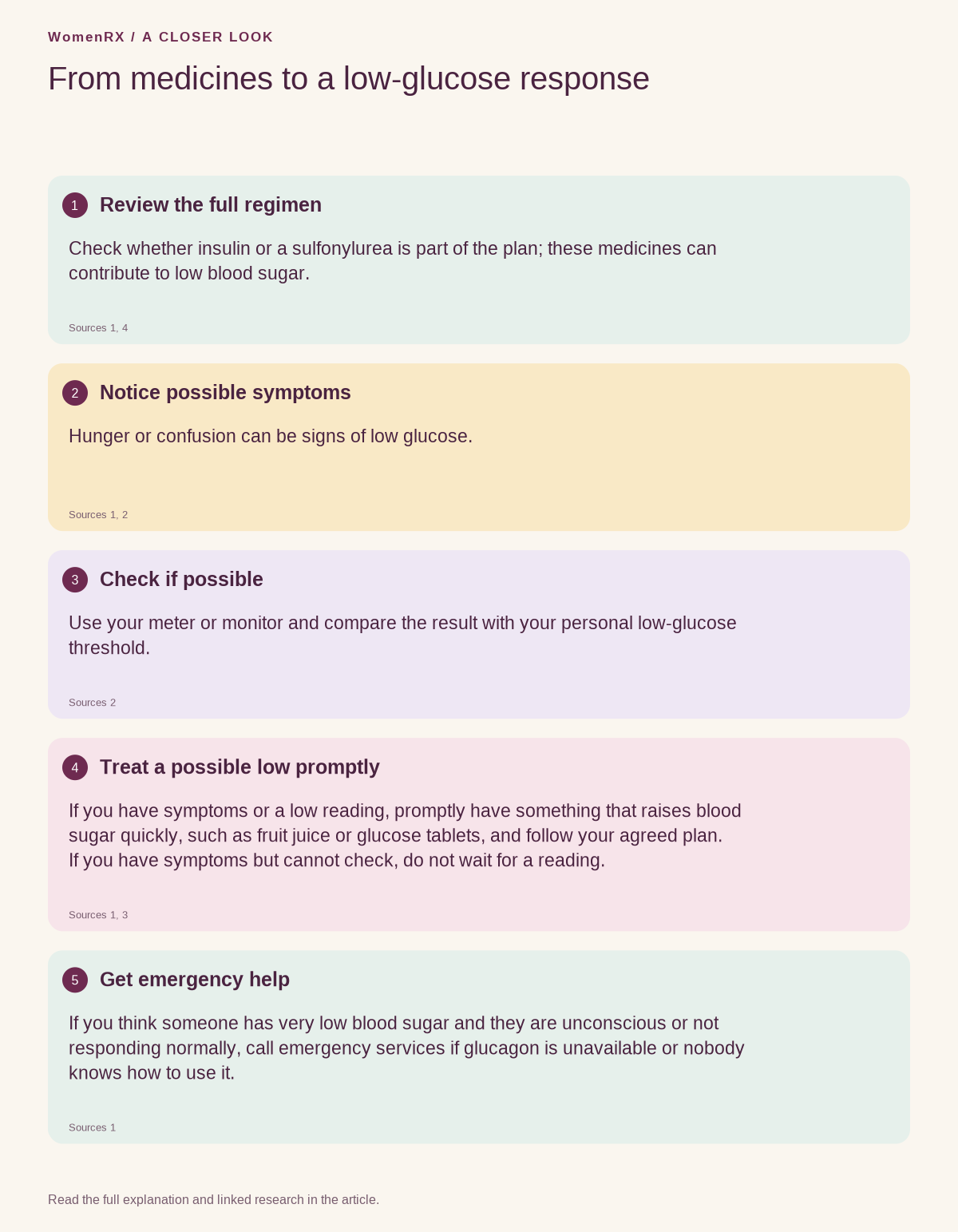
From medicines to a low-glucose response
Review the full regimen: Check whether insulin or a sulfonylurea is part of the plan; these medicines can contribute to low blood sugar.14
Notice possible symptoms: Hunger or confusion can be signs of low glucose.12
Check if possible: Use your meter or monitor and compare the result with your personal low-glucose threshold.2
Treat a possible low promptly: If you have symptoms or a low reading, promptly have something that raises blood sugar quickly, such as fruit juice or glucose tablets, and follow your agreed plan. If you have symptoms but cannot check, do not wait for a reading.13
Get emergency help: If you think someone has very low blood sugar and they are unconscious or not responding normally, call emergency services if glucagon is unavailable or nobody knows how to use it.1
Read the figure as text
Use this flow to connect your medication combination with the next step if symptoms or a low reading occur.- Review the full regimen: Check whether insulin or a sulfonylurea is part of the plan; these medicines can contribute to low blood sugar.14
- Notice possible symptoms: Hunger or confusion can be signs of low glucose.12
- Check if possible: Use your meter or monitor and compare the result with your personal low-glucose threshold.2
- Treat a possible low promptly: If you have symptoms or a low reading, promptly have something that raises blood sugar quickly, such as fruit juice or glucose tablets, and follow your agreed plan. If you have symptoms but cannot check, do not wait for a reading.13
- Get emergency help: If you think someone has very low blood sugar and they are unconscious or not responding normally, call emergency services if glucagon is unavailable or nobody knows how to use it.1
More questions, answered
What blood sugar reading is considered low?
For many people with diabetes, a reading below 70 mg/dL is low, but your own threshold may differ. If you have a low reading or symptoms of a low, promptly have something that raises blood sugar quickly, such as fruit juice or glucose tablets, and follow your agreed response plan. If you have symptoms but cannot check, do not wait for a reading before treating them. 1 2
Should I change my insulin if I start a GLP-1 medicine?
Follow your agreed treatment plan rather than changing your insulin or sulfonylurea dose outside it. Ask the prescriber managing your diabetes whether your plan needs adjusting and how to monitor for lows. 1 3
Sources you can check
- Low blood sugar (hypoglycaemia) - NHSAccessed 2026-09-25Return to first citation
- Blood Glucose | Blood Sugar | Diabetes | MedlinePlusAccessed 2026-09-25Return to first citation
- Diabetes Medicine | Insulin | MedlinePlusAccessed 2026-09-25Return to first citation
- Diabetes Medications as Monotherapy or Metformin-Based Combination Therapy for Type 2 Diabetes: A Systematic Review and Meta-analysis.Maruthur NM, Tseng E, Hutfless S, Wilson LM, Suarez-Cuervo C, Berger Z, Chu Y, Iyoha E, Segal JB, Bolen S. · Annals of internal medicine · 2016Return to first citation
- The Efficacy of IDegLira (Insulin Degludec/Liraglutide Combination) in Adults with Type 2 Diabetes Inadequately Controlled with a GLP-1 Receptor Agonist and Oral Therapy: DUAL III Randomized Clinical Trial.Linjawi S, Bode BW, Chaykin LB, Courrèges JP, Handelsman Y, Lehmann LM, Mishra A, Simpson RW. · Diabetes therapy : research, treatment and education of diabetes and related disorders · 2017Return to first citation