Can Wegovy Make Your Blood Sugar Too Low?
Low blood sugar is a bigger concern when Wegovy is used alongside insulin or a sulfonylurea than when it’s used without those diabetes medicines.
Wegovy can lower blood sugar, but a lower reading isn’t necessarily hypoglycemia. The main concern is for people with type 2 diabetes, especially those also taking insulin or a sulfonylurea. If you have type 2 diabetes, Wegovy’s prescribing information says to check your blood sugar before starting it and while taking it. Agree with your prescriber on when to check, especially if you also take insulin or a sulfonylurea, and check promptly if symptoms suggest a low.32
Lower blood sugar isn’t always low blood sugar
If your glucose has been running high, bringing it down may be part of your treatment goal. Hypoglycemia means it has fallen too far. For many people with diabetes, a reading below 70 mg/dL is considered low, though your care team may give you a different threshold.2
That distinction matters with Wegovy. Its prescribing information warns of an increased risk of hypoglycemia in people with type 2 diabetes, particularly when they also use insulin or a sulfonylurea.3 Examples of sulfonylureas include glimepiride and glipizide.6
The other medicine can change the picture
Start by checking your medication list, not just the name on your Wegovy prescription. Insulin and sulfonylureas can cause glucose to fall too low; using Wegovy alongside them makes an individualized monitoring plan particularly useful. Wegovy’s prescribing information says that people with type 2 diabetes should check their blood sugar before starting Wegovy and while taking it, not only when symptoms appear. Ask your prescriber what reading counts as low for you, when to check, and whom to contact if lows recur. Don’t change a diabetes medicine on your own in response to starting Wegovy.312
This can matter when eating patterns change, too. In a small post-hoc analysis of 26 adults with type 1 diabetes using insulin pumps, logged carbohydrate intake and mealtime insulin use fell after semaglutide was started. That finding helps explain why insulin needs may need review when someone is eating differently. It does not establish a hypoglycemia rate for people taking Wegovy, and results for women weren’t reported separately.7
If you don’t have diabetes and don’t take glucose-lowering medicines, hypoglycemia is uncommon in general. Still, symptoms deserve attention rather than an assumption that Wegovy must be the cause.12
If you think your glucose is low
Shaking, sweating, a fast heartbeat, dizziness, or confusion can be signs of low blood sugar. Symptoms can differ from person to person and may come on quickly. If you have diabetes and can check your glucose, do so when symptoms appear. Don’t wait for symptoms if your usual monitoring shows a low reading.123
If you have diabetes and are awake and able to swallow, follow your low-glucose care plan when you have a low reading or typical symptoms. A quick source of sugar, such as juice or glucose tablets, can raise glucose. Check your glucose again after 10 to 15 minutes. If it’s still low, have another quick source of sugar and check again after 10 minutes. Once you feel better and your glucose is back above your low threshold, follow with food that lasts longer, such as a sandwich or your next meal if it’s due. If lows happen often, occur at night, or you no longer reliably notice them, contact your diabetes care team to review your plan.12
If you don’t have diabetes but have symptoms of low blood sugar, seek clinical advice about what’s causing them rather than assuming you need the same treatment plan.12
If someone becomes unconscious during a severe low, don’t put food or drink in their mouth. If glucagon is available and someone with them knows how to use it, give it immediately. Seek emergency help immediately if glucagon isn’t available or nobody knows how to use it. If glucagon is given and the person hasn’t recovered within 10 minutes, seek emergency help. Stay with them until they’re fully recovered.1
Pregnancy and past gestational diabetes call for a separate conversation
If you’re pregnant, planning pregnancy, or breastfeeding, review your Wegovy and diabetes treatment plan with your prescriber. Those circumstances call for treatment decisions beyond the question of low blood sugar. The clinical trials included in a review of semaglutide in women with polycystic ovary syndrome excluded pregnant and breastfeeding participants, and a systematic review found limited clinical evidence on diabetes medicines during breastfeeding.56
A history of gestational diabetes doesn’t, by itself, show that Wegovy will cause a low. It’s a useful reason to make sure you know your current glucose status and whether any medicine you now take can cause hypoglycemia. A small retrospective study found differences in metabolic evaluation between women with and without prior gestational diabetes five years after delivery; it did not study Wegovy-related lows.43
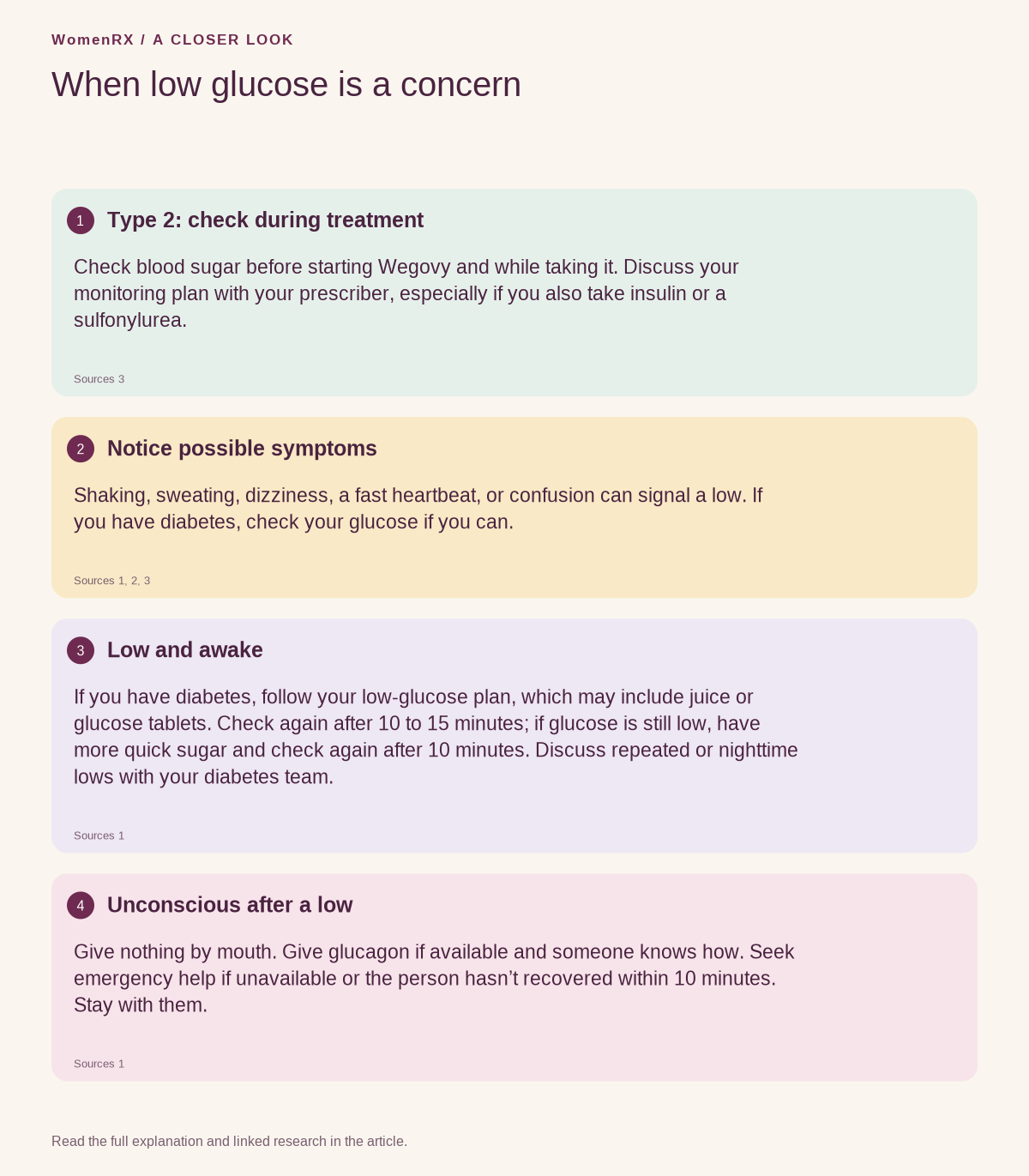
When low glucose is a concern
Type 2: check during treatment: Check blood sugar before starting Wegovy and while taking it. Discuss your monitoring plan with your prescriber, especially if you also take insulin or a sulfonylurea.3
Notice possible symptoms: Shaking, sweating, dizziness, a fast heartbeat, or confusion can signal a low. If you have diabetes, check your glucose if you can.123
Low and awake: If you have diabetes, follow your low-glucose plan, which may include juice or glucose tablets. Check again after 10 to 15 minutes; if glucose is still low, have more quick sugar and check again after 10 minutes. Discuss repeated or nighttime lows with your diabetes team.1
Unconscious after a low: Give nothing by mouth. Give glucagon if available and someone knows how. Seek emergency help if unavailable or the person hasn’t recovered within 10 minutes. Stay with them.1
Read the figure as text
Use your medicines, symptoms, and glucose reading to decide what needs attention.- Type 2: check during treatment: Check blood sugar before starting Wegovy and while taking it. Discuss your monitoring plan with your prescriber, especially if you also take insulin or a sulfonylurea.3
- Notice possible symptoms: Shaking, sweating, dizziness, a fast heartbeat, or confusion can signal a low. If you have diabetes, check your glucose if you can.123
- Low and awake: If you have diabetes, follow your low-glucose plan, which may include juice or glucose tablets. Check again after 10 to 15 minutes; if glucose is still low, have more quick sugar and check again after 10 minutes. Discuss repeated or nighttime lows with your diabetes team.1
- Unconscious after a low: Give nothing by mouth. Give glucagon if available and someone knows how. Seek emergency help if unavailable or the person hasn’t recovered within 10 minutes. Stay with them.1
More questions, answered
Do I need a continuous glucose monitor while taking Wegovy?
Not everyone does. A continuous glucose monitor can show changes throughout the day and night and may be especially useful for someone taking insulin who has trouble with low glucose. If you have type 2 diabetes, Wegovy’s prescribing information says to check your blood sugar before starting it and while taking it. Agree with your prescriber on how and when to check based on your medicines and whether you’ve had lows.321
Sources you can check
- Low blood sugar (hypoglycaemia) - NHSAccessed 2026-09-25Return to first citation
- Blood Glucose | Blood Sugar | Diabetes | MedlinePlusAccessed 2026-09-25Return to first citation
- WEGOVY (SEMAGLUTIDE) INJECTION, SOLUTION WEGOVY (SEMAGLUTIDE) TABLET [NOVO NORDISK PHARMACEUTICAL INDUSTRIES, LP] | US prescribing information and patient instructionsAccessed 2026-09-25Return to first citation
- The relationship between lifestyle and metabolic evaluation in women with a history of gestational diabetes.Bahador E, Saber M, FadakarDavarani MM, Khanjani N, Gohari BH, Safinejad H. · Journal of education and health promotion · 2021Return to first citation
- Efficacy and Safety of Semaglutide in Patients with Polycystic Ovary Syndrome: A Scoping Review.La Vignera S, Condorelli RA. · Biomedicines · 2026Return to first citation
- Maternal-to-Infant Transfer of Medications for Type 2 Diabetes Mellitus Via Breastmilk: A Systematic Review of Available Evidence and Clinical Guidelines.Richardson K, Kiptoo J, Mpora Odongkara B, Ojara FW, Waitt C. · Clinical pharmacology and therapeutics · 2026Return to first citation
- Changes to insulin requirements over time with semaglutide in adults with type 1 diabetes on insulin pump therapy: A post-hoc analysis of a double-blinded, randomised, crossover trial.Pasqua MR, Tsoukas MA, Haidar A. · Diabetes, obesity & metabolism · 2026Return to first citation