Does Tirzepatide Reduce Food Cravings?
A short randomized trial found lower cravings on average, but it doesn’t show that cravings will disappear or that the medicine treats every kind of difficult eating.
In a six-week randomized trial of adults with overweight or obesity, participants taking tirzepatide reported fewer food cravings, less hunger, and lower overall appetite than those taking placebo. These are average results, not a prediction for one person. The trial included men and women, but its reported findings don’t establish whether effects differ by sex or for people with PCOS, menopause, or an eating-disorder history. 1
Tirzepatide may reduce food cravings for some people. The clearest direct evidence comes from a short randomized trial in which participants reported fewer cravings and less appetite than participants taking placebo. But “cravings” can mean different things, and a change in appetite isn’t the same as a change in every eating behavior. 1
If you’re considering treatment because food feels persistently on your mind, it helps to separate the experience you want to change: frequent hunger, a strong desire for a particular food, being drawn to food cues, or eating that feels hard to control. Research doesn’t answer all of those questions equally well.
What the tirzepatide trial measured
The six-week phase 1 trial randomized 114 adults with overweight or obesity and without diabetes to tirzepatide, placebo, or liraglutide. At week three, the tirzepatide group ate less than the placebo group at a meal where participants could eat as much as they wanted. Compared with placebo, participants taking tirzepatide also reported lower overall appetite, food cravings, perceived hunger, tendency to overeat, and reactivity to food in their surroundings. These are group averages, not a guarantee of an individual response. 1
The trial also found no effect on reported volitional restriction of food intake compared with placebo. In plain language, the findings point toward a reduced drive to eat, rather than greater reliance on consciously holding back. The trial was short, so it doesn’t establish how long these changes might last. 1
A separate three-month retrospective study at one obesity clinic in China found comparable changes in appetite and food cravings among people treated with tirzepatide or semaglutide. Because it was observational rather than randomized, it can describe what happened in that clinic but cannot establish that the medicines caused the changes or that their effects would be the same in other groups. 2
Cravings, hunger, and emotional eating aren’t interchangeable
Hunger, overall appetite, and cravings overlap, but they describe different experiences. A craving can be a strong desire for a particular food; someone might have that desire without feeling generally hungry. Food-cue reactivity is another related measure, describing how strongly someone responds to food in their surroundings. Reviews of GLP-1 medicines also distinguish wanting food from liking its taste: those experiences can change independently. 13
The tirzepatide trial’s findings on appetite and cravings don’t establish that the medicine changes why a person eats, including eating in response to emotion. Nor do they establish it as a treatment for eating-disorder symptoms. If your concern is episodes of loss-of-control eating, restriction, or other distressing eating patterns, appetite reduction and support for those concerns are separate questions. The trial doesn’t answer whether tirzepatide helps with them. 1
What the results mean for women
The trial included male and female adults, and its reported results describe the overall group. They establish an average effect in that mixed-sex sample, not whether the effect differs for women. They also don’t establish what to expect for someone with PCOS, during perimenopause or menopause, or with a history of an eating disorder. 1
That gap matters because a study’s average result can’t tell you which specific experience will change for you. The available findings support a possible reduction in cravings and other appetite-related measures; they don’t show that those effects are unique to women or that life stage or PCOS predicts a stronger or weaker response. A review of GLP-1 medicines describes varied eating experiences, with some people reporting less interest in food and others little change or persistent appetite, but those class-wide observations don’t predict an individual’s response to tirzepatide. 3
A useful way to frame your own question is to name the experience you hope will shift: general hunger, cravings for certain foods, food-cue reactivity, or eating that feels difficult to control. Tirzepatide research has measured some of these more directly than others, and the short trial’s average result can’t promise which one will change for you. 1
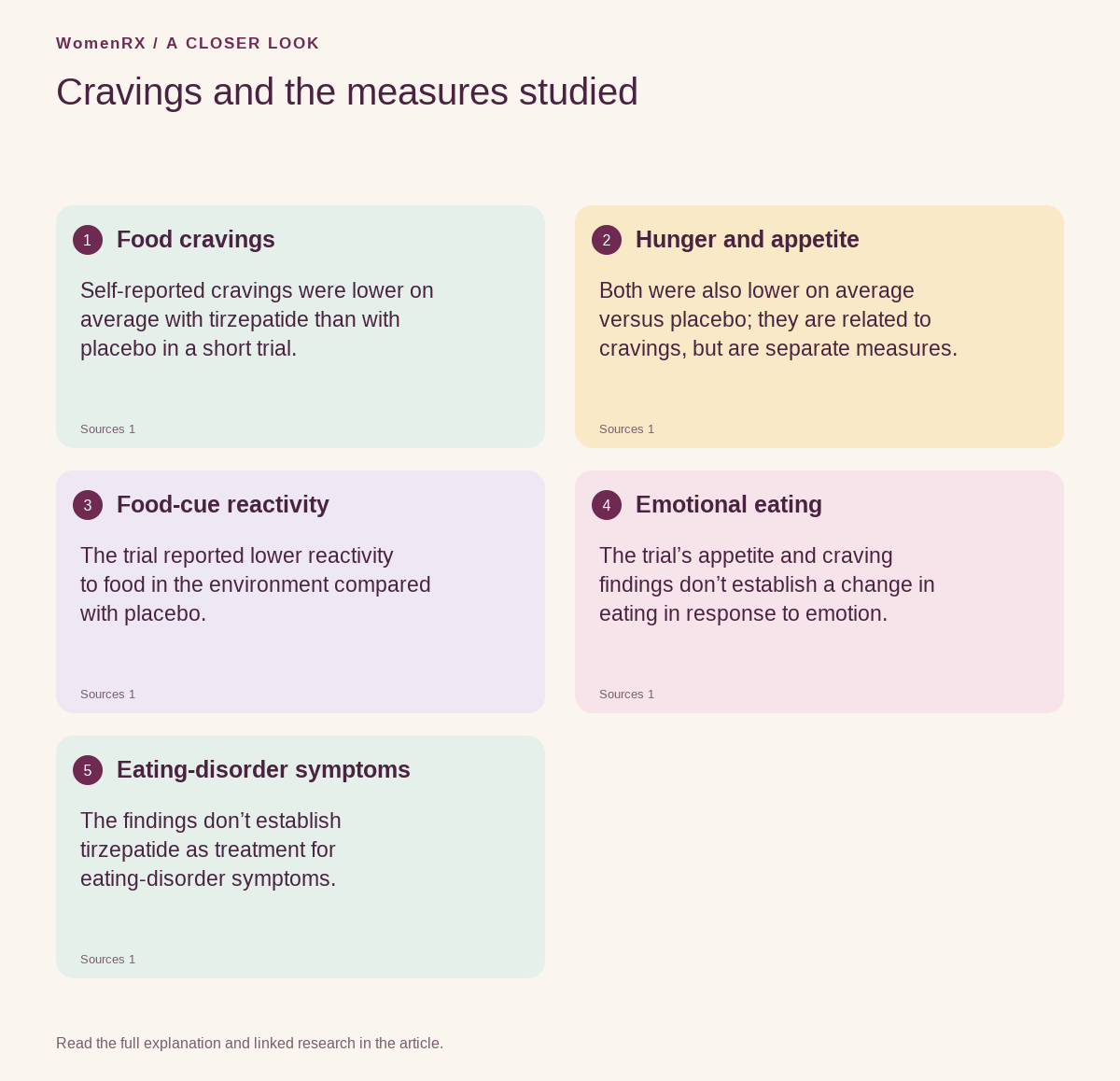
Cravings and the measures studied
Food cravings: Self-reported cravings were lower on average with tirzepatide than with placebo in a short trial.1
Hunger and appetite: Both were also lower on average versus placebo; they are related to cravings, but are separate measures.1
Food-cue reactivity: The trial reported lower reactivity to food in the environment compared with placebo.1
Emotional eating: The trial’s appetite and craving findings don’t establish a change in eating in response to emotion.1
Eating-disorder symptoms: The findings don’t establish tirzepatide as treatment for eating-disorder symptoms.1
Read the figure as text
The trial measured several appetite-related experiences. Its findings don’t answer every question about eating.- Food cravings: Self-reported cravings were lower on average with tirzepatide than with placebo in a short trial.1
- Hunger and appetite: Both were also lower on average versus placebo; they are related to cravings, but are separate measures.1
- Food-cue reactivity: The trial reported lower reactivity to food in the environment compared with placebo.1
- Emotional eating: The trial’s appetite and craving findings don’t establish a change in eating in response to emotion.1
- Eating-disorder symptoms: The findings don’t establish tirzepatide as treatment for eating-disorder symptoms.1
Sources you can check
- Tirzepatide on ingestive behavior in adults with overweight or obesity: a randomized 6-week phase 1 trial.Martin CK, Carmichael OT, Carnell S, Considine RV, Kareken DA, Dydak U, Mattes RD, Scott D, Shcherbinin S, Nishiyama H, Knights A, Urva S, Biernat L, Pratt E, Haupt A, Mintun M, Ot... · Nature medicine · 2025Return to first citation
- Comparative Efficacy of Semaglutide and Tirzepatide in Chinese Adults with Obesity without Diabetes: A Real-World Observational Study.Yao Z, Ahmad A, Gong F, Zhang N, Zeng M, Ge Q. · Diabetes, metabolic syndrome and obesity : targets and therapy · 2026Return to first citation
- Altered eating experience during GLP-1 receptor agonist therapy: a sensory-liking-wanting framework for food preference and nutritional behaviour.Du J, Yang Z, Chen Y. · Frontiers in nutrition · 2026Return to first citation