Does Wegovy Reduce Food Cravings? What Studies Show
Semaglutide can reduce hunger and food cravings for some people, but studies measure these changes separately from weight loss.
Yes. In a 20-week randomized trial of 72 adults with obesity, semaglutide was escalated to 2.4 mg weekly over the study period. Compared with placebo, participants reported less hunger, more fullness, and fewer or weaker cravings, and ate less at a test meal. These outcomes don’t mean cravings disappear for everyone or that Wegovy treats eating disorders or distress about food. 3
Semaglutide may make food less compelling: studies have found lower hunger, greater fullness, and fewer or weaker food cravings compared with placebo. But those changes aren’t the same as losing weight, and they don’t mean cravings will vanish. Researchers measure appetite-related experiences with questionnaires and meal tests, while also measuring body weight. 2 3
Hunger, appetite, cravings, and food thoughts aren’t identical
In everyday terms, hunger is the feeling that you want or need to eat. Appetite is a broader interest in eating. A craving is a strong desire for a particular food or kind of food. Food preoccupation means food is taking up your thoughts; it isn’t automatically the same as hunger or a specific craving.
Semaglutide is a GLP-1 receptor agonist. The US prescribing information describes GLP-1 as a regulator of appetite and calorie intake, with receptors in brain areas involved in appetite regulation. 1 That helps explain why appetite can change during treatment, but it doesn’t predict exactly how any one person will feel.
What the studies actually measured
In a randomized, placebo-controlled trial, 72 adults with obesity received weekly semaglutide, dose-escalated to 2.4 mg over 20 weeks, or placebo. Researchers collected participants’ ratings of hunger, fullness, and satiety, asked about eating control and cravings, and measured food eaten at a test lunch. At week 20, energy intake at that lunch was 35% lower with semaglutide than with placebo. Participants also reported fewer or weaker cravings and better control of eating. 3
A smaller 12-week crossover trial in 30 participants with obesity also found lower hunger and food cravings, better reported eating control, and less energy consumed across test meals with semaglutide than with placebo. That trial used a different dose and design, so its results shouldn’t be treated as a direct comparison with the 20-week study. 2
These measures answer different questions. A meal test records what people ate in a particular study setting. Appetite ratings and craving questionnaires record what participants reported feeling. Weight is measured separately. A result on one measure doesn’t prove that every other part of someone’s relationship with food has changed.
The studies support a possible reduction in cravings, not their elimination. They also don’t establish that less food preoccupation means improved mental health, or that semaglutide treats an eating disorder. “Better control of eating” in a research questionnaire is an outcome the study measured, not a diagnosis or a treatment claim. 2 3
Making sense of your own changes
If you’re taking Wegovy, consider what has shifted specifically: Do you feel hungry less often? Are you satisfied sooner? Are particular cravings less frequent or less intense? Or are thoughts about food still taking up a lot of your attention? Separating these experiences can make it easier to describe what’s changing without using weight as the only measure of whether treatment is affecting you.
If you menstruate and notice appetite or craving changes that seem to come and go, you could note the timing alongside the change. The results summarized here don’t report effects by menstrual-cycle phase, so they don’t establish a cycle-related pattern. The results are presented overall rather than broken down by sex, so they don’t show whether outcomes differed between women and men. 2 3
A change is worth raising with your prescriber if it feels disruptive, makes it difficult to eat or drink enough, or is tied to distressing restriction or loss of control. Stronger appetite suppression isn’t automatically a better outcome. The useful question is whether the change is helping in a way that feels manageable for you, not whether you have stopped wanting food.
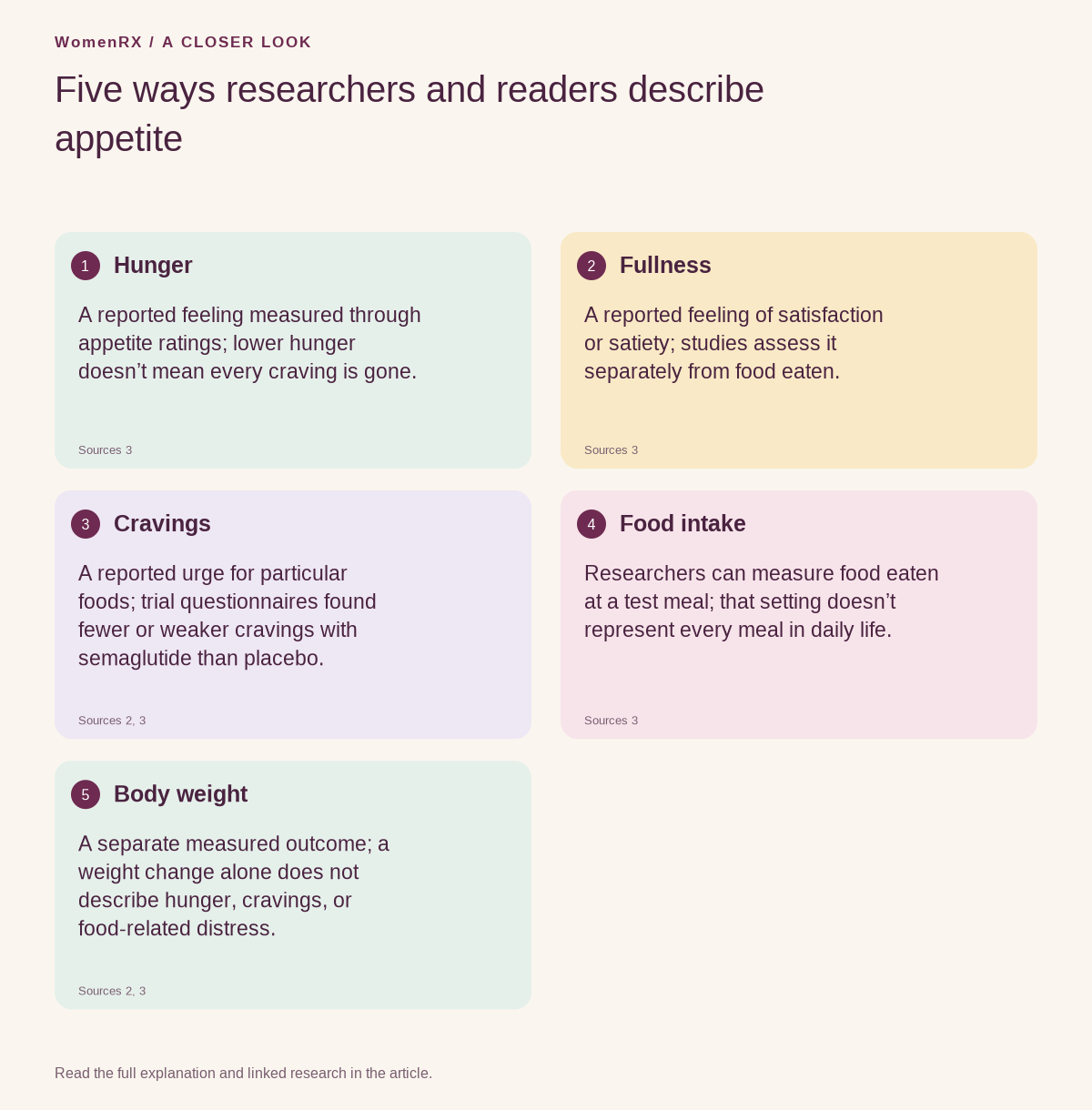
Five ways researchers and readers describe appetite
Hunger: A reported feeling measured through appetite ratings; lower hunger doesn’t mean every craving is gone.3
Fullness: A reported feeling of satisfaction or satiety; studies assess it separately from food eaten.3
Cravings: A reported urge for particular foods; trial questionnaires found fewer or weaker cravings with semaglutide than placebo.23
Food intake: Researchers can measure food eaten at a test meal; that setting doesn’t represent every meal in daily life.3
Body weight: A separate measured outcome; a weight change alone does not describe hunger, cravings, or food-related distress.23
Read the figure as text
These experiences can overlap, but they aren’t interchangeable. Studies measure some with participant reports and others with observed intake or weight.- Hunger: A reported feeling measured through appetite ratings; lower hunger doesn’t mean every craving is gone.3
- Fullness: A reported feeling of satisfaction or satiety; studies assess it separately from food eaten.3
- Cravings: A reported urge for particular foods; trial questionnaires found fewer or weaker cravings with semaglutide than placebo.23
- Food intake: Researchers can measure food eaten at a test meal; that setting doesn’t represent every meal in daily life.3
- Body weight: A separate measured outcome; a weight change alone does not describe hunger, cravings, or food-related distress.23
More questions, answered
Does having fewer cravings mean Wegovy is working?
Not by itself. Trials measured cravings alongside other outcomes, including appetite, food intake, and weight. A change in one measure doesn’t establish what’s happening in the others. 2 3
Sources you can check
- WEGOVY (SEMAGLUTIDE) INJECTION, SOLUTION WEGOVY (SEMAGLUTIDE) TABLET [NOVO NORDISK PHARMACEUTICAL INDUSTRIES, LP] | US prescribing information and patient instructionsAccessed 2026-09-25Return to first citation
- Effects of once-weekly semaglutide on appetite, energy intake, control of eating, food preference and body weight in subjects with obesity.Blundell J, Finlayson G, Axelsen M, Flint A, Gibbons C, Kvist T, Hjerpsted JB. · Diabetes, obesity & metabolism · 2017Return to first citation
- The effect of semaglutide 2.4 mg once weekly on energy intake, appetite, control of eating, and gastric emptying in adults with obesity.Friedrichsen M, Breitschaft A, Tadayon S, Wizert A, Skovgaard D. · Diabetes, obesity & metabolism · 2021Return to first citation