Tirzepatide and Food Cravings: What Studies Measure
A short randomized trial measured cravings and appetite, but a group-level change can’t predict how your eating will feel on treatment.
Yes. A six-week randomized phase 1 trial in adults with overweight or obesity measured self-reported food cravings and appetite, as well as energy eaten at a test meal. Compared with placebo, tirzepatide reduced these measures early in the study. That finding describes an average group response, not a promise that cravings will disappear for you or stay changed over time. 1
Cravings were measured, not just inferred from weight
The clearest direct evidence comes from a randomized phase 1 trial of 114 adults without diabetes. Participants were assigned to tirzepatide, placebo, or liraglutide and followed for six weeks. Researchers measured energy intake at an unrestricted test lunch as the primary outcome, and also collected self-reports about appetite, food cravings, hunger, overeating tendencies, and reactions to food cues. 1
At week three, the tirzepatide group ate less at the test lunch than the placebo group. The researchers also reported lower self-rated overall appetite, cravings, hunger, tendency to overeat, and reactivity to food in the environment compared with placebo. These results show that the study measured eating-related experiences directly; they weren’t guessed from the amount of weight participants lost. 1
But the measures answer different questions. Eating less at one test meal is an observed behavior in a particular setting. A rating of craving is a person’s report about an internal experience. Neither one tells you exactly what will happen at your meals, around a favorite food, or during a difficult afternoon.
A changed appetite isn’t the same as a changed craving
Appetite is a broad experience that can include hunger, fullness, and interest in eating. A craving is a more specific pull toward a food or type of food. Someone might feel less hungry overall but still want a particular snack; another person might notice less interest in food without describing a specific craving. These are useful distinctions when you’re trying to explain what has changed.
A separate, three-month observational study followed 183 Chinese adults with obesity and without diabetes who received tirzepatide or semaglutide. It assessed eating behavior and appetite with the Control of Eating Questionnaire and the Simplified Nutritional Appetite Questionnaire. The study reported comparable changes in appetite and cravings between the two medication groups. Because it was observational, conducted at one clinic, and involved a different population and timeframe from the randomized trial, it doesn’t establish that the medicines will feel the same to every person. 2
Weight is another outcome, not a direct craving measure. A change on the scale can’t tell you whether cravings have eased, whether portions have changed, or whether you feel satisfied after meals. Likewise, feeling less hungry by itself doesn’t establish how your weight will change. Keeping these outcomes separate makes treatment progress easier to describe without treating any one experience as proof of success or failure.
What to notice between follow-ups
If you’re taking tirzepatide, it may help to describe eating patterns in concrete terms rather than saying only “my appetite is better” or “it isn’t working.” For example, you might notice whether you’re hungry before meals, how often a particular food comes to mind, whether you stop eating sooner, or whether you still feel drawn to food when you’re not physically hungry. These are examples of observations to share, not a formal score or a requirement to track every meal.
It can also help to distinguish a welcome reduction in cravings from appetite loss that makes eating difficult. In a qualitative interview study of 29 Japanese participants who had completed a 72-week tirzepatide trial, appetite loss was commonly described, but the interviews did not use that experience as a standardized craving measure. The selected participants’ reports offer context about lived experience, not a rate that predicts what will happen to you. 3
What the research can’t promise you
The randomized study offers evidence that cravings and related appetite measures can change on average, but it was short. Its participants included men and women, yet the reported results don’t provide separate outcomes by sex. These studies also don’t report results by menstrual stage. So they don’t establish whether cravings respond differently across menstrual-cycle phases or for women at different life stages. 12
The practical takeaway is simple: research has measured cravings, appetite, and eating behavior as distinct outcomes, and early results suggest they can decrease with tirzepatide. Your own experience may not match the average. Describing what changed, what did not, and whether eating feels manageable gives a clearer picture than relying on weight alone.
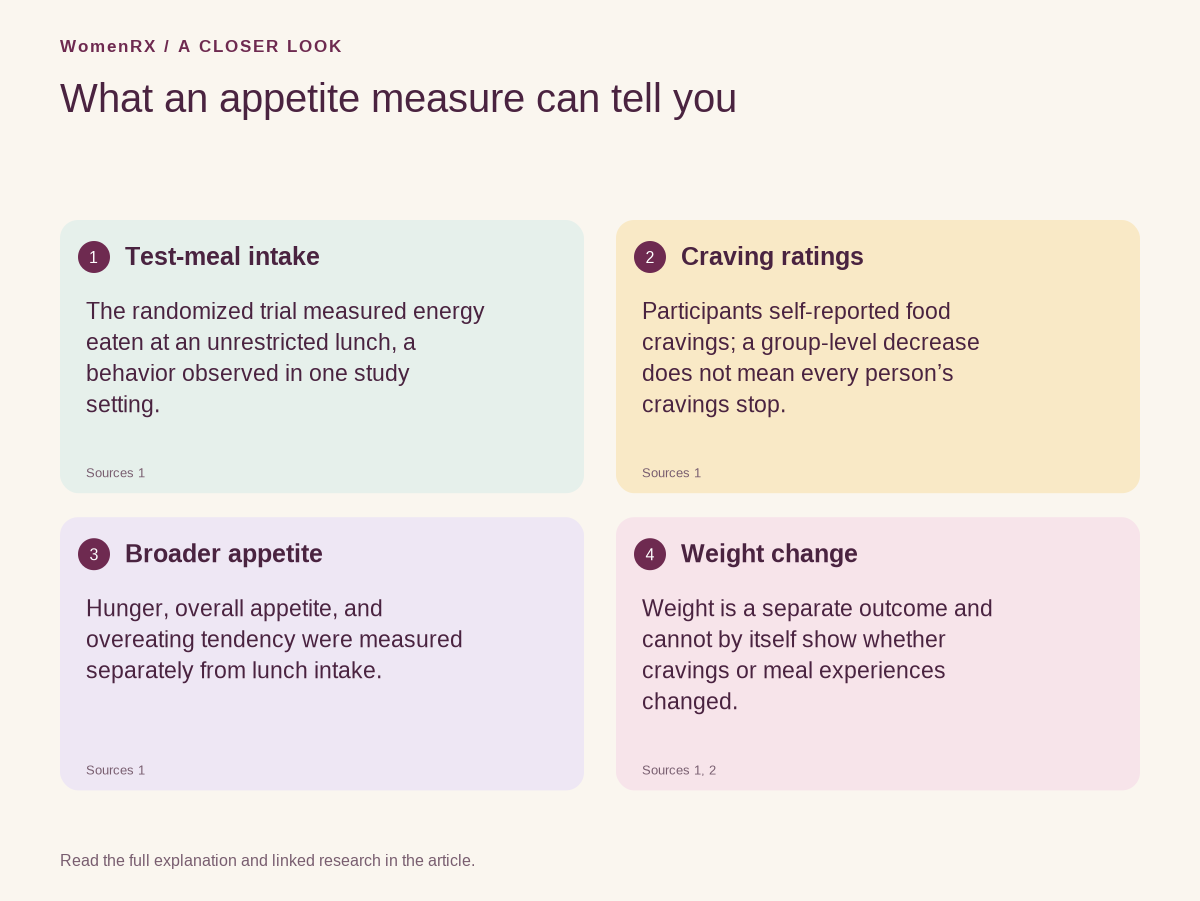
What an appetite measure can tell you
Test-meal intake: The randomized trial measured energy eaten at an unrestricted lunch, a behavior observed in one study setting.1
Craving ratings: Participants self-reported food cravings; a group-level decrease does not mean every person’s cravings stop.1
Broader appetite: Hunger, overall appetite, and overeating tendency were measured separately from lunch intake.1
Weight change: Weight is a separate outcome and cannot by itself show whether cravings or meal experiences changed.12
Read the figure as text
These outcomes describe different parts of eating. A result in one category does not stand in for the others or guarantee an individual response.- Test-meal intake: The randomized trial measured energy eaten at an unrestricted lunch, a behavior observed in one study setting.1
- Craving ratings: Participants self-reported food cravings; a group-level decrease does not mean every person’s cravings stop.1
- Broader appetite: Hunger, overall appetite, and overeating tendency were measured separately from lunch intake.1
- Weight change: Weight is a separate outcome and cannot by itself show whether cravings or meal experiences changed.12
More questions, answered
Does less hunger mean food cravings will stop?
Not necessarily. Hunger and a specific desire for a food are related but distinct experiences, and the trial measured them as separate self-reported outcomes. A group average doesn’t predict whether both will change for you. 1
Do studies show different craving effects by menstrual cycle?
These studies don’t report craving outcomes by menstrual stage. The randomized trial included male and female participants, but its reported results don’t give separate sex-specific findings. 1
Sources you can check
- Tirzepatide on ingestive behavior in adults with overweight or obesity: a randomized 6-week phase 1 trial.Martin CK, Carmichael OT, Carnell S, Considine RV, Kareken DA, Dydak U, Mattes RD, Scott D, Shcherbinin S, Nishiyama H, Knights A, Urva S, Biernat L, Pratt E, Haupt A, Mintun M, Ot... · Nature medicine · 2025Return to first citation
- Comparative Efficacy of Semaglutide and Tirzepatide in Chinese Adults with Obesity without Diabetes: A Real-World Observational Study.Yao Z, Ahmad A, Gong F, Zhang N, Zeng M, Ge Q. · Diabetes, metabolic syndrome and obesity : targets and therapy · 2026Return to first citation
- Experience with Tirzepatide and Weight Management During and After a Clinical Trial in Japanese Patients with Obesity Disease: A Qualitative Study.Kiyosue A, Sato M, Cai Z, Fukushima Y, Takai M, Takahashi T, Nagashima H, Suo S, Takeda R, Shimoura K, Shingaki T. · Advances in therapy · 2026Return to first citation