Menopause Food Cravings: Look for Patterns, Not Rules
Cravings can change in midlife, but they aren’t inevitable; sleep and eating patterns may be useful to notice without assuming hormones explain everything.
Menopause doesn’t make everyone crave particular foods, and a craving alone can’t reveal its cause. A review of midlife women’s health describes possible links between sleep disruption and eating behavior, while appetite also reflects signals that respond to meals and other influences. A brief, nonjudgmental log can help you notice what tends to coincide with cravings, without calorie counting or restrictive rules. 1 2
A craving isn’t a diagnosis
A stronger pull toward a certain food can feel like proof that menopause has changed your appetite. But a craving by itself can’t tell you why it happened, and it isn’t a sign of weak willpower.
Appetite isn’t controlled by one switch. Signals from the gut respond to food and help shape hunger and fullness. The pleasure or reward of eating can also influence what sounds appealing. These influences interact, so it’s too simple to point to one hormone as the cause of a particular craving. 2
Sleep may be part of the picture
Sleep can become less settled in midlife, including around the menopause transition. A review of sleep, health, and metabolism in midlife women discusses how sleep disturbance may affect eating behavior. It also describes sleep restriction and age-related changes in sleep as possible influences on appetite. That makes sleep worth noticing, but it doesn’t show that a poor night causes a specific craving. 1
Mood, stress, and the circumstances around eating can be useful personal context too. You can note them without treating them as established menopause-specific causes. For example, a craving after a stressful day is an observation, not proof that stress caused it.
Look at meal timing without judging food
Appetite-related signals respond to eating and contribute to hunger, meal stopping, and fullness. But changes in these signals don’t automatically predict what someone will eat. A review of appetite-related gut hormones cautions against reading eating behavior directly from hormone measurements alone. 2
So, instead of labeling a food as good or bad, you might notice when a craving appears and what was happening beforehand. For example, you could write that you wanted a snack late in the afternoon after sleeping poorly and delaying lunch. That helps describe your day; it doesn’t prove menopause or either circumstance caused the craving.
Keep a short, low-pressure record
For a few days, if it feels helpful, jot down:
- What you craved and roughly when
- Whether sleep felt settled or disrupted
- When you last ate, or whether a meal was delayed
- Your mood and what was happening around you
You don’t need calorie counts, detailed food rules, or a perfect record. Look for patterns that repeat, while leaving room for ordinary variation. If tracking makes eating feel more stressful, stop. The aim is to understand what fits your own days, not to turn every craving into a symptom to fix.
If you notice a recurring pattern, you could make a small, practical change to your routine and see whether it feels helpful. For instance, if cravings often coincide with a long gap between meals, you might try making your usual meal or snack timing more consistent. That’s a personal experiment, not a treatment or proof of cause.
What the pattern can tell you
Research on midlife sleep and eating behavior makes sleep a reasonable factor to observe, but it doesn’t establish one menopause-specific explanation for food cravings. The appetite review explains how signals related to eating work, but not why an individual woman craves a particular food. 1 2
Your notes can still help you see whether cravings tend to show up alongside disrupted sleep, meal timing, mood, or other circumstances. Treat that as information about your own routine, not a rule about menopause or a reason to restrict foods.
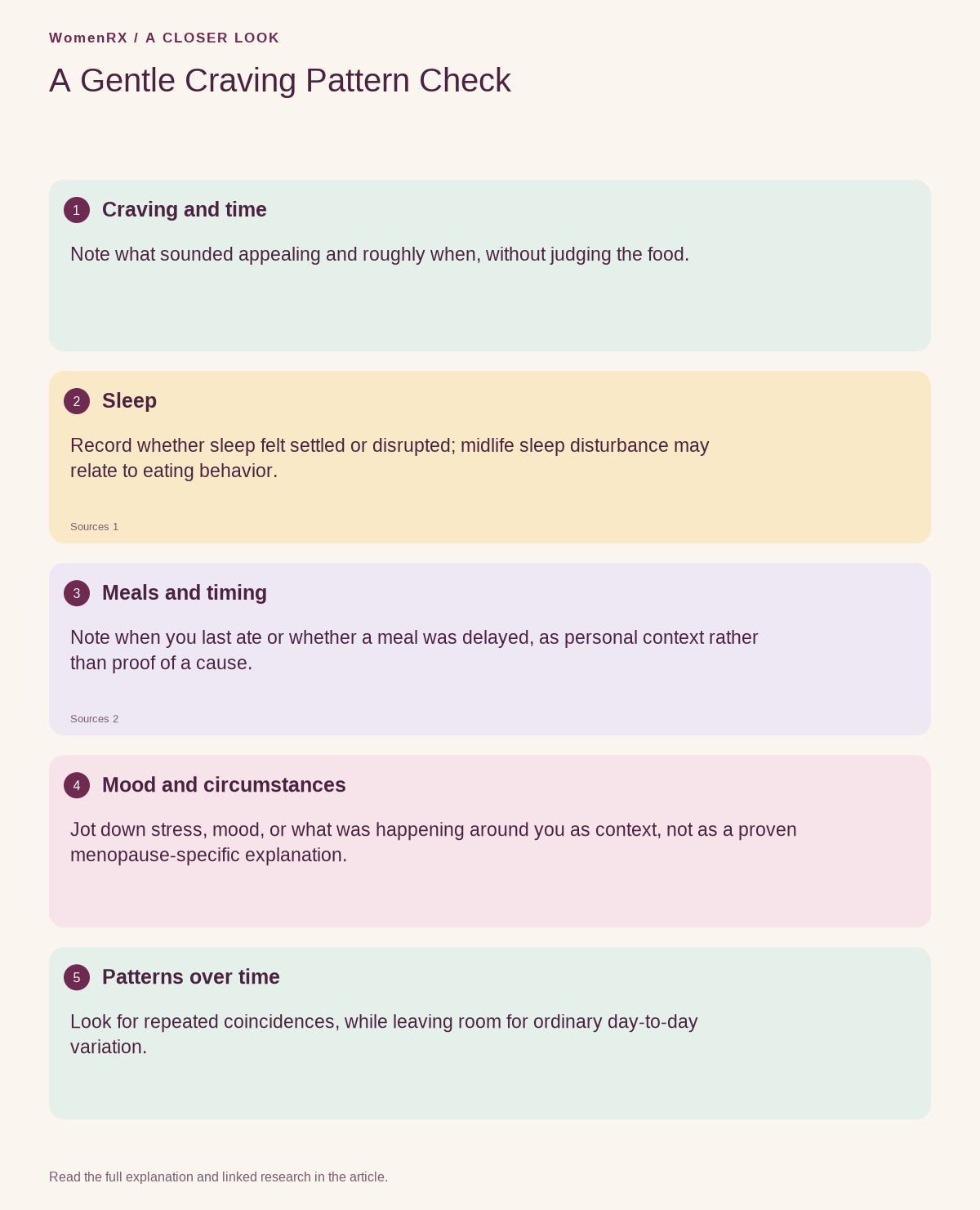
A Gentle Craving Pattern Check
Craving and time: Note what sounded appealing and roughly when, without judging the food.
Sleep: Record whether sleep felt settled or disrupted; midlife sleep disturbance may relate to eating behavior.1
Meals and timing: Note when you last ate or whether a meal was delayed, as personal context rather than proof of a cause.2
Mood and circumstances: Jot down stress, mood, or what was happening around you as context, not as a proven menopause-specific explanation.
Patterns over time: Look for repeated coincidences, while leaving room for ordinary day-to-day variation.
Read the figure as text
Use these prompts to notice what tends to coincide with cravings. This is an informal reflection tool, not a test or proof of cause.- Craving and time: Note what sounded appealing and roughly when, without judging the food.
- Sleep: Record whether sleep felt settled or disrupted; midlife sleep disturbance may relate to eating behavior.1
- Meals and timing: Note when you last ate or whether a meal was delayed, as personal context rather than proof of a cause.2
- Mood and circumstances: Jot down stress, mood, or what was happening around you as context, not as a proven menopause-specific explanation.
- Patterns over time: Look for repeated coincidences, while leaving room for ordinary day-to-day variation.
Sources you can check
- Sleep, Health, and Metabolism in Midlife Women and Menopause: Food for Thought.Kravitz HM, Kazlauskaite R, Joffe H. · Obstetrics and gynecology clinics of North America · 2018Return to first citation
- Appetite-related Gut Hormone Responses to Feeding Across the Life Course.Holliday A, Horner K, Johnson KO, Dagbasi A, Crabtree DR. · Journal of the Endocrine Society · 2025Return to first citation