Sugar Cravings: Look for Patterns, Not Hormone Problems
When something sweet sounds especially appealing, the timing of the craving may tell you more than the craving itself.
A sugar craving doesn’t tell you that your hormones are out of balance. Notice what surrounds it instead: a long gap since eating, tempting food cues, poor sleep, a stressful moment, or a recent medication change. Those observations can suggest a useful next step without turning a craving into a diagnosis or a reason to restrict food. 3 5 4
Start with the situation, not an explanation
Wanting something sweet is a real experience, but it isn’t a test for a particular hormone problem. Before trying to explain it, notice the setting. Did the craving arrive after you missed a meal? While you were walking past a bakery? At the end of a demanding day? More than one thing can be happening at once.
For a few occasions, jot down when the craving appeared, when you last ate, how you slept, and what was going on around you. Keep it brief. You’re looking for a repeat you can respond to, not grading what you ate or proving that you have perfect self-control.
Notice the gap since your last meal
Hunger and food cues can work together. In a crossover experiment involving 47 healthy people, participants were fasting when they encountered sweet food cues. They showed a strong craving response to those cues, which eased after they drank a sugary beverage. The experiment took place in a lab; it doesn’t show that a particular meal schedule prevents cravings in everyday life. 3
Still, a recurring pattern is worth acting on. For example, if something sweet sounds irresistible on days when lunch gets pushed late, try making room for a satisfying meal or snack when you can. Then notice whether the afternoon feels different. You don’t have to earn food by waiting until a craving becomes intense.
A stricter food rule isn’t the automatic answer. In a secondary analysis of a two-year trial involving adults with obesity, people assigned to low-carbohydrate and low-fat diets reported different changes in cravings for the food categories those diets restricted. That finding doesn’t establish that restriction is necessary, or tell you which way of eating would suit your life. 2
Put sleep and stress in the picture
If cravings seem more noticeable after a short night, record that alongside the rest of the day. In a small pilot study of 12 physicians working on call, reports of unhealthy food consumption were associated with shorter sleep. The study measured eating, not sugar cravings, and it can’t tell us whether sleep was the cause. It does give you a reason to look at your own sleep pattern without treating one tired day as proof. 5
Stress is another piece of context, not a diagnosis. The body responds to a challenge with changes that include the release of stress hormones, but that fact alone doesn’t explain a desire for sweets. 1 If you notice cravings during a particular stretch of your day, ask what’s happening then. You might find a long meal gap, a familiar food cue, stress, or some combination.
What if the pattern seems hormonal?
If you menstruate, you can include cycle dates in your notes if you suspect a repeat. A craving on its own, though, can’t identify a menstrual-cycle phase or establish a hormone imbalance.
Menopause can bring several changes into the same period of life. In online focus groups with 40 women in Ireland, some described sugar or salt cravings alongside changes in sleep, appetite, and other aspects of daily life. Their accounts describe experiences, not proof that a hormone change caused a particular craving. 6 That’s why it helps to look at your circumstances rather than blame every new food preference on hormones.
Include medication timing when it’s relevant
A noticeable appetite change after starting or changing a medication is worth bringing up with your prescriber or pharmacist. Name the medication and when the change began rather than assuming the two are connected or stopping it because of a craving.
Medicines can have specific effects on appetite. For example, in a six-week randomized trial of 114 adults without diabetes who had overweight or obesity, participants assigned to tirzepatide reported fewer food cravings than those assigned to placebo at week three. That result applies to tirzepatide in that study; it doesn’t predict what a different medication will do. 4
Look back at your notes for one workable adjustment. If the pattern is a long gap without food, make eating easier to fit into that part of the day. If cravings arise around a particular cue, simply recognizing the cue may help you decide what you want. And if you choose to eat something sweet, that isn’t a failure of the exercise. The aim is to understand what’s happening well enough to respond kindly and usefully.
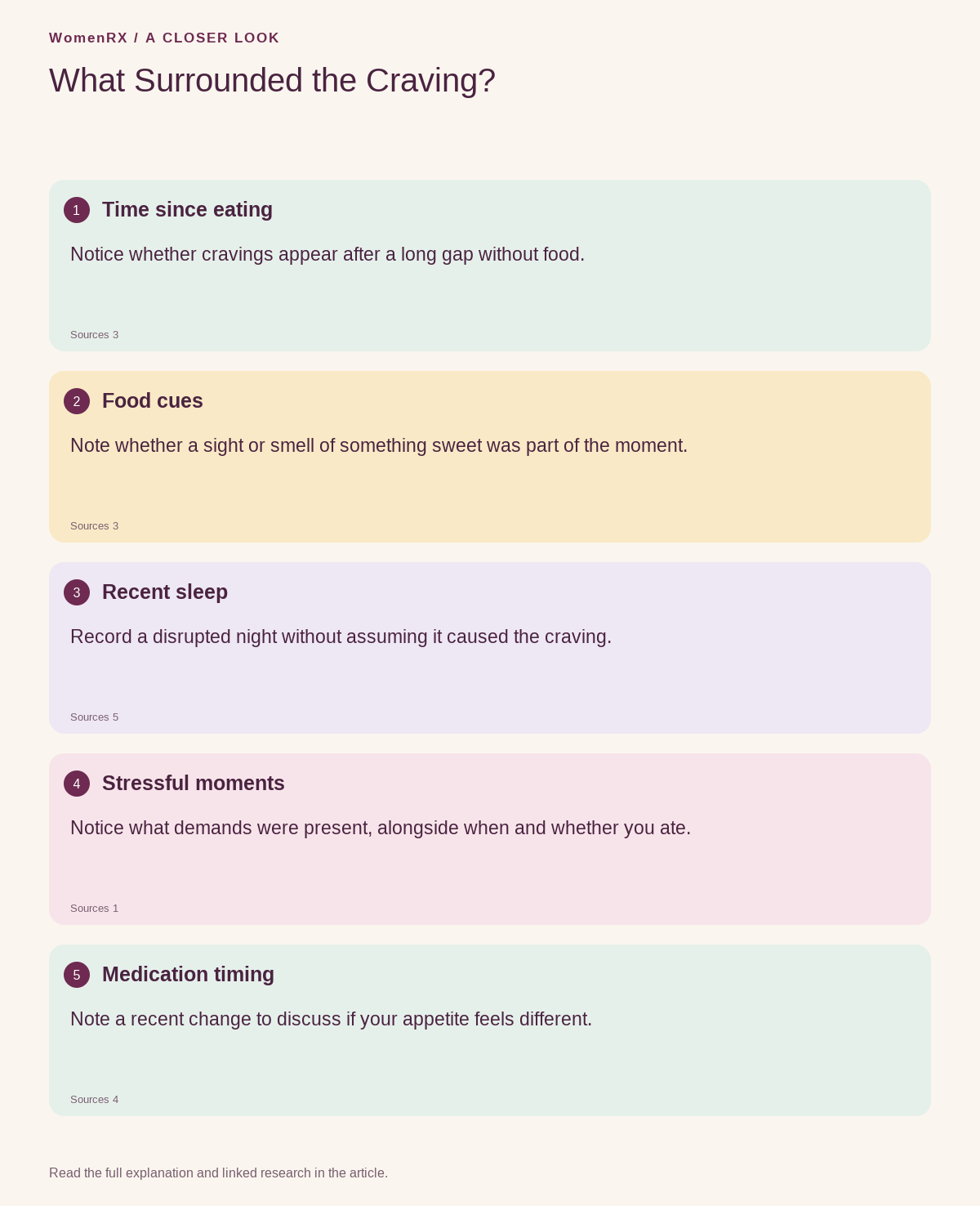
What Surrounded the Craving?
Time since eating: Notice whether cravings appear after a long gap without food.3
Food cues: Note whether a sight or smell of something sweet was part of the moment.3
Recent sleep: Record a disrupted night without assuming it caused the craving.5
Stressful moments: Notice what demands were present, alongside when and whether you ate.1
Medication timing: Note a recent change to discuss if your appetite feels different.4
Read the figure as text
Use these prompts to spot a repeat you can respond to. They aren’t a diagnostic checklist.- Time since eating: Notice whether cravings appear after a long gap without food.3
- Food cues: Note whether a sight or smell of something sweet was part of the moment.3
- Recent sleep: Record a disrupted night without assuming it caused the craving.5
- Stressful moments: Notice what demands were present, alongside when and whether you ate.1
- Medication timing: Note a recent change to discuss if your appetite feels different.4
More questions, answered
Does craving sugar mean my blood sugar is low?
No. A craving can’t tell you your blood glucose level. In a small experiment, fasting participants responded to sweet food cues, but those results don’t make cravings a way to measure blood sugar. 3
Should I cut out sugar to stop cravings?
Not automatically. A trial analysis found that cravings changed differently under two restrictive diets, but it doesn’t show that cutting out sugar is necessary or that one approach will work for you. Start by noticing when cravings occur and whether you’ve had enough to eat. 2
Sources you can check
- Stress: MedlinePlusAccessed 2026-09-25Return to first citation
- Change in food cravings, food preferences, and appetite during a low-carbohydrate and low-fat diet.Martin CK, Rosenbaum D, Han H, Geiselman PJ, Wyatt HR, Hill JO, Brill C, Bailer B, Miller BV, Stein R, Klein S, Foster GD. · Obesity (Silver Spring, Md.) · 2011Return to first citation
- Taste of Things to Come: Craving Responses to Ingestion of and Mouth Rinse with a Sugary Drink in Connection with Food Cues and Associations with Continuous Interstitial Glucose Measurement in a Healthy Population.Al Gamode A, Malik RB, Butler J, Kubis HP. · Nutrients · 2026Return to first citation
- Tirzepatide on ingestive behavior in adults with overweight or obesity: a randomized 6-week phase 1 trial.Martin CK, Carmichael OT, Carnell S, Considine RV, Kareken DA, Dydak U, Mattes RD, Scott D, Shcherbinin S, Nishiyama H, Knights A, Urva S, Biernat L, Pratt E, Haupt A, Mintun M, Ot... · Nature medicine · 2025Return to first citation
- Interventions for Unhealthy Eating Patterns of Resident Otolaryngologists on Call.Luk HG, Pine H. · Laryngoscope investigative otolaryngology · 2026Return to first citation
- From Disruption to Control: Insights from Focus Groups Exploring Nutrition and Chemosensory Changes During Menopause.O'Donovan S, Monaghan S, Murphy A, Conroy PM. · Nutrients · 2025Return to first citation