Sugar Cravings: What Patterns Might Be Driving Them?
A sweet craving can reflect hunger, habit, or a wish for comfort, so look for the pattern before deciding what to change.
Try tracing a craving to what came before it: how long since you ate, what the meal included, where you were, and how you were feeling. If you may be hungry, try a satisfying meal or snack with fiber-rich plant foods and a protein source. Notice whether restriction or a familiar routine plays a part, without treating sugar as forbidden. Cycle or sleep patterns are worth observing, not assuming.
Start with the moment, not a food rule
A craving for something sweet doesn’t automatically mean you’re hungry, lacking a nutrient, or doing anything wrong. It can be a simple preference. It can also show up alongside hunger, a familiar routine, or a feeling you’re trying to soothe. The useful question is less “How do I stop this?” and more “What tends to happen before it?”
For a few days, make a quick note when the craving arrives: when you last ate, what the meal or snack included, what was happening around you, and whether you felt physically hungry, tired, stressed, or simply in the mood for something sweet. This is a personal pattern-finding exercise, not a diagnostic test. You don’t need to track calories or judge the food.
If it feels like hunger, try more staying power
A long gap since your last meal, or a meal that didn’t leave you satisfied, may make eating something appealing. If hunger seems likely, try eating a meal or snack rather than relying on willpower to push through it. Fiber adds bulk and can help you feel full faster; fruits, vegetables, and whole grains are sources. Protein comes from foods such as beans, nuts, dairy, meat, and some grains. These foods can help make a snack or meal more substantial, though that doesn’t guarantee a craving will disappear. 1 2
For example, you could try fruit with yogurt or nuts, or beans with a whole-grain food. These are options to test, not “craving cures.” If you still want something sweet afterward, you can have it. Adding a more filling food is different from making sugar off-limits.
Notice whether restriction is part of the loop
If you’ve been trying to avoid sweets completely, pay attention to whether cravings feel more prominent on those days. In a two-year randomized trial of adults with obesity, participants assigned to a low-carbohydrate diet reported larger decreases in cravings for carbohydrates and preferences for high-sugar foods than those assigned to a low-fat diet. The trial tested prescribed diets in that population; it doesn’t show that everyone needs to restrict carbohydrates, or that banning sweets is necessary. 3
A useful experiment may be to stop treating a desired food as a failure and notice what happens when you allow it alongside ordinary meals. The goal is to learn whether rigid rules are making food occupy more of your attention, not to follow a new rule about how often you can eat sweets.
Separate a routine from physical hunger
Cravings can become linked to a time, place, or activity: dessert after dinner, candy during a commute, or a sweet drink during an afternoon break. If the same setting keeps appearing in your notes, choose a response that fits what you want in that moment. You might have the sweet, take a pause and check whether you’re hungry, or change the routine by making a different snack available. None of these options needs to be a test of self-control.
Late-day eating alone doesn’t establish that a person has stronger cravings. In a cross-sectional study of 100 US adults, people with an evening chronotype reported more frequent and later snacking than morning-type adults, but the groups did not differ significantly in measured food cravings. 4
Keep cycle and sleep patterns as questions
If you menstruate, note whether cravings seem to cluster at a particular point in your cycle. A few observations can help you see whether that pattern is consistent for you; a craving in one cycle doesn’t establish a universal hormone explanation. Likewise, note whether cravings happen after a short or disrupted night, but don’t assume sleep caused them based on a single instance. Cycle or sleep timing may be worth observing, but a pattern alone doesn’t prove what caused a craving.
When the pattern is bigger than sweets
If eating feels distressing, hard to control, or tied to rules that are taking over your day, the issue may deserve support beyond swapping snacks. You don’t have to wait until you have a perfect explanation for the pattern before talking it through with a qualified care professional. The aim is to find an approach that supports eating well without making food feel like a constant battle.
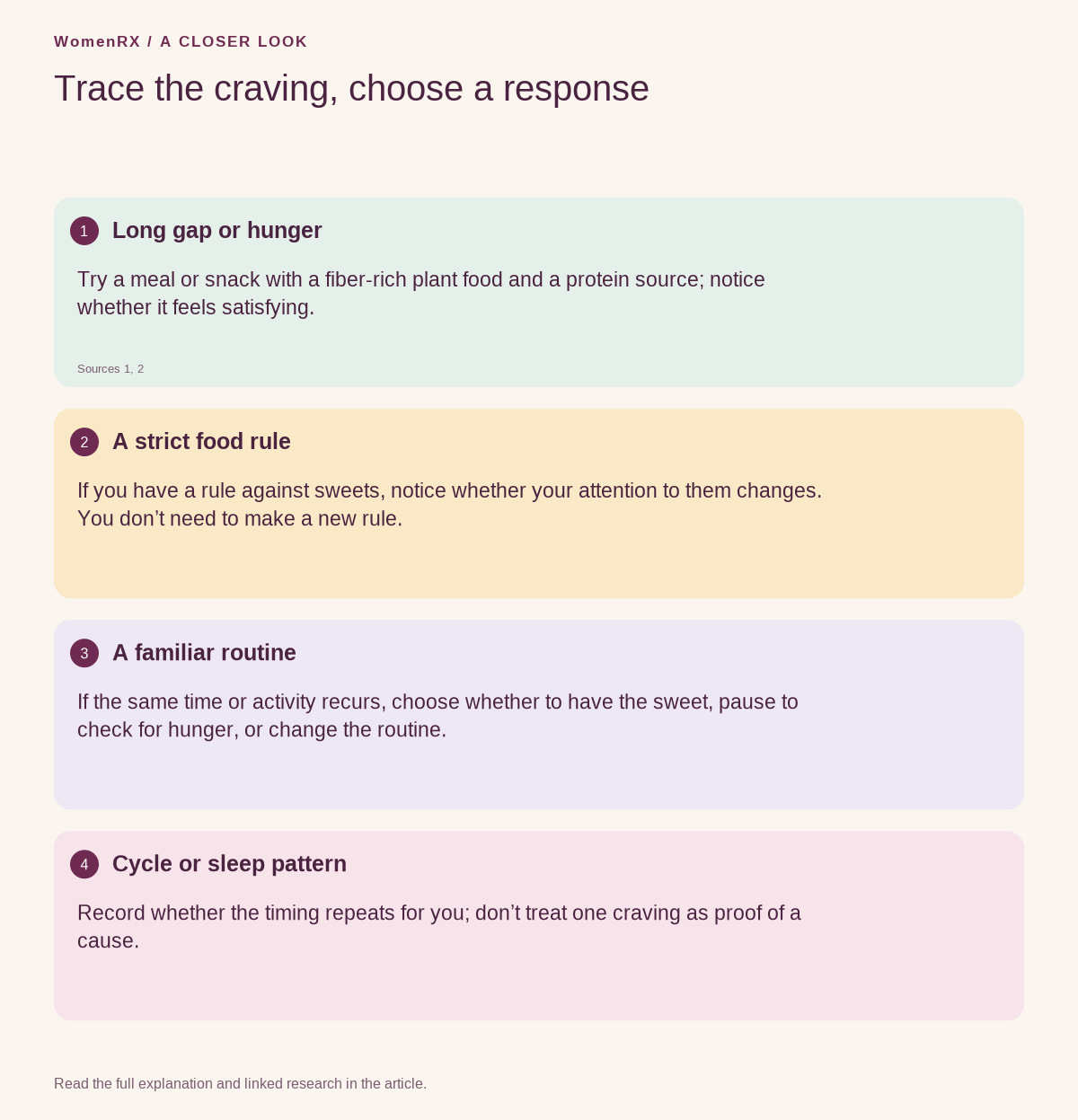
Trace the craving, choose a response
Long gap or hunger: Try a meal or snack with a fiber-rich plant food and a protein source; notice whether it feels satisfying.12
A strict food rule: If you have a rule against sweets, notice whether your attention to them changes. You don’t need to make a new rule.
A familiar routine: If the same time or activity recurs, choose whether to have the sweet, pause to check for hunger, or change the routine.
Cycle or sleep pattern: Record whether the timing repeats for you; don’t treat one craving as proof of a cause.
Read the figure as text
Use the moment before a craving to consider a proportionate next step. These are prompts for reflection, not a validated assessment.- Long gap or hunger: Try a meal or snack with a fiber-rich plant food and a protein source; notice whether it feels satisfying.12
- A strict food rule: If you have a rule against sweets, notice whether your attention to them changes. You don’t need to make a new rule.
- A familiar routine: If the same time or activity recurs, choose whether to have the sweet, pause to check for hunger, or change the routine.
- Cycle or sleep pattern: Record whether the timing repeats for you; don’t treat one craving as proof of a cause.
More questions, answered
Does craving sweets mean I have a nutrient deficiency?
A craving by itself doesn’t identify a nutrient deficiency. Look at the broader pattern, including whether you’re hungry or have gone a long time without eating, rather than using the craving as a diagnosis.
Should I cut out sugar to reduce cravings?
Not necessarily. One long-term trial found different changes in food cravings between two prescribed diets in adults with obesity, but it doesn’t establish that everyone should restrict sugar or carbohydrates. You can observe how your own eating rules affect cravings without making sweets forbidden. 3
Sources you can check
- Dietary Proteins: MedlinePlusAccessed 2026-09-25Return to first citation
- Dietary Fiber: MedlinePlusAccessed 2026-09-25Return to first citation
- Change in food cravings, food preferences, and appetite during a low-carbohydrate and low-fat diet.Martin CK, Rosenbaum D, Han H, Geiselman PJ, Wyatt HR, Hill JO, Brill C, Bailer B, Miller BV, Stein R, Klein S, Foster GD. · Obesity (Silver Spring, Md.) · 2011Return to first citation
- Snacking behavior differs between evening and morning chronotype individuals but no differences are observed in overall energy intake, diet quality, or food cravings.Yang CL, Tucker RM. · Chronobiology international · 2022Return to first citation