Semaglutide and Food Cravings: What Studies Measure
Some trials measured cravings directly, but that’s different from measuring hunger, appetite, or what people actually eat.
Yes. In randomized trials, researchers used questionnaires that ask about cravings and control over eating, and some found better scores with semaglutide than placebo. Other studies measured hunger, appetite ratings, or food intake instead. These outcomes overlap, but they are not interchangeable, and the reported studies don’t establish whether craving changes differ by sex or life stage. 1 2
“Craving” isn’t the same as “hungry”
Hunger is a feeling that you need food. Appetite is broader: it can include how much you feel like eating, whether you feel full, and how appealing food seems. A craving is a stronger pull toward a particular food or type of food, such as sweets or salty snacks. Eating behavior is another outcome again: it describes choices or intake, not necessarily the urge behind them.
That distinction matters because a study showing lower food intake doesn’t automatically show that cravings eased. And a lower craving score on a questionnaire doesn’t prove that someone ate less in daily life.
What researchers have measured
One small randomized crossover trial studied oral semaglutide in 15 people with type 2 diabetes. Over 12 weeks, participants completed a questionnaire about eating control and cravings, rated feelings such as hunger and fullness, and ate meals and snacks in a supervised food-intake assessment. Among 13 people with intake data, measured energy intake was lower with semaglutide than with placebo. The researchers also reported fewer cravings and better eating control; appetite ratings differed after a higher-fat breakfast, but not after a standard breakfast. 1
A larger, longer randomized trial, STEP 5, studied weekly semaglutide in adults with overweight or obesity alongside lifestyle support. In a subgroup who completed the Control of Eating Questionnaire, several craving-related scores improved compared with placebo. Some differences appeared at weeks 20, 52, and 104, while others were reported at weeks 20 and 52. The questionnaire asked about experiences such as craving control and cravings for sweet or savory foods. 2
So the answer to “has craving relief been studied directly?” is yes. The answer isn’t that every study measured the same thing, or that everyone’s cravings will change. The smaller diabetes trial used oral semaglutide; STEP 5 studied a different population and a weekly treatment. Their findings support an effect on measured craving and eating-control scores in those study settings, not a guarantee about one person’s experience. 1 2
What the results can’t tell you
Questionnaire scores describe what participants reported. They’re useful for measuring subjective experiences, but they aren’t the same as observing every meal or proving why a change happened. In STEP 5, improvements in craving scores were associated with weight reduction. That association doesn’t establish whether craving changes caused weight loss, followed it, or were related in another way. The study’s reported p-values also weren’t adjusted for multiple comparisons, so the range of questionnaire findings deserves some care in interpretation. 2
The oral semaglutide trial offers a different kind of evidence: it included a measured food-intake assessment as well as self-reported cravings and appetite. But it was exploratory and small, and its participants had type 2 diabetes. It can’t by itself tell us how the findings apply to everyone considering semaglutide for weight management. 1
Neither study summary reports a craving-outcome analysis by sex or life stage. That means these findings can’t answer whether results differ for women, or whether they differ across cycling years, perimenopause, or postmenopause. It doesn’t show that semaglutide works differently for women; it leaves that comparison unanswered. 1 2
A useful way to read claims about cravings
When you see a claim that semaglutide “stops cravings,” ask what outcome was actually measured. A direct questionnaire measure is closer to the question of craving than a hunger rating or a food-intake measure. Even then, check who was studied, how long they were followed, and whether the result was a reported change in scores or a measured change in eating.
The research supports a narrower, more useful takeaway: in the studied groups, semaglutide was associated with improvements in some directly measured craving and eating-control scores. Those measures don’t promise that cravings will disappear, explain every change in eating, or establish a women-specific effect. 1 2
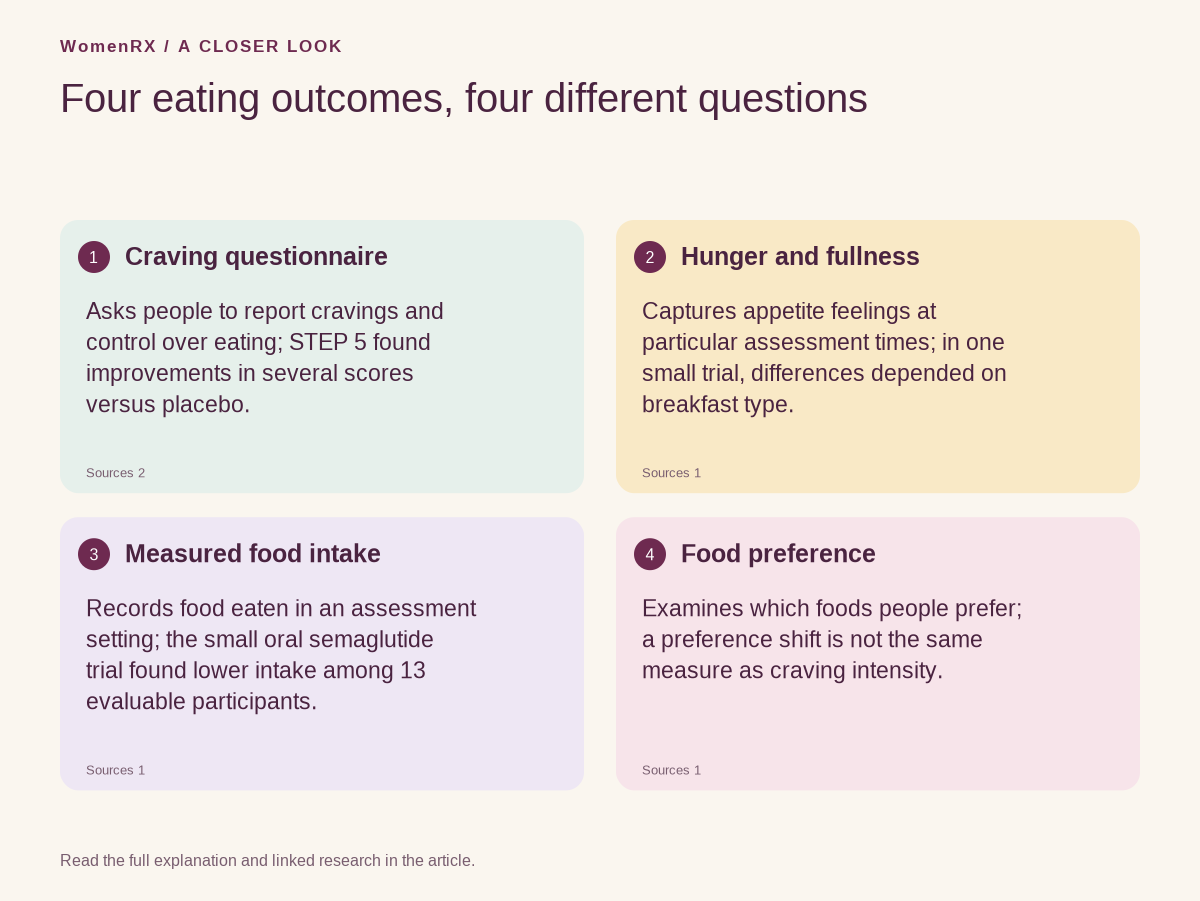
Four eating outcomes, four different questions
Craving questionnaire: Asks people to report cravings and control over eating; STEP 5 found improvements in several scores versus placebo.2
Hunger and fullness: Captures appetite feelings at particular assessment times; in one small trial, differences depended on breakfast type.1
Measured food intake: Records food eaten in an assessment setting; the small oral semaglutide trial found lower intake among 13 evaluable participants.1
Food preference: Examines which foods people prefer; a preference shift is not the same measure as craving intensity.1
Read the figure as text
Semaglutide studies have used measures that capture different parts of eating. A result in one category doesn’t automatically establish a change in another.- Craving questionnaire: Asks people to report cravings and control over eating; STEP 5 found improvements in several scores versus placebo.2
- Hunger and fullness: Captures appetite feelings at particular assessment times; in one small trial, differences depended on breakfast type.1
- Measured food intake: Records food eaten in an assessment setting; the small oral semaglutide trial found lower intake among 13 evaluable participants.1
- Food preference: Examines which foods people prefer; a preference shift is not the same measure as craving intensity.1
More questions, answered
Does lower appetite mean cravings will go away?
Not necessarily. Appetite ratings and craving questionnaire scores measure different experiences. In the oral semaglutide trial, appetite differences depended on the breakfast condition, while researchers separately reported fewer cravings and better eating control. 1
Do these studies show whether cravings change differently for women?
The reported results don’t include sex- or life-stage-specific analyses of craving outcomes. They can’t establish whether women’s results differ from men’s or vary across stages of life. 1 2
Sources you can check
- Effects of oral semaglutide on energy intake, food preference, appetite, control of eating and body weight in subjects with type 2 diabetes.Gibbons C, Blundell J, Tetens Hoff S, Dahl K, Bauer R, Baekdal T. · Diabetes, obesity & metabolism · 2021Return to first citation
- Two-year effect of semaglutide 2.4 mg on control of eating in adults with overweight/obesity: STEP 5.Wharton S, Batterham RL, Bhatta M, Buscemi S, Christensen LN, Frias JP, Jódar E, Kandler K, Rigas G, Wadden TA, Garvey WT. · Obesity (Silver Spring, Md.) · 2023Return to first citation