Protein Shakes for Weight Loss: Match the Drink to Its Job
A protein shake can replace a meal, complement one, or simply add calories, depending on how you use it and what the product contains.
Start with the role you want the shake to play. If it replaces a meal, look for a product specifically intended as a meal replacement and compare its calories, protein, and listed vitamins and minerals with what that meal would provide. If it’s a snack or add-on, count it as extra food rather than assuming protein itself causes weight loss. Studied meal-replacement plans are structured approaches, not just protein drinks. 3 4
First decide: replacement or addition?
A shake doesn’t have one fixed job. You might use it instead of breakfast, have it between meals, or blend it into a meal you’d eat anyway. Those choices affect whether it replaces food or adds to your day.
For weight management, the distinction matters because reducing overall calorie intake is part of the lifestyle approach used for long-term weight loss. If a shake is added to a meal rather than replacing something, its calories are added too. Protein is a nutrient your body needs, but a higher-protein drink isn’t automatically a weight-loss product. 1 2
Before choosing one, finish this sentence: “I plan to use this instead of ___.” If you can’t name what it replaces, it’s probably an addition, not a meal replacement.
Three roles, three label questions
A drink that replaces a meal
Look for a product labeled and designed for meal replacement, then check the serving size, calories, protein, and whether vitamins and minerals are listed. In a study of overweight women, meal replacements were part of a planned, energy-restricted diet that also included a prepackaged entrée, fruits and vegetables, and regular classes. The study wasn’t a test of casually adding a protein shake to someone’s usual meals. 4
A separate eight-week trial in overweight adult women compared exercise alone with exercise plus intermittent meal replacement using protein-enriched shakes. The combined group lost more weight on average, but because the intervention paired shakes with exercise and a planned eating approach, the result doesn’t show that protein shakes alone caused the difference. 3
A protein drink that complements a meal
If you already plan to eat a meal, ask what the drink adds. Check the serving calories and protein, and consider whether you actually need an additional source of protein. Protein needs vary with age, sex, health, and physical activity, and most Americans get enough from their diets, according to MedlinePlus. 2
A shake can be a convenient protein source, but convenience doesn’t make it a replacement for a meal. If your goal is to replace a meal, assess the whole product and the meal it’s meant to stand in for, not just the protein number.
A protein-containing snack
A snack can be a drink or a food. Either way, think of it as something between meals, not as a shortcut to weight loss. A small study of a meal-replacement bar found that participants’ hunger ratings stayed below their starting level for several hours after eating it, but that was a short-term hunger study, not evidence that a protein shake causes lasting weight loss. 5
If you’re choosing a snack, compare its calories and protein with other snacks you’d consider, and choose one that fits your day. The most useful choice is the one that serves your purpose without quietly turning into an extra meal.
What the women’s studies can, and can’t, tell you
Research in women has examined shakes as part of organized plans, rather than as a stand-alone weight-loss ingredient. In a 16-week randomized trial, 43 women with obesity followed an energy-restricted program that included three soy or casein shakes daily, a packaged entrée, and fruits or vegetables. Both groups lost weight; the study found no significant difference between the soy and casein groups. That supports the value of understanding the whole plan, not a claim that one protein source is best. 4
The eight-week trial also involved overweight adult women, but paired intermittent meal replacement with moderate-intensity exercise. Its results are short-term and don’t establish how a casual shake habit works over time or whether the same results apply across women’s ages and life stages. 3
If you’re pregnant or breastfeeding, these studies don’t establish whether a weight-loss meal-replacement plan is appropriate for you. If you have a medical condition, or are considering a product with added weight-loss ingredients, get individualized advice before using it to replace meals. NIH notes that some weight-loss supplement ingredients can interact with medications; that warning applies to supplement ingredients, not automatically to ordinary protein drinks. 1
A quick way to assess your options
- Name the role. Is this replacing a meal, complementing one, or serving as a snack?
- Read the serving information. Compare calories and protein for the amount you’ll actually use.
- For a meal replacement, check more than protein. Look for whether the product is intended to replace a meal and what vitamins and minerals it lists. Studied meal replacements were part of structured plans and were described as nutritionally balanced, not simply as high-protein drinks. 3
- Notice what else is in it. If the product includes weight-loss ingredients beyond protein, consider those ingredients separately, including possible medication interactions. 1
- Check whether it fits your eating pattern. If it’s an add-on, count it as one. If it’s replacing a meal, make sure that’s the product’s intended use and that the rest of your plan still works for you.
The practical test isn’t whether the front label says “protein.” It’s whether the drink has a clear role in your plan and whether you’re using it in that role.
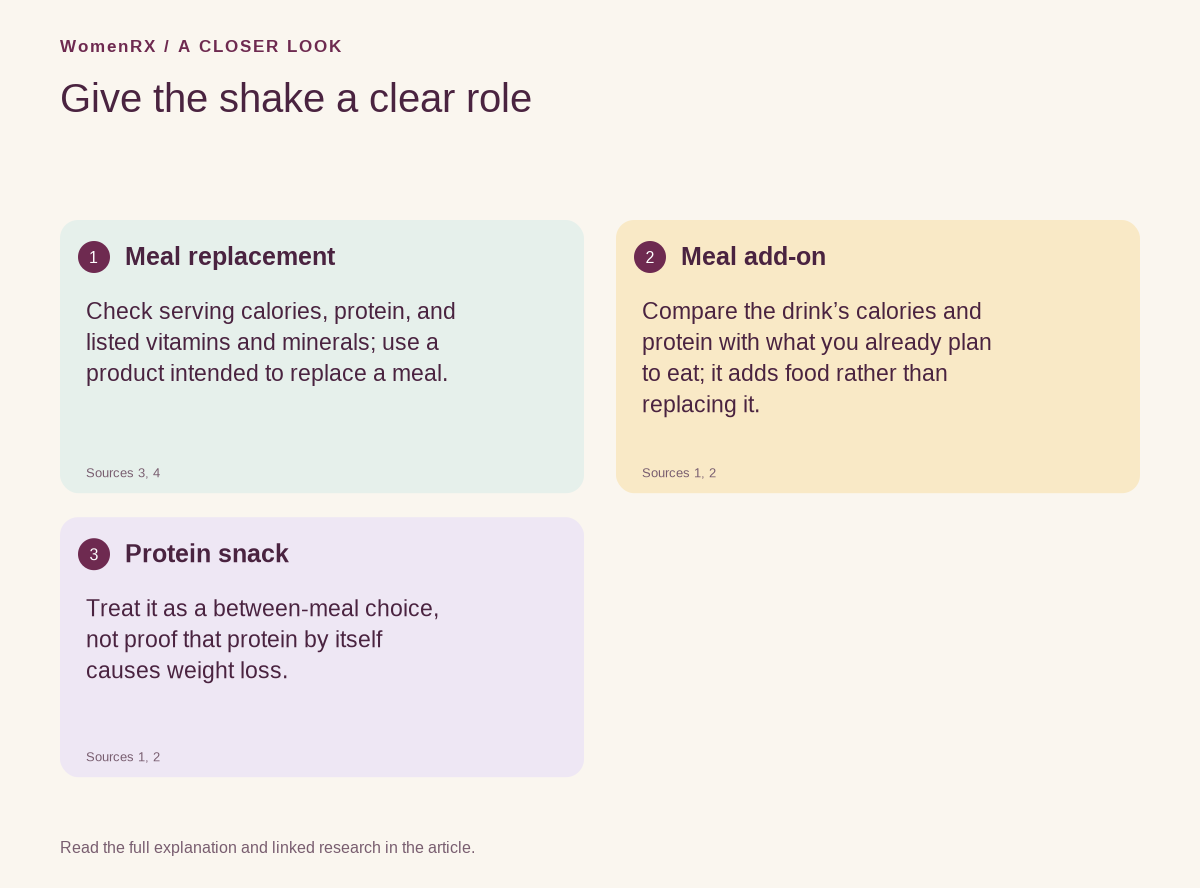
Give the shake a clear role
Meal replacement: Check serving calories, protein, and listed vitamins and minerals; use a product intended to replace a meal.34
Meal add-on: Compare the drink’s calories and protein with what you already plan to eat; it adds food rather than replacing it.12
Protein snack: Treat it as a between-meal choice, not proof that protein by itself causes weight loss.12
Read the figure as text
The same kind of drink can function differently depending on whether it replaces food, complements a meal, or serves as a snack.- Meal replacement: Check serving calories, protein, and listed vitamins and minerals; use a product intended to replace a meal.34
- Meal add-on: Compare the drink’s calories and protein with what you already plan to eat; it adds food rather than replacing it.12
- Protein snack: Treat it as a between-meal choice, not proof that protein by itself causes weight loss.12
More questions, answered
Does soy protein work better than casein for weight loss?
In a 16-week trial of women following the same structured, energy-restricted meal-replacement plan, weight loss did not differ significantly between the soy-shake and casein-shake groups. That trial doesn’t establish that either protein source is better for weight loss outside that plan. 4
Sources you can check
- Dietary Supplements for Weight Loss - Health Professional Fact SheetAccessed 2026-09-25Return to first citation
- Dietary Proteins: MedlinePlusAccessed 2026-09-25Return to first citation
- Protein-enriched intermittent meal replacement combined with moderate-intensity training for weight loss and body composition in overweight women.Liu Q, Guo Y, Peng B, Fan D, Wu J, Wang J, Wang R, Liu JM, Wu J, Wang S, Zhao Y. · Scientific reports · 2025Return to first citation
- Soy compared to casein meal replacement shakes with energy-restricted diets for obese women: randomized controlled trial.Anderson JW, Fuller J, Patterson K, Blair R, Tabor A. · Metabolism: clinical and experimental · 2007Return to first citation
- Short-term hunger intensity changes following ingestion of a meal replacement bar for weight control.Rothacker DQ, Watemberg S. · International journal of food sciences and nutrition · 2004Return to first citation