Whey or Plant Protein? Choose What Fits Your Needs
For muscle goals, soy and whey both have encouraging training evidence, but your diet, tolerance, and the specific product matter more than choosing a side.
You don’t have to choose whey or plant protein based on sex alone. In a 12-week resistance-training trial that included women, soy and whey supplements matched for leucine supported similar gains, though women’s results weren’t reported separately. Compare the specific product’s protein per serving, source, ingredients, allergen information, and cost, then choose what suits your diet and routine. 4
Choose for the job you need the powder to do
Protein powder can be a convenient way to add protein, but it isn’t required for building strength or a substitute for a varied diet. Protein needs depend on factors including age, sex, health, and physical activity; MedlinePlus notes that most Americans get enough protein from food. 1
If you’re considering a powder to support resistance training, the available comparison doesn’t show that whey is automatically better than plant protein. In a randomized 12-week study, 48 untrained adults completed a supervised resistance-training program; 31 were women and 17 were men. The soy and whey supplements were matched for leucine, and both groups gained lean body mass and strength, with no significant differences between groups. The study didn’t report women’s results separately, and it had no training-only or placebo group, so it can’t show that the supplements themselves caused the gains. 4
That finding applies to soy and whey under the study’s conditions. It doesn’t establish that every plant powder performs the same way, or that one source is best for every person.
Compare the actual serving, not the package promise
Protein per serving: Compare the grams of protein on the nutrition label for the serving you’d actually use. A larger scoop or container doesn’t necessarily mean you’re getting more protein per serving. The label can help compare products, but it doesn’t tell you how much protein you need overall.
Source and amino acids: Whey is an animal-derived protein; soy is plant-derived. Both are described as complete proteins in the soy-versus-whey research, but that doesn’t mean every plant protein has the same amino-acid profile. The study notes that soy has fewer essential amino acids per gram than whey. 4 If a product provides an amino-acid profile, you can compare it; if it doesn’t, don’t assume that a “plant protein” label tells you exactly what’s in the blend. MedlinePlus also recommends eating different plant protein sources to obtain the amino acids the body needs. 1
Allergens and tolerance: Check the ingredients and allergen information for the specific product, rather than relying on a broad label such as “plant-based.” A food allergy involves an immune response and can be serious; food intolerance is different and can cause symptoms such as digestive discomfort. 23 If you know you need to avoid an ingredient, confirm that the product doesn’t contain it.
Added ingredients: Read the full ingredient list for flavorings, sweeteners, or other ingredients you prefer to avoid. Two powders made from the same protein source can still have different ingredients. That’s a matter of fit and preference, not proof that one formula builds more muscle.
Cost and testing: Compare the price for the serving you’d use, rather than the container price alone. If independent testing matters to you, look for clear product-specific information about who tested the powder and what the testing covered. Don’t treat testing as evidence that one protein source is better for muscle goals.
What the muscle studies do, and don’t, tell you
The soy-and-whey trial is useful because it included women, but its results were reported for the whole group. It can’t tell us whether women responded differently from men. It also tested soy, not pea, wheat, or every plant blend. 4
A separate 12-week trial compared a soy-and-pea blend with whey during supervised resistance training in 44 young men. Both groups improved in measures including lean mass and strength, with no significant between-group differences. Because the participants were men, the trial doesn’t provide a women-specific result. 5
In later life, one short study offers a different kind of comparison. Twenty-seven adults ages 50 to 70 followed a diet focused on whey-supplemented animal protein or pea-supplemented plant protein, with resistance training, for 10 days. Muscle protein synthesis was higher in the trained leg than the untrained leg in both groups, with no difference between the diets. That short-term finding isn’t the same as evidence about long-term muscle or strength changes. 7
A single-meal study also shows why the exact protein and preparation matter: in healthy older men, 35 grams of wheat protein hydrolysate produced a lower muscle protein synthesis response than 35 grams of casein. A larger serving of wheat protein hydrolysate increased synthesis above baseline. This measured a short-term response after a meal, not long-term results in women. 6
Together, these studies support a practical conclusion: protein source matters less as a simple “animal versus plant” label than the specific protein, serving, and situation being studied. They don’t establish one universally best powder.
A decision that fits your life stage
If you eat dairy and tolerate it, whey may be one option. If you prefer plant-based foods, soy has direct comparison evidence with whey during resistance training, though the women in that trial weren’t analyzed separately. For other plant proteins, use the product label to compare what’s in the serving rather than assuming the soy result applies to every powder. 4
These studies don’t establish a preferred protein powder or protein target during pregnancy or lactation. If you’re choosing a supplement during either stage, this muscle-training evidence doesn’t answer that specific question.
If food already meets your needs, you may not need powder at all. If you do choose one, start with the amount of protein per serving, the source and ingredients, your tolerance, and the price you’ll actually pay. The best fit is the one that works for your diet and routine, not the one with the broadest claim on the front of the container.
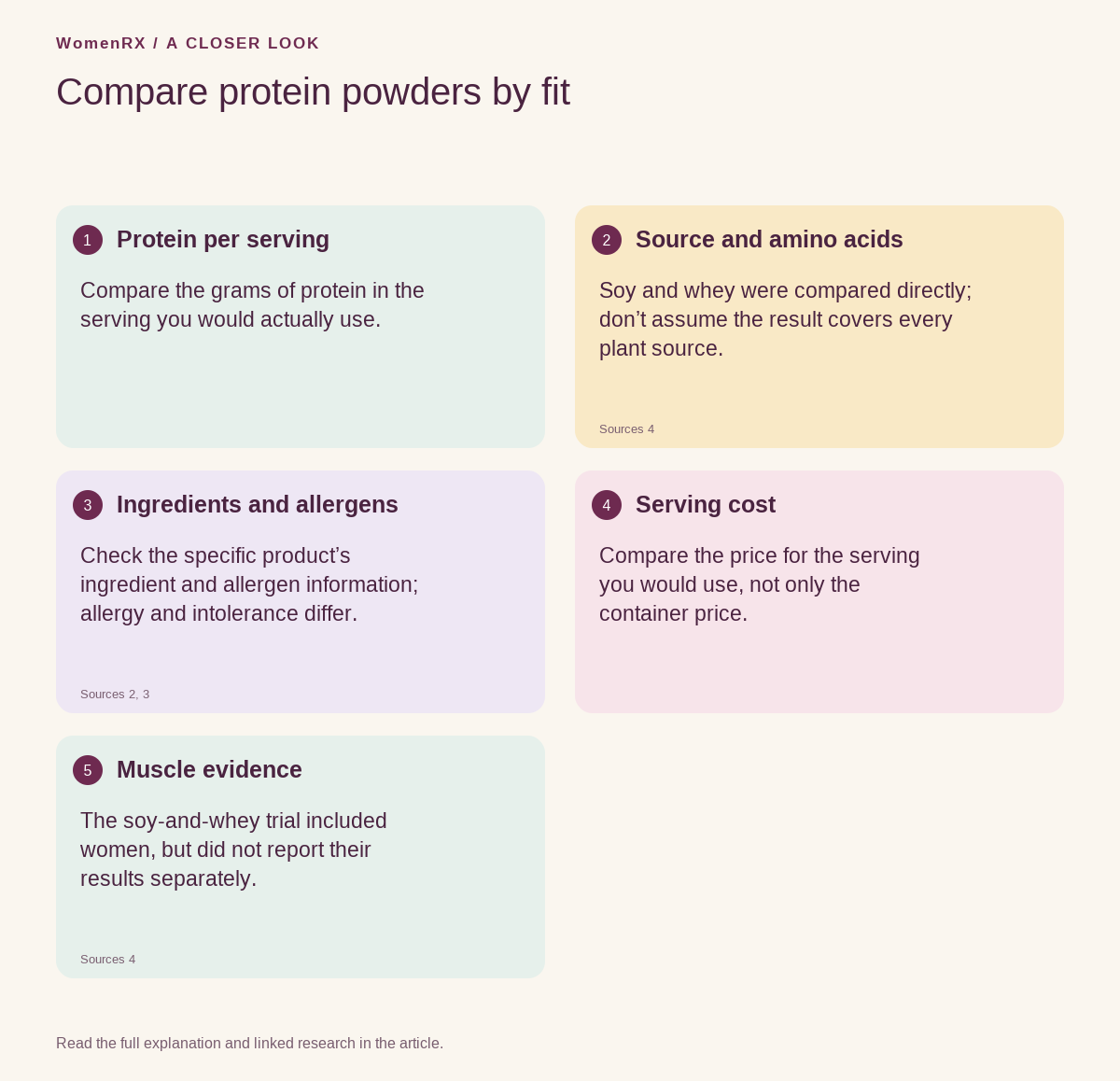
Compare protein powders by fit
Protein per serving: Compare the grams of protein in the serving you would actually use.
Source and amino acids: Soy and whey were compared directly; don’t assume the result covers every plant source.4
Ingredients and allergens: Check the specific product’s ingredient and allergen information; allergy and intolerance differ.23
Serving cost: Compare the price for the serving you would use, not only the container price.
Muscle evidence: The soy-and-whey trial included women, but did not report their results separately.4
Read the figure as text
Use the label to compare products, then keep the muscle research in its proper scope.- Protein per serving: Compare the grams of protein in the serving you would actually use.
- Source and amino acids: Soy and whey were compared directly; don’t assume the result covers every plant source.4
- Ingredients and allergens: Check the specific product’s ingredient and allergen information; allergy and intolerance differ.23
- Serving cost: Compare the price for the serving you would use, not only the container price.
- Muscle evidence: The soy-and-whey trial included women, but did not report their results separately.4
More questions, answered
Does the muscle research apply specifically to women?
One 12-week randomized trial included 31 women among 48 participants who completed the study, but it reported results for the full group rather than women separately. It offers a soy-versus-whey comparison that included women, not a women-only conclusion. 4
Does the soy-and-whey result apply to every plant protein?
No. That trial tested soy, while another 12-week trial tested a soy-and-pea blend against whey in young men. Results from either study shouldn’t be treated as proof that every plant protein or blend performs identically. 45
Sources you can check
- Dietary Proteins: MedlinePlusAccessed 2026-09-25Return to first citation
- Food intolerance - NHSAccessed 2026-09-25Return to first citation
- Food allergy - NHSAccessed 2026-09-25Return to first citation
- No Significant Differences in Muscle Growth and Strength Development When Consuming Soy and Whey Protein Supplements Matched for Leucine Following a 12 Week Resistance Training Program in Men and Women: A Randomized Trial.Lynch HM, Buman MP, Dickinson JM, Ransdell LB, Johnston CS, Wharton CM. · International journal of environmental research and public health · 2020Return to first citation
- Similar effects between animal-based and plant-based protein blend as complementary dietary protein on muscle adaptations to resistance training: findings from a randomized clinical trial.Santini MH, Erwig Leitão A, Mazzolani BC, Smaira FI, de Souza MSC, Santamaria A, Gualano B, Roschel H. · Journal of the International Society of Sports Nutrition · 2025Return to first citation
- Ingestion of Wheat Protein Increases In Vivo Muscle Protein Synthesis Rates in Healthy Older Men in a Randomized Trial.Gorissen SH, Horstman AM, Franssen R, Crombag JJ, Langer H, Bierau J, Respondek F, van Loon LJ. · The Journal of nutrition · 2016Return to first citation
- Resistance training increases myofibrillar protein synthesis in middle-to-older aged adults consuming a typical diet with no influence of protein source: a randomized controlled trial.Korzepa M, Quinlan JI, Marshall RN, Rogers LM, Belfield AE, Elhassan YS, Lawson A, Ayre C, Senden JM, Goessens JP, Glover EI, Wallis GA, van Loon LJ, Breen L. · The American journal of clinical nutrition · 2025Return to first citation