Protein Timing After 40: What Matters Most?
A trial in older women found no clear advantage to taking whey immediately after strength training instead of immediately before it.
For muscle, think about the whole day before fine-tuning the workout clock. A broad review suggests total protein and how it’s spread across meals may matter; a trial in older women found no detected advantage to whey immediately before versus after training. That trial didn’t compare daily totals or meal patterns, and it doesn’t establish a special schedule for women over 40. 2 3
What the before-or-after study found
In a randomized trial, 70 pre-conditioned older women followed a resistance-training program three times a week for 12 weeks. One group received whey protein immediately before training, another received it immediately afterward, and a third received placebo at both times. Both whey groups had greater improvements than the placebo group in measured muscle mass, strength, and walking performance. The researchers found no difference between the before- and after-training whey groups. 2
That answers a fairly narrow question: in this program, did putting the whey on one side of the workout work better than putting it on the other? No advantage was detected. It doesn’t prove the timings are exactly equivalent, and it doesn’t show that everyone who trains needs a shake. 2
Daily amount, meal pattern, and workout timing
These are related, but they aren’t interchangeable questions. Your body needs protein from food every day to build and maintain tissues. How much you need depends in part on your age, health, and activity. Protein-containing foods include dairy, meat, beans, nuts, and some grains. 1
A 2025 review summarizes resistance-training research as suggesting that the muscle-protein-synthesis response has diminishing returns around 1.6 grams of protein per kilogram of body weight per day. That’s a broad research estimate, not a target established for women over 40, and a short-term muscle-protein response isn’t the same as a guaranteed strength or muscle gain. 3
The same review discusses spreading protein more evenly across meals as a way to support the muscle-building response. That’s a plausible planning consideration, not proof that a particular breakfast-lunch-dinner pattern produces better long-term results for women. The older-women trial compared whey timing around a workout; it didn’t test different daily protein totals or meal distributions. 2 3
So, a useful order is to make resistance training workable, consider whether your overall daily protein intake is sufficient for your circumstances, and then think about distribution and workout timing. That’s a practical way to organize the questions, not a head-to-head ranking proven by one trial. Resistance training is a central strategy for supporting muscle with age, and protein may contribute to its effects. 3 4
For example, if you usually eat little protein until dinner, including a protein-containing food at breakfast or lunch may make regular intake easier. You don’t need to treat equal portions at every meal as a proven requirement. 1 2 3
Fit the workout into the day you actually have
If you train shortly before lunch, lunch can be a convenient time for a protein-containing meal. If eating beforehand fits better, the trial offers no reason to regard that choice as a mistake. Its finding is about whey taken immediately before versus immediately after training, not a rule for how close every meal must be to exercise. 2
A shake may be convenient, but it’s not the only way to get dietary protein. The trial tested whey against placebo; it did not compare whey with a protein-containing meal or establish that a supplement is necessary when you already eat enough protein. 1 2
Does turning 40 change the timing rule?
There’s no special timing rule established by this trial for your 40s or 50s. Its participants were described as older women, and the results were not reported separately for women in midlife or by menopausal status. The study is useful evidence against assuming that immediately after is better than immediately before for the women studied. It cannot identify an ideal schedule for every woman over 40. 2
If you’re deciding where to put your effort, start with the eating and training habits you can sustain. Let the clock serve those habits, rather than the other way around. 1 2 4
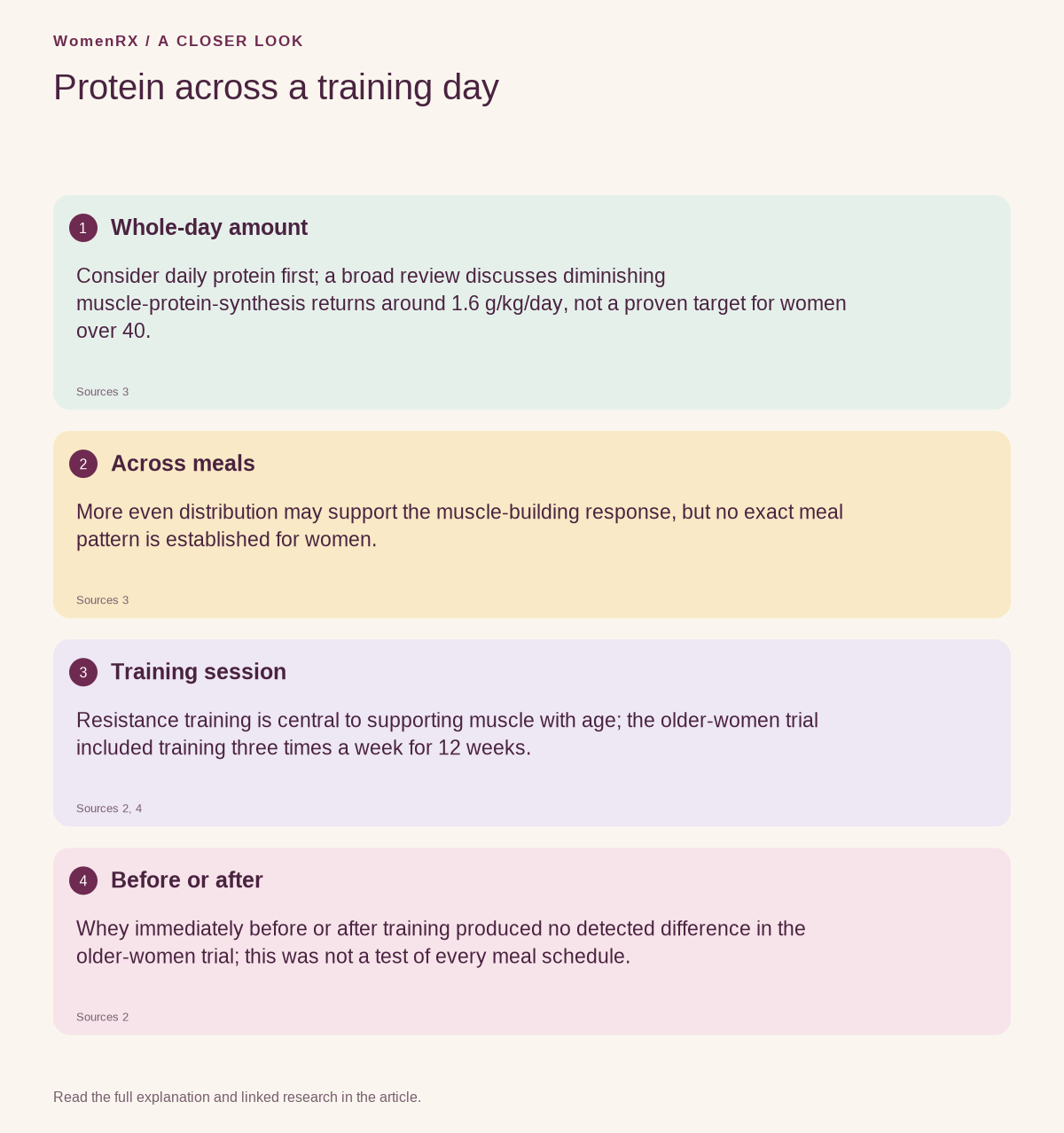
Protein across a training day
Whole-day amount: Consider daily protein first; a broad review discusses diminishing muscle-protein-synthesis returns around 1.6 g/kg/day, not a proven target for women over 40.3
Across meals: More even distribution may support the muscle-building response, but no exact meal pattern is established for women.3
Training session: Resistance training is central to supporting muscle with age; the older-women trial included training three times a week for 12 weeks.24
Before or after: Whey immediately before or after training produced no detected difference in the older-women trial; this was not a test of every meal schedule.2
Read the figure as text
A simple day-level view separates the overall protein question from meal distribution and the narrower before-or-after workout comparison.- Whole-day amount: Consider daily protein first; a broad review discusses diminishing muscle-protein-synthesis returns around 1.6 g/kg/day, not a proven target for women over 40.3
- Across meals: More even distribution may support the muscle-building response, but no exact meal pattern is established for women.3
- Training session: Resistance training is central to supporting muscle with age; the older-women trial included training three times a week for 12 weeks.24
- Before or after: Whey immediately before or after training produced no detected difference in the older-women trial; this was not a test of every meal schedule.2
More questions, answered
Is an even amount of protein at every meal necessary?
No exact per-meal pattern was established in the trial of older women. A review suggests possible benefits from more even distribution in older adults, but it doesn’t establish a required meal schedule or demonstrate greater long-term strength gains specifically in women. 2 3
Sources you can check
- Dietary Proteins: MedlinePlusAccessed 2026-09-25Return to first citation
- Effects of Whey Protein Supplementation Pre- or Post-Resistance Training on Muscle Mass, Muscular Strength, and Functional Capacity in Pre-Conditioned Older Women: A Randomized Clinical Trial.Nabuco HCG, Tomeleri CM, Sugihara Junior P, Fernandes RR, Cavalcante EF, Antunes M, Ribeiro AS, Teixeira DC, Silva AM, Sardinha LB, Cyrino ES. · Nutrients · 2018Return to first citation
- The Role of Mammalian Target of Rapamycin (mTOR) and Adenosine Monophosphate-Activated Protein Kinase (AMPK) Signaling in Skeletal Muscle Hypertrophy: A Literature Review With Implications for Health and Disease.Jeong SY. · Cureus · 2025Return to first citation
- Nutritional Supplements to Support Resistance Exercise in Countering the Sarcopenia of Aging.McKendry J, Currier BS, Lim C, Mcleod JC, Thomas ACQ, Phillips SM. · Nutrients · 2020Return to first citation