Marine or Other Collagen Peptides: What Matters Most
Marine tells you where collagen comes from, not whether it will work better for your goal.
Marine collagen describes a source, often fish. The human studies cited here don’t show that fish-derived collagen works better than collagen from another source for skin, hair, or bone. Start with the outcome you care about, then check whether a study tested collagen alone or as part of a blend. If you have a fish allergy, the product’s exact source matters. 1 2 3
A source label isn’t a result
A product labeled marine collagen tells you something about its origin. In one hair-loss trial, the collagen was explicitly fish-derived; a review of bone and muscle research also listed products made from other sources, including chicken. Neither finding means one source is absorbed better or produces a better result. To establish that, a trial would need to compare sources for the same outcome under comparable conditions. These studies didn’t do that. 2 3
So if you’re choosing between a marine product and another collagen peptide product, ask a more useful question first: What are you hoping it will do? Evidence about hair, bone density, and skin appearance isn’t interchangeable.
For hair, the other ingredients complicate the answer
A 12-week randomized trial enrolled 83 people with diagnosed hair-loss conditions, including 57 women. One group received condition-specific drug treatment plus a supplement containing fish-derived hydrolyzed collagen, amino acids, iron, and selenium. The comparison group received drug treatment alone. Hair-assessment scores were better in the supplement group, but the trial couldn’t tell which ingredient contributed to the difference. It also didn’t compare fish collagen with collagen from another source or report a separate result for the women. 3
A separate study followed women with self-reported hair thinning who received personalized combinations of products, which could include marine collagen peptides. Because the combinations varied and the study didn’t isolate collagen’s effect, improvements in that group can’t establish what marine collagen did. 4
That’s a meaningful distinction if a label uses a hair study to promote collagen alone. A result for a blend added to hair-loss treatment is evidence about that combination, not a reason to rank marine collagen above another source.
For bone, life stage matters more than the marine label
A 2025 meta-analysis of collagen-peptide research included several trials involving postmenopausal women, some with osteopenia or low bone mineral density. It reported improvements in bone mineral density at the spine and femoral neck, but bone-density results varied substantially across trials. The included interventions differed too: some tested collagen-related products alongside calcium and vitamin D, and not every study measured bone density. The analysis doesn’t establish that marine collagen is preferable for postmenopausal women, or that a change in bone density means fewer fractures. 2
This evidence is more relevant to a postmenopausal woman asking about bone measurements than to someone choosing a collagen powder for her skin. It still isn’t a marine-versus-other-source comparison.
For skin, don’t borrow an answer from a hair or bone study
If smoother-looking or more hydrated skin is your goal, the hair-loss trial and bone meta-analysis don’t answer whether an oral marine product helps, let alone whether it outperforms another collagen source. A skin claim needs human evidence measuring the skin outcome promised for a comparable product. Results from a hair blend or a bone-density trial can’t fill that gap. 2 3
Make the label do some work
Compare the full ingredient lists, not just the large-print word marine. Check which animal source the product names, whether it contains other active ingredients, and whether the evidence behind its claim studied a similar formula for your intended outcome. A single-ingredient collagen product and a collagen-plus-micronutrient blend aren’t the same intervention. 2 3
If you have a fish allergy, pay particular attention to whether the collagen is fish-derived. Allergy guidance recommends avoiding known allergens where possible; the fish-origin supplement in the hair trial excluded people allergic to its ingredients. If a product’s source or allergen information is unclear, resolve that question before using it rather than assuming that hydrolyzed means suitable for you. 1 3
The practical takeaway: choose by your goal and the actual formula, with allergies as a first filter. The source name alone isn’t evidence of a better outcome.
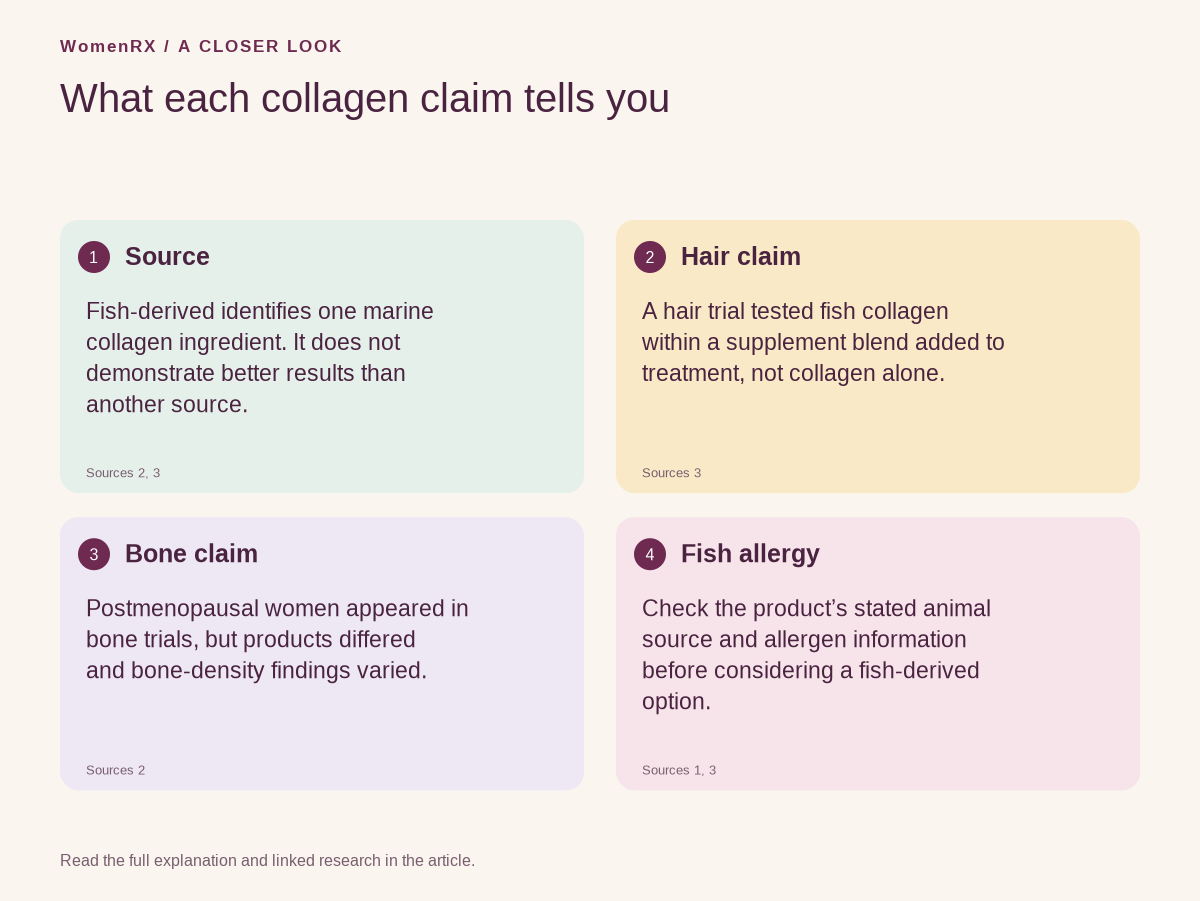
What each collagen claim tells you
Source: Fish-derived identifies one marine collagen ingredient. It does not demonstrate better results than another source.23
Hair claim: A hair trial tested fish collagen within a supplement blend added to treatment, not collagen alone.3
Bone claim: Postmenopausal women appeared in bone trials, but products differed and bone-density findings varied.2
Fish allergy: Check the product’s stated animal source and allergen information before considering a fish-derived option.13
Read the figure as text
Source, studied outcome, formula, and allergy information answer different buying questions.- Source: Fish-derived identifies one marine collagen ingredient. It does not demonstrate better results than another source.23
- Hair claim: A hair trial tested fish collagen within a supplement blend added to treatment, not collagen alone.3
- Bone claim: Postmenopausal women appeared in bone trials, but products differed and bone-density findings varied.2
- Fish allergy: Check the product’s stated animal source and allergen information before considering a fish-derived option.13
Sources you can check
- Allergies - NHSAccessed 2026-09-25Return to first citation
- Efficacy of collagen peptide supplementation on bone and muscle health: a meta-analysis.Sun C, Yang A, Teng F, Xia Y. · Frontiers in nutrition · 2025Return to first citation
- Efficacy and tolerability of an oral supplement containing amino acids, iron, selenium, and marine hydrolyzed collagen in subjects with hair loss (androgenetic alopecia, AGA or FAGA or telogen effluvium). A prospective, randomized, 3-month, controlled, assessor-blinded study.Milani M, Colombo F, GFM‐O‐Trial Investigators Group. · Skin research and technology : official journal of International Society for Bioengineering and the Skin (ISBS) [and] International Society for Digital Imaging of Skin (ISDIS) [and] International Society for Skin Imaging (ISSI) · 2023Return to first citation
- Artificial Intelligence-Based Personalization of Treatment Regimen for Hair Loss: A 6-Month Clinical Trial.Bhardwaj V, Rodgers N, Harth O, Harth Y. · Journal of drugs in dermatology : JDD · 2025Return to first citation