Fibroids, Fertility, and Pregnancy: What Matters Most
A fibroid’s relationship to the uterine cavity may matter more for fertility than simply having a fibroid.
Fibroids don’t automatically prevent pregnancy. The location and whether a fibroid changes the shape of the uterine cavity are useful details to discuss, especially because fibroids that affect the cavity have the clearest link with difficulty conceiving. Evidence about removing fibroids is mixed, so surgery is a personal decision based on the fibroid, symptoms, and reproductive plans, not a guarantee of pregnancy. 1 5
A fibroid finding isn’t the whole fertility story
Many people with fibroids become pregnant without problems, and some fibroids cause no symptoms at all. When fertility is a concern, the finding that a fibroid exists is only a starting point. Its location and whether it distorts the uterine cavity are more useful questions than presence alone. 1 5
An ultrasound can show how many fibroids there are, where they are, and their size. For a fertility discussion, it can also help to ask whether a fibroid changes the shape of the uterine cavity, where an embryo implants. Size still contributes to the overall picture, but it isn’t a stand-alone rule for whether treatment is needed. 2 5
Location helps frame what is known
The evidence is clearest for fibroids described as submucosal: reviews report an association with lower chances of pregnancy. Fibroids described as intramural have also been associated with lower pregnancy and live-birth rates, but the evidence about whether removing them improves fertility is uncertain. Subserosal fibroids appear to have little effect on fertility in the review, particularly when smaller. These are patterns, not a way to predict an individual outcome. 5
Cavity distortion is worth asking about directly. The review describes ways fibroids that affect the cavity may interfere with the conditions needed for embryo implantation. That helps explain why two people with fibroids, or even two people with similarly sized fibroids, may have different discussions about fertility treatment. 5
Conception and pregnancy outcomes are different questions
A fibroid’s possible effect on getting pregnant is not the same as its possible effect after pregnancy begins. A review reports associations between fibroids in pregnancy and outcomes including pregnancy loss, preterm birth, placental problems, breech presentation, preeclampsia, cesarean delivery, and postpartum hemorrhage. These are associations across groups, not a forecast for one pregnancy; the cited material doesn’t give absolute risks for an individual. 5
So if you’re planning a pregnancy, it can help to discuss both questions: might this fibroid affect conception, and could its location or your treatment history matter during pregnancy? Many people with fibroids do have pregnancies without problems, and a fibroid alone doesn’t establish what will happen. 1 5
Removal is a choice, not a promise
For a cavity-affecting fibroid, a clinician may discuss myomectomy, an operation to remove fibroids while keeping the uterus. Earlier evidence summarized in a review suggests fertility may improve after removal of submucosal fibroids. But the evidence isn’t equally clear for every location, and the benefit of removing intramural fibroids for fertility remains uncertain. 5
A randomized trial illustrates why certainty is limited. It compared hysteroscopic removal with no removal for small submucosal fibroids and uterine polyps in people with infertility or recurrent miscarriage. Recruitment stopped at 35 participants, far short of the planned 1,120. Within 15 months, live birth occurred in 3 of 19 participants assigned to removal and 3 of 16 assigned to no removal. The trial was too small to establish whether removal helps or doesn’t help. 4
Surgery also needs to fit your situation, including symptoms, fibroid location and number, and whether you want to become pregnant. Removing a fibroid cannot promise conception or a live birth, and a decision to wait may also be reasonable. The useful conversation is about what problem surgery is intended to address and what uncertainty remains. 1 2 4 5
Make the scan report more useful
If you have an imaging report, bring the exact wording and ask: What type or location does it describe? Does the fibroid distort the uterine cavity? How does that finding relate to my fertility goals? If removal is being considered, ask what benefit is expected in your specific case and what is not known. 2 5
Fibroids are one possible contributor to fertility difficulties, not the only one. Fertility evaluation may consider factors in either partner, and the timing of an evaluation also depends on age and how long you’ve been trying. 3
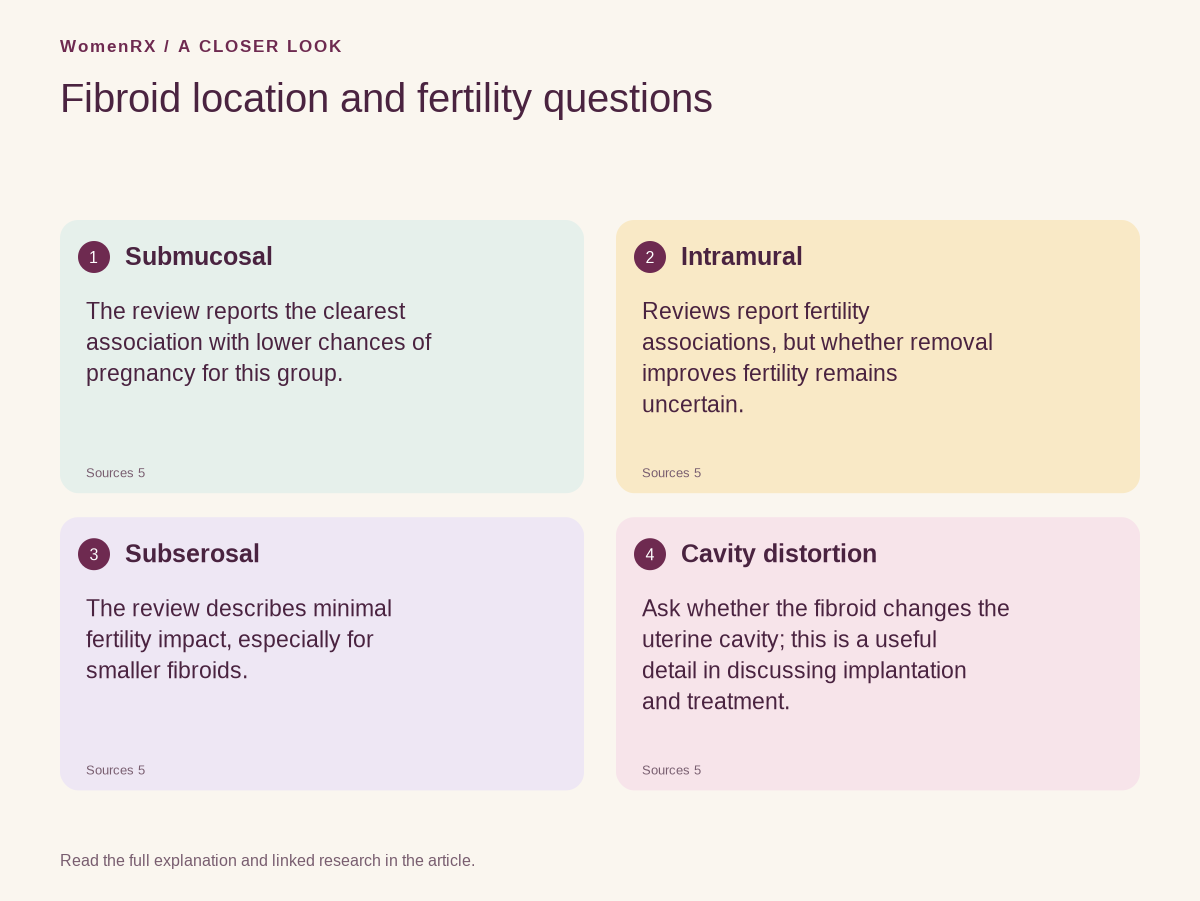
Fibroid location and fertility questions
Submucosal: The review reports the clearest association with lower chances of pregnancy for this group.5
Intramural: Reviews report fertility associations, but whether removal improves fertility remains uncertain.5
Subserosal: The review describes minimal fertility impact, especially for smaller fibroids.5
Cavity distortion: Ask whether the fibroid changes the uterine cavity; this is a useful detail in discussing implantation and treatment.5
Read the figure as text
Location patterns can help focus a fertility conversation, but they don’t determine an individual outcome or make size a stand-alone rule.- Submucosal: The review reports the clearest association with lower chances of pregnancy for this group.5
- Intramural: Reviews report fertility associations, but whether removal improves fertility remains uncertain.5
- Subserosal: The review describes minimal fertility impact, especially for smaller fibroids.5
- Cavity distortion: Ask whether the fibroid changes the uterine cavity; this is a useful detail in discussing implantation and treatment.5
More questions, answered
Does having fibroids mean I’ll need a C-section?
No. A fibroid diagnosis alone doesn’t determine delivery mode. A review notes a different consideration after myomectomy: if the uterine cavity was opened during the operation, that surgical detail may affect delivery planning. Ask for the operative report or your surgeon’s guidance if you’ve had fibroid surgery. 5
Does removing a fibroid guarantee I’ll get pregnant?
No. Removal may be discussed when a fibroid affects the uterine cavity, but the evidence varies by fibroid location and the available randomized trial was too small to settle whether removal improves live birth. Surgery can’t guarantee pregnancy. 4 5
Sources you can check
- Uterine Fibroids | Fibroids | MedlinePlusAccessed 2026-09-25Return to first citation
- Fibroids - NHSAccessed 2026-09-25Return to first citation
- Infertility | Infertility Treatments | MedlinePlusAccessed 2026-09-25Return to first citation
- Removal of small fibroids and polyps in patients with infertility and recurrent miscarriage: The HELP Fertility? RCT.Metwally M, McKendrick K, Ridsdale K, Pye C, Walters S, Amer S, Barr A, Chatters R, Cheong Y, Choudhary M, Connor M, Desoysa L, El-Toukhy T, Keetharuth A, Latimer N, Loban A, Mohiy... · Health technology assessment (Winchester, England) · 2026Return to first citation
- Fibroids and infertility.Mocanu E, Tarlatzis B, Feldberg D, Diaz I, O'Brien C, Purandare N. · International journal of gynaecology and obstetrics: the official organ of the International Federation of Gynaecology and Obstetrics · 2026Return to first citation