Adenomyosis, Fertility, and Pregnancy: What to Know
Adenomyosis may make conception harder or raise some pregnancy risks, but it doesn’t make pregnancy impossible, and a diagnosis alone can’t predict your individual chances.
Pregnancy is possible with adenomyosis, but reports from selected groups can’t establish how often people with the condition conceive overall. Research links adenomyosis with fertility challenges and some complications after conception, yet disease features, coexisting endometriosis, fertility history, and treatment choices all matter. Surgery hasn’t been shown to improve fertility for everyone, so decisions need to fit your specific situation. 3 6 7
Adenomyosis means tissue similar to the uterine lining is growing within the muscle wall of the uterus. It can cause painful or heavy periods, but some people have no symptoms. Pregnancy has occurred in reported cohorts of people with adenomyosis, but those selected groups don’t establish how often people with the condition conceive overall. Fertility and pregnancy questions may deserve a closer look, especially if you’re also dealing with infertility or pregnancy loss. 1 3 4 6
Conception and pregnancy outcomes are different questions
Adenomyosis has been associated with infertility and with lower success in some fertility-treatment settings. Researchers propose that changes in uterine contractions, inflammation, or the lining’s ability to support implantation could play a role. These are possible explanations, not proof that adenomyosis is the sole cause of difficulty conceiving. 5 7
A pregnancy can also happen and then face different challenges. Reviews have reported associations with miscarriage and some complications later in pregnancy, including preterm birth and placental problems. Those associations don’t establish what will happen in an individual pregnancy, and the evidence doesn’t provide a dependable personal risk estimate based on the diagnosis alone. 4 7
Keeping the two questions separate helps: difficulty conceiving doesn’t tell you exactly how a pregnancy would go, and a reported pregnancy risk doesn’t mean conception is impossible.
Why the diagnosis doesn’t tell the whole story
Adenomyosis isn’t one uniform pattern. Studies have classified it by factors such as where it is in the uterine muscle and how extensive it is. A review of nine studies found possible differences between subtypes, but the studies were mostly observational, definitions varied, and the authors said the available fertility-treatment evidence was too limited for firm conclusions. Coexisting endometriosis may also influence results, particularly in some disease patterns. 3
Your own history matters, too. A clinician interpreting a scan or discussing fertility can consider the adenomyosis findings alongside whether endometriosis is also suspected, how long you’ve been trying to conceive, prior fertility treatment, and any history of pregnancy loss. These details help put group-level research in context; they don’t turn it into a precise prediction.
Treatment is a tradeoff, not a guaranteed fertility fix
Adenomyosis treatments aren’t interchangeable. Some are aimed at easing symptoms; fertility goals can change which approaches are suitable. Surgery to remove adenomyosis may be considered in selected cases, but the evidence that it improves fertility is uncertain, and surgery can matter for a later pregnancy. In a small, single-center study of 21 people, most of those having surgery had diffuse disease, while those not having surgery had focal disease. The groups therefore weren’t a like-for-like comparison. The study also reported placenta accreta in one postsurgical pregnancy. These findings raise questions to discuss, but they can’t establish a general benefit or quantify a usual surgical risk. 6
The useful question isn’t simply “Should I treat the adenomyosis?” It’s “What problem is treatment meant to address in my case, what might it mean for trying to conceive, and what are the tradeoffs if I become pregnant afterward?” A fertility specialist and a gynecologist familiar with adenomyosis can help weigh those questions together.
Questions that can make the next conversation useful
You might ask:
- What did the imaging show about the location and extent of the adenomyosis, and how certain is the diagnosis?
- Is there reason to consider endometriosis or another factor that could also affect fertility?
- Given my fertility history, what are the reasonable options before considering surgery?
- If surgery is being proposed, what evidence supports it for my situation, and what pregnancy-related concerns should I understand afterward?
- If I become pregnant, does my history change how my pregnancy should be followed?
If you’re already pregnant, tell your pregnancy-care team about a known or suspected adenomyosis diagnosis. Pregnancy-related changes can make its usual imaging features harder to distinguish, so interpreting a scan may require care. 4
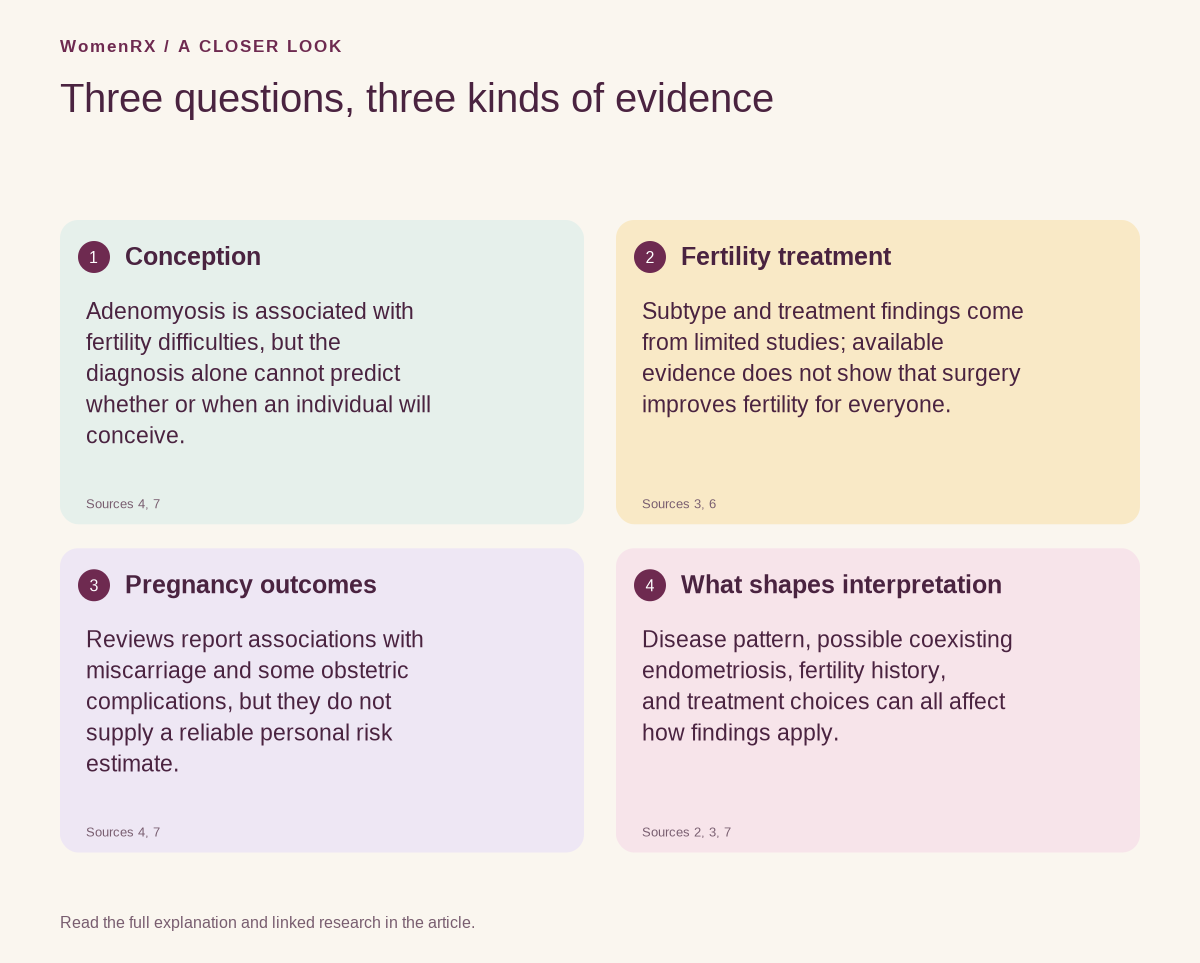
Three questions, three kinds of evidence
Conception: Adenomyosis is associated with fertility difficulties, but the diagnosis alone cannot predict whether or when an individual will conceive.47
Fertility treatment: Subtype and treatment findings come from limited studies; available evidence does not show that surgery improves fertility for everyone.36
Pregnancy outcomes: Reviews report associations with miscarriage and some obstetric complications, but they do not supply a reliable personal risk estimate.47
What shapes interpretation: Disease pattern, possible coexisting endometriosis, fertility history, and treatment choices can all affect how findings apply.237
Read the figure as text
A diagnosis can raise separate questions about conception, fertility treatment, and pregnancy. Evidence for one doesn’t automatically answer the others.- Conception: Adenomyosis is associated with fertility difficulties, but the diagnosis alone cannot predict whether or when an individual will conceive.47
- Fertility treatment: Subtype and treatment findings come from limited studies; available evidence does not show that surgery improves fertility for everyone.36
- Pregnancy outcomes: Reviews report associations with miscarriage and some obstetric complications, but they do not supply a reliable personal risk estimate.47
- What shapes interpretation: Disease pattern, possible coexisting endometriosis, fertility history, and treatment choices can all affect how findings apply.237
More questions, answered
Does adenomyosis mean I need fertility treatment?
No. A diagnosis by itself doesn’t determine whether you need treatment. The decision depends on your fertility history, disease features, and any other factors identified during evaluation. Research on assisted reproduction and adenomyosis subtypes remains limited. 3
Can surgery for adenomyosis improve fertility?
It may be considered for selected people, but current evidence doesn’t establish that it improves fertility for everyone. Studies are small and difficult to compare, and surgery can have implications for a later pregnancy. Ask what benefit is expected in your specific case and what the tradeoffs are. 5 6
Sources you can check
- Adenomyosis - NHSAccessed 2026-09-25Return to first citation
- Comorbidity of endometriosis and adenomyosis: A systematic review examining the impact of co-morbid disease on fertility and pregnancy outcomes.Koroneos Z, Cao M, Mooney S, Tyson K, Holdsworth-Carson S. · European journal of obstetrics, gynecology, and reproductive biology · 2026Return to first citation
- The impact of adenomyosis localization in myometrium on fertility and pregnancy outcomes: a narrative systematic review of the literature.Kolovos G, Kalampokas T, Dedes I, Vlahos N, Mueller M. · Frontiers in reproductive health · 2026Return to first citation
- Ultrasound signs of adenomyosis in pregnancy and counselling related to infertility and obstetric outcomes.Bertucci E, Ceffa S, Danieli A, Diamanti M, Sileo FG, Tramontano AL, Alboni C, La Marca A. · Minerva obstetrics and gynecology · 2026Return to first citation
- Clinical Profile and Management Outcomes of Women with Adenomyosis: A Prospective Review from a Fertility Centre in Nigeria.Elachi FA, Ayuba CF, Egwuda K, Ifezoke TD, Ekele IO, Dunah AA, Dawuud RM, Azaki D, Gazali S, Mukaddas H, Evule CL. · Nigerian medical journal : journal of the Nigeria Medical Association · 2026Return to first citation
- Pregnancy Outcomes With and Without Adenomyomectomy in Infertile Patients With Adenomyosis: A Single-Center Retrospective Study.Hamaguchi F, Kitawaki Y, Ohara T, Miyamoto T, Okunomiya A, Sunada M, Okada Y, Mandai M, Horie A. · The journal of obstetrics and gynaecology research · 2025Return to first citation
- Adenomyosis, Infertility and Maternal-Fetal Outcomes: Diagnostic and Therapeutic Strategies Across Disease Phenotype-A Narrative Review.Martire FG, Costantini E, Ianes I, d'Abate C, Sorrenti G, De Bonis M, Lazzeri L, Zupi E. · Journal of clinical medicine · 2026Return to first citation