IBS and Pregnancy: What to Know Before You Conceive
Studies of pregnancy outcomes can’t tell you whether IBS affects your chance of conceiving, and they don’t predict how your bowel symptoms will change.
Studies of deliveries and delivery-related hospitalizations look at people who were already pregnant, so they can’t answer whether IBS affects the chance of conceiving. They report some associations with pregnancy outcomes, but they don’t show that IBS caused them. They also don’t establish whether pregnancy tends to improve or worsen IBS symptoms. A useful next step is a medicine-by-medicine review before or early in pregnancy. 2 3

Fertility and pregnancy outcomes are different questions
If you have IBS and are trying to conceive, it helps to separate two questions: whether IBS affects the chance of getting pregnant, and what may happen during a pregnancy. Two large US hospital-database studies address the second question. One examined more than 9 million deliveries, and another looked at delivery-related hospitalizations. Because both studies examined delivery-related records, they can’t tell us whether people with IBS take longer to conceive or are more likely to experience infertility. 2 3
That’s a limit of these studies, not proof that IBS has no effect on fertility. That leaves the fertility question open. If conception is taking longer than you expected, don’t assume IBS explains it; these pregnancy-outcome studies can’t identify the reason.
What pregnancy-outcome studies have found
In a US database study of deliveries from 2004 to 2014, 8,962 of about 9.1 million deliveries were recorded as involving IBS. After statistical adjustment, the researchers reported associations between IBS and several outcomes, including preeclampsia and gestational diabetes. Congenital anomalies were recorded in 1.7% of the IBS group and 0.4% of the comparison group; the adjusted odds ratio was 2.57. These are findings from one retrospective hospital-database study, not evidence that IBS caused an outcome or an individual prediction for your pregnancy. 2
A separate US analysis of delivery-related hospitalizations from 2020 to 2022 found associations with placental complications and postpartum infection. It did not find an association with major maternal complications or mortality. The authors also cautioned that administrative data may miss IBS diagnoses, lack detail about symptoms and medicines, and cannot establish cause and effect. 3
These studies don’t offer one simple risk estimate for every pregnant person with IBS. They use different years, patient groups, and outcomes, and both rely on hospital records rather than detailed information about each person’s IBS. Treat them as signals to interpret cautiously, not a reason to expect complications.
Your bowel symptoms may need their own plan
IBS can involve abdominal pain or cramping, bloating, constipation, diarrhea, or changing bowel habits. 1 Pregnancy brings changes that may affect digestion. 3 The hospital-database studies don’t establish whether IBS symptoms usually get better, worse, or stay the same. One recent analysis specifically lacked detail on symptom severity and the outpatient course of IBS. 3
That means your own baseline is more useful than a prediction based on the diagnosis alone. Before trying to conceive, note what your IBS looks like on an ordinary week: your main symptoms, common triggers if you know them, and what currently helps. This isn’t a way to forecast pregnancy symptoms; it gives you and your care team a starting point for discussing changes.
Review treatments one by one
IBS care can involve changes to eating habits, stress management, probiotics, or medicines. 1 The pregnancy-outcome studies above don’t establish the safety of particular IBS medicines, supplements, or other treatments during pregnancy. Don’t assume a treatment is appropriate in pregnancy simply because it helped your IBS before.
Before conception, or as soon as you know you’re pregnant, make a list of everything you use for bowel symptoms, including over-the-counter products and supplements. Bring the exact names and how often you take them to your prenatal clinician or pharmacist for a product-by-product review. Useful questions include: Is this specific product appropriate while trying to conceive or pregnant? If it isn’t, what alternatives fit my symptoms? Should I keep using it while we decide? This keeps the conversation focused on the treatment you actually use, rather than a blanket rule for IBS.
If you’re planning a pregnancy, you don’t need to assume IBS will prevent conception or dictate how pregnancy will feel. Keep the fertility question separate from pregnancy-outcome findings, and review your current symptom plan and medicines individually.
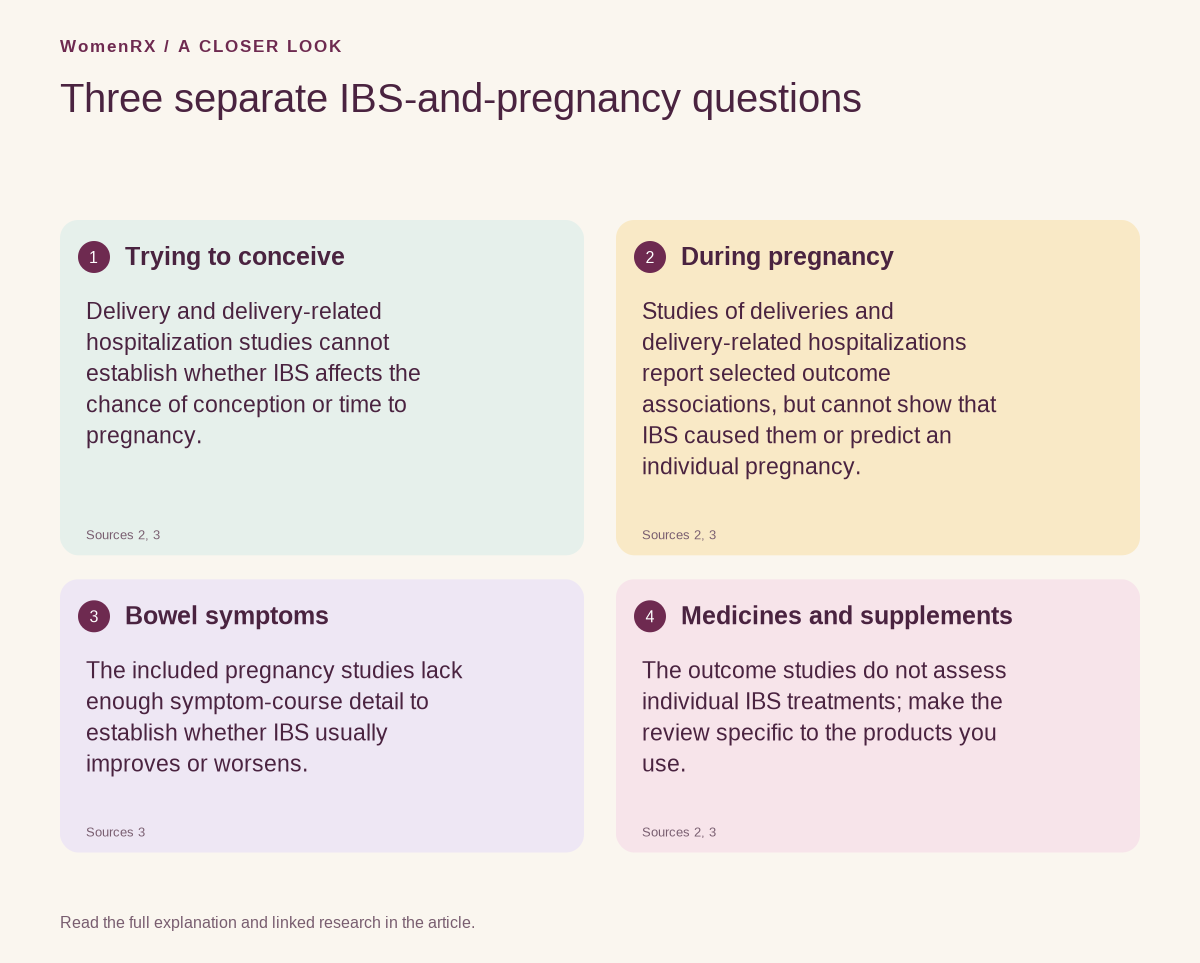
Three separate IBS-and-pregnancy questions
Trying to conceive: Delivery and delivery-related hospitalization studies cannot establish whether IBS affects the chance of conception or time to pregnancy.23
During pregnancy: Studies of deliveries and delivery-related hospitalizations report selected outcome associations, but cannot show that IBS caused them or predict an individual pregnancy.23
Bowel symptoms: The included pregnancy studies lack enough symptom-course detail to establish whether IBS usually improves or worsens.3
Medicines and supplements: The outcome studies do not assess individual IBS treatments; make the review specific to the products you use.23
Read the figure as text
The evidence differs by question: pregnancy-outcome databases don’t answer fertility or predict symptom changes, and they don’t assess individual treatment safety.- Trying to conceive: Delivery and delivery-related hospitalization studies cannot establish whether IBS affects the chance of conception or time to pregnancy.23
- During pregnancy: Studies of deliveries and delivery-related hospitalizations report selected outcome associations, but cannot show that IBS caused them or predict an individual pregnancy.23
- Bowel symptoms: The included pregnancy studies lack enough symptom-course detail to establish whether IBS usually improves or worsens.3
- Medicines and supplements: The outcome studies do not assess individual IBS treatments; make the review specific to the products you use.23
More questions, answered
Do the pregnancy studies show that IBS causes infertility?
No. Delivery and delivery-related hospitalization studies examine people who were already pregnant, so they can’t determine whether IBS affects the chance of conceiving or time to pregnancy. 2 3
Will pregnancy make my IBS better or worse?
These studies don’t establish a usual direction of change. One analysis lacked information about people’s outpatient IBS symptoms and course, so it can’t predict what will happen for you. 3
Sources you can check
- Irritable Bowel Syndrome | IBS | MedlinePlusAccessed 2026-09-25Return to first citation
- Pregnancy, delivery, and neonatal outcomes among women with irritable bowel syndrome (IBS) an evaluation of over 9 million deliveries.Alnoman A, Badeghiesh AM, Baghlaf HA, Dahan MH. · The journal of maternal-fetal & neonatal medicine : the official journal of the European Association of Perinatal Medicine, the Federation of Asia and Oceania Perinatal Societies, the International Society of Perinatal Obstetricians · 2022Return to first citation
- Maternal Outcomes and Resource Utilization in Pregnancy-Related Hospitalizations Among Patients With Irritable Bowel Syndrome: A Nationwide Inpatient Analysis, 2020-2022.Latif MH, Kang A, Mazhar E, Mohammed KA, Riley J, El-Halawani H, Qureshi K. · Cureus · 2026Return to first citation