Interstitial Cystitis and Pregnancy: What to Discuss Before Trying
Interstitial cystitis hasn’t been shown to prevent conception, but research on fertility, pregnancy symptoms, and treatment choices is limited.
The available research doesn’t establish that interstitial cystitis (IC), also called bladder pain syndrome, causes infertility. Studies of people who became pregnant can’t tell us how likely someone with IC is to conceive. One large database study linked IC with some pregnancy complications; a small case series reported both healthy births and two pregnancies terminated because of IC symptoms. Neither predicts an individual pregnancy. 2 3 5
Keep conception and pregnancy outcomes separate
If you have IC and want to become pregnant, the diagnosis alone isn’t a reason to assume you’ll have trouble conceiving. A small case series reported the interval from IC diagnosis to the menstrual period preceding pregnancy among its participants. That isn’t a measure of how long they spent trying to conceive. Neither it nor a study of deliveries establishes the chance of conception with IC compared with people without it, or provides a reliable estimate of time to pregnancy. 2 3
That distinction matters because it prevents a worrying pregnancy-outcome statistic from being mistaken for a fertility prediction. It also means there isn’t enough evidence to promise that conception will be unaffected. The honest takeaway is narrower: these studies don’t establish that IC causes infertility, and they don’t settle the question of fertility. 2 5
What pregnancy studies can, and can’t, tell you
A U.S. retrospective database study compared deliveries among more than 9 million pregnancies, including 793 in people diagnosed with chronic IC. After adjustment for other factors, an IC diagnosis was associated with higher odds of preeclampsia and preterm delivery, among other outcomes. These are associations from a database study, not proof that IC caused complications. The study included people with diagnosed IC who reached delivery, so it can’t describe everyone with IC or predict what will happen in your pregnancy. Its findings also don’t give your personal odds. 2
A much smaller 2003 report followed 12 people treated for IC. Thirteen healthy babies were delivered, and symptom relief was maintained during pregnancy in almost all participants. The report also described two pregnancies that were terminated because of symptoms attributed to IC. Both details matter: this case series shows different experiences, but it’s too small to establish how common any outcome is or whether treatment was responsible for symptom relief. 3
A 2023 review describes the effects of bladder pain syndrome on pregnancy, and pregnancy on symptoms, as poorly understood. Bladder discomfort and urinary symptoms are common in pregnancy, which can make the picture harder to interpret. Symptoms shouldn’t automatically be treated as proof that IC is worsening, or that a pregnancy complication is present; they deserve assessment in context. 5
Together, the studies give reasons to plan individualized care, not to expect a particular outcome. The larger database study identifies associations worth discussing; it doesn’t confirm causation. The small case series describes both healthy births and pregnancies ended because of symptoms, not a prediction for anyone else. 2 3
Make a plan around your actual treatment
Before trying, make a complete list of what you use for bladder symptoms: prescription and over-the-counter medicines, supplements, herbs, procedures, and any implanted device. Ask how each item might be handled while trying to conceive, during pregnancy, and after birth. Pregnancy medicine decisions depend on the particular treatment and its risks and benefits; don’t stop or start a medicine without discussing it with the person prescribing it. 1
If you have sacral neuromodulation, include the device plan in that conversation. A systematic review found only 22 patients across 26 pregnancies with the device for several different conditions; just one had intractable IC. The authors concluded that activation or deactivation decisions should be individualized. That evidence is too limited to offer a general rule for someone with IC. 4
Ask how to get your bladder symptoms assessed during pregnancy, when to report a change, and which members of your care team should coordinate treatment. A review notes that investigation and management options exist during pregnancy, while also emphasizing that the evidence and management choices are limited. 5
A short preconception conversation
You might bring these questions to the clinicians who manage your bladder symptoms and pregnancy care:
- Symptoms: What are my usual symptoms, and how should we assess a meaningful change during pregnancy?
- Treatments: Which of my medicines, supplements, procedures, or devices need a plan before I try to conceive? What should I do if symptoms flare?
- Coordination: Who will help weigh treatment benefits against pregnancy considerations, and how should my care be coordinated?
- Uncertainty: What should I understand about the limits of the pregnancy-outcome research, and what does that mean for my care?
The goal isn’t to predict your pregnancy from a diagnosis code or a small case series. It’s to enter pregnancy with a treatment plan that reflects your symptoms and the specific choices you’re making.
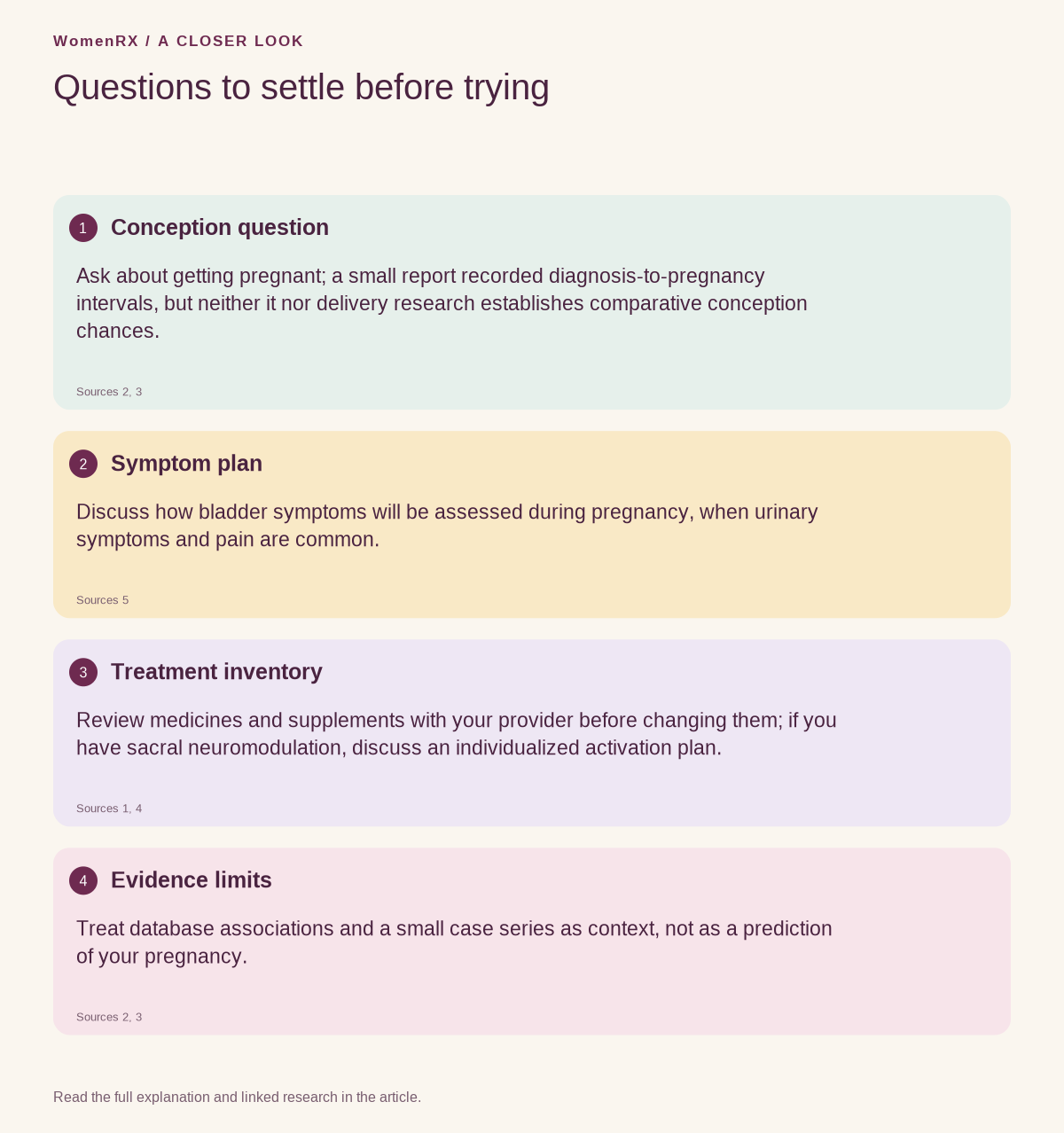
Questions to settle before trying
Conception question: Ask about getting pregnant; a small report recorded diagnosis-to-pregnancy intervals, but neither it nor delivery research establishes comparative conception chances.23
Symptom plan: Discuss how bladder symptoms will be assessed during pregnancy, when urinary symptoms and pain are common.5
Treatment inventory: Review medicines and supplements with your provider before changing them; if you have sacral neuromodulation, discuss an individualized activation plan.14
Evidence limits: Treat database associations and a small case series as context, not as a prediction of your pregnancy.23
Read the figure as text
Separate what you can plan now from what pregnancy research cannot yet predict.- Conception question: Ask about getting pregnant; a small report recorded diagnosis-to-pregnancy intervals, but neither it nor delivery research establishes comparative conception chances.23
- Symptom plan: Discuss how bladder symptoms will be assessed during pregnancy, when urinary symptoms and pain are common.5
- Treatment inventory: Review medicines and supplements with your provider before changing them; if you have sacral neuromodulation, discuss an individualized activation plan.14
- Evidence limits: Treat database associations and a small case series as context, not as a prediction of your pregnancy.23
More questions, answered
Does interstitial cystitis mean I’ll have trouble getting pregnant?
Studies don’t establish that IC causes infertility. A small case series reported intervals from diagnosis to pregnancy among people who conceived, but that doesn’t show how long they tried or how their conception chances compare with those of people without IC. 2 3
Should I stop my IC medicine before trying to conceive?
Don’t stop or start a medicine on your own. Ask about the specific medicine’s risks and benefits while trying to conceive and during pregnancy; those decisions depend on the treatment and your circumstances. 1
Sources you can check
- Pregnancy and Medicines | MedlinePlusAccessed 2026-09-25Return to first citation
- Interstitial Cystitis/Bladder Pain Syndrome's Correlations with Pregnancy and Neonatal Outcomes: A Study of a Population Database.Khojah MI, Badeghiesh AM, Ismail S, Baghlaf HA, Almamlouk N, Dahan MH. · The Journal of urology · 2021Return to first citation
- Pregnancy outcomes following the diagnosis of interstitial cystitis.Onwude JL, Selo-Ojeme DO. · Gynecologic and obstetric investigation · 2003Return to first citation
- The effect of sacral neuromodulation on pregnancy: a systematic review.Mahran A, Soriano A, Safwat AS, Hijaz A, Mahajan ST, Trabuco EC, Siegel SW, El-Nashar SA. · International urogynecology journal · 2017Return to first citation
- Bladder pain syndrome and pregnancy.Ivare AM, Obloza A, Goddard JC. · European journal of obstetrics, gynecology, and reproductive biology · 2023Return to first citation