Interstitial Cystitis and Hormones: What Symptom Changes Mean
A symptom flare around your period may be real, but it doesn’t show that hormones caused interstitial cystitis or changed your hormone levels.
An older review describes possible worsening of interstitial cystitis symptoms with ovulatory hormones, but it doesn’t establish a predictable menstrual-cycle pattern. A study linked use of female hormones with IC/BPS risk, but it couldn’t show that hormones caused the condition. Menopause guidance addresses menopausal symptoms, not hormone therapy as a general treatment for IC/BPS. 3 4 2

A cycle-related flare is a pattern, not a diagnosis of cause
If bladder pain, urgency, or frequency seems to rise at a particular point in your cycle, that pattern is worth taking seriously as your experience. It doesn’t, by itself, show that a hormone fluctuation caused the flare or caused IC/BPS. Symptoms can vary, and pain is experienced and reported individually. 1
An older review of IC treatment literature describes symptoms as sometimes worsening with ovulatory hormones. That’s a report of a possible connection, not strong evidence that every person with IC/BPS will flare at ovulation, or that hormones are the underlying cause. The review doesn’t provide enough detail to establish how common or predictable this is. 4
There’s also a difference between a hormone-related symptom pattern and a hormone-related disease mechanism. A review proposes that estrogen may influence sensory nerve signaling involved in visceral pain, but this is a possible explanation, not proof of what drives an individual’s bladder symptoms. 5
What the human study can and can’t tell you
A study comparing women with and without IC/BPS examined possible risk factors and reported an association with exogenous female hormones. It did not establish that hormone use caused IC/BPS, explain which hormone or timing mattered, or show that people with IC/BPS have abnormal hormone levels. It also wasn’t a study of symptom changes across the menstrual cycle. 3
Animal research offers another possible piece of the mechanism: in rats, estrogen affected signaling in sensory neurons connected to pelvic organs. Those findings can help generate hypotheses, but they don’t demonstrate that the same process causes menstrual flares in women or prove a treatment will help. 6
So, if your symptoms reliably change during your cycle, you can describe that as a personal pattern. Neither the review’s brief report nor the risk-factor study establishes a general rule about how estrogen or other hormones cause IC/BPS. 3 4
Menopause symptoms and IC/BPS aren’t interchangeable
Menopause-related genitourinary symptoms are a separate reason someone may seek treatment. The North American Menopause Society’s position statement discusses hormone therapy for bothersome menopausal symptoms, including genitourinary syndrome of menopause. That guidance does not establish hormone therapy as a general treatment for IC/BPS. 2
This distinction matters if bladder symptoms change around menopause: a menopausal symptom and IC/BPS may need to be considered as separate possibilities, rather than assuming one explains the other. The menopause guidance does not tell us whether IC/BPS symptoms follow a menopause-related pattern or whether IC/BPS changes hormone levels. 2
The research discussed above does not address how IC/BPS symptoms change during pregnancy. A pattern you notice can be useful information about your own symptoms, but it can’t predict what will happen for someone else.
What to do with a pattern you notice
If you want to see whether symptoms track with your cycle, note the timing of bleeding and bladder symptoms in a simple calendar or notes app. This isn’t a test for hormone-related IC/BPS; it’s a way to make a recurring pattern easier to describe. Also note whether symptoms appear at other times, since a cycle association alone doesn’t establish the cause.
If you’re considering hormone therapy for menopause symptoms, keep that decision separate from the question of whether it will treat IC/BPS. Hormone therapy has benefits and risks that depend on the person and treatment, so its use should be based on a menopausal indication and an individualized discussion, not on an assumption that it will calm bladder pain. 2
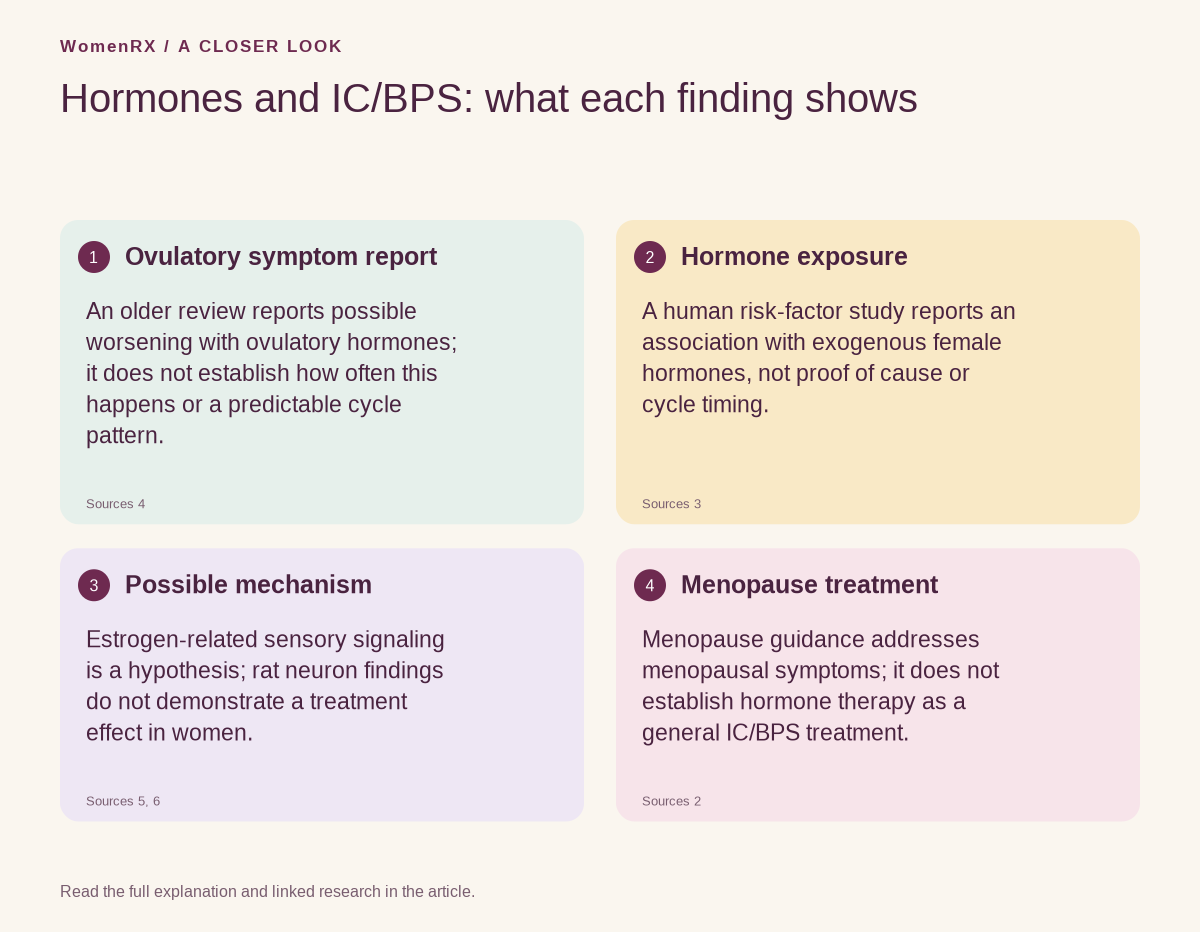
Hormones and IC/BPS: what each finding shows
Ovulatory symptom report: An older review reports possible worsening with ovulatory hormones; it does not establish how often this happens or a predictable cycle pattern.4
Hormone exposure: A human risk-factor study reports an association with exogenous female hormones, not proof of cause or cycle timing.3
Possible mechanism: Estrogen-related sensory signaling is a hypothesis; rat neuron findings do not demonstrate a treatment effect in women.56
Menopause treatment: Menopause guidance addresses menopausal symptoms; it does not establish hormone therapy as a general IC/BPS treatment.2
Read the figure as text
These distinctions help separate a reported symptom connection from evidence about mechanism, cause, or treatment.- Ovulatory symptom report: An older review reports possible worsening with ovulatory hormones; it does not establish how often this happens or a predictable cycle pattern.4
- Hormone exposure: A human risk-factor study reports an association with exogenous female hormones, not proof of cause or cycle timing.3
- Possible mechanism: Estrogen-related sensory signaling is a hypothesis; rat neuron findings do not demonstrate a treatment effect in women.56
- Menopause treatment: Menopause guidance addresses menopausal symptoms; it does not establish hormone therapy as a general IC/BPS treatment.2
More questions, answered
Does a flare before or during my period mean hormones caused my IC?
No. A recurring timing pattern may be real for you, and an older review describes possible symptom worsening with ovulatory hormones, but that doesn’t prove hormones caused IC/BPS or explain your individual symptoms. 4
Is menopause hormone therapy a general treatment for IC/BPS?
The menopause position statement supports hormone therapy for certain bothersome menopausal symptoms; it does not establish it as a general treatment for IC/BPS. 2
Sources you can check
- Pain | MedlinePlusAccessed 2026-09-25Return to first citation
- The 2022 hormone therapy position statement of The North American Menopause Society.“The 2022 Hormone Therapy Position Statement of The North American Menopause Society” Advisory Panel. · Menopause (New York, N.Y.) · 2022Return to first citation
- Prodrome and Non-prodrome Phenotypes of Bladder Pain Syndrome/Interstitial Cystitis.Warren JW, Jian N, Gallicchio L, Wu D, Clauw DJ. · Urology · 2018Return to first citation
- New agents for the medical treatment of interstitial cystitis.Theoharides TC, Sant GR. · Expert opinion on investigational drugs · 2001Return to first citation
- Estrogen and Visceral Nociception at the Level of Primary Sensory Neurons.Chaban V. · Pain research and treatment · 2012Return to first citation
- Effects of estrogens and bladder inflammation on mitogen-activated protein kinases in lumbosacral dorsal root ganglia from adult female rats.Cheng Y, Keast JR. · BMC neuroscience · 2009Return to first citation