What an Interstitial Cystitis Diagnosis Really Means
Interstitial cystitis/bladder pain syndrome is diagnosed from a pattern of symptoms and careful evaluation, not one test that settles the question.
An interstitial cystitis/bladder pain syndrome (IC/BPS) diagnosis means bladder-area pain, pressure, or discomfort occurs with urinary symptoms and no other cause has adequately explained them. There is no single confirmatory test. Evaluation can be complicated because urinary, pelvic-floor, and gynecologic conditions may feel similar or overlap. Clinicians differ on when cystoscopy is needed, so it’s reasonable to ask what the test would clarify in your case. 2 3 4
What the diagnosis describes
IC/BPS is a name for a group of symptoms, not a claim that every person has the same underlying problem. The pattern can include pain, pressure, or discomfort around the bladder along with urinary urgency or frequent urination. For some people, discomfort worsens as the bladder fills and eases after urinating; others may have a different mix of symptoms. The condition’s causes aren’t fully understood. 2 4
That distinction matters: a diagnosis gives symptoms a useful clinical framework, but it doesn’t identify one proven cause or guarantee that a particular treatment will work. Current care is increasingly described as individualized because people can have different symptom patterns and contributing factors. 1 2 3
There isn’t one test that confirms it
A common misconception is that a test can simply prove or disprove IC/BPS. Reviews describe diagnosis as primarily based on symptoms and evaluation for other conditions that could explain them. Tests can help assess the situation, but IC/BPS is not diagnosed with a single established confirmatory test. 2 5
Cystoscopy, which lets a specialist look inside the bladder, is an area where recommendations differ. A 2026 international expert consensus proposal says cystoscopy is essential to assess and classify IC/BPS. A narrative review, describing variation among guidelines, says cystoscopy is used mainly to characterize the condition and identify Hunner lesions. Those positions aren’t identical. The practical question is not whether every person must have the procedure, but what it is expected to rule out or clarify for you. 2 3
Symptoms don’t tell you whether it’s an infection
Urinary burning, urgency, frequency, and pelvic discomfort can occur in IC/BPS, but those symptoms also overlap with urinary tract infections and other conditions. Symptoms alone therefore don’t establish either IC/BPS or infection. The diagnosis is considered in the context of an evaluation for other explanations, rather than by assuming that recurring bladder symptoms have one cause. 2 4
For women, the overlap can extend beyond the urinary tract. Endometriosis, vulvar pain, pelvic-floor dysfunction, and pain during sex may coexist with bladder pain or contribute to pelvic symptoms. That doesn’t mean those conditions are the same as IC/BPS; it means a bladder-focused label may not explain every source of pain. 4 6
Diet: personal triggers aren’t a universal rule
A revised guideline summary mentions individualized dietary management as part of IC/BPS care. 1
If you suspect a food affects your symptoms, treat that as a personal observation to discuss, not as proof of a diagnosis or a reason to adopt a restrictive diet. The useful distinction is between a possible individual trigger and a universally established treatment.
Treatment is tailored, and results can vary
Treatment may combine non-medication approaches, medicines, treatments delivered into the bladder, procedures, or other specialist care. Which options make sense depends on the person’s symptoms and assessment; no single approach is described as universally effective. An international consensus paper notes that treatment effects in randomized trials have often been modest, one reason a one-size-fits-all sequence may not serve everyone well. 1 2 3
A diagnosis can be a starting point for matching care to the problem, not the end of the evaluation. If pelvic pain, pain with sex, or other gynecologic symptoms are part of your experience, it’s useful to say so plainly. Those details may point to additional pain sources that deserve attention alongside bladder symptoms. 4 6
A focused question to bring into the discussion is: “What else could explain or contribute to these symptoms, and what would this test or treatment help us learn?” That keeps the conversation about your actual symptom pattern, rather than treating the label as a complete explanation.
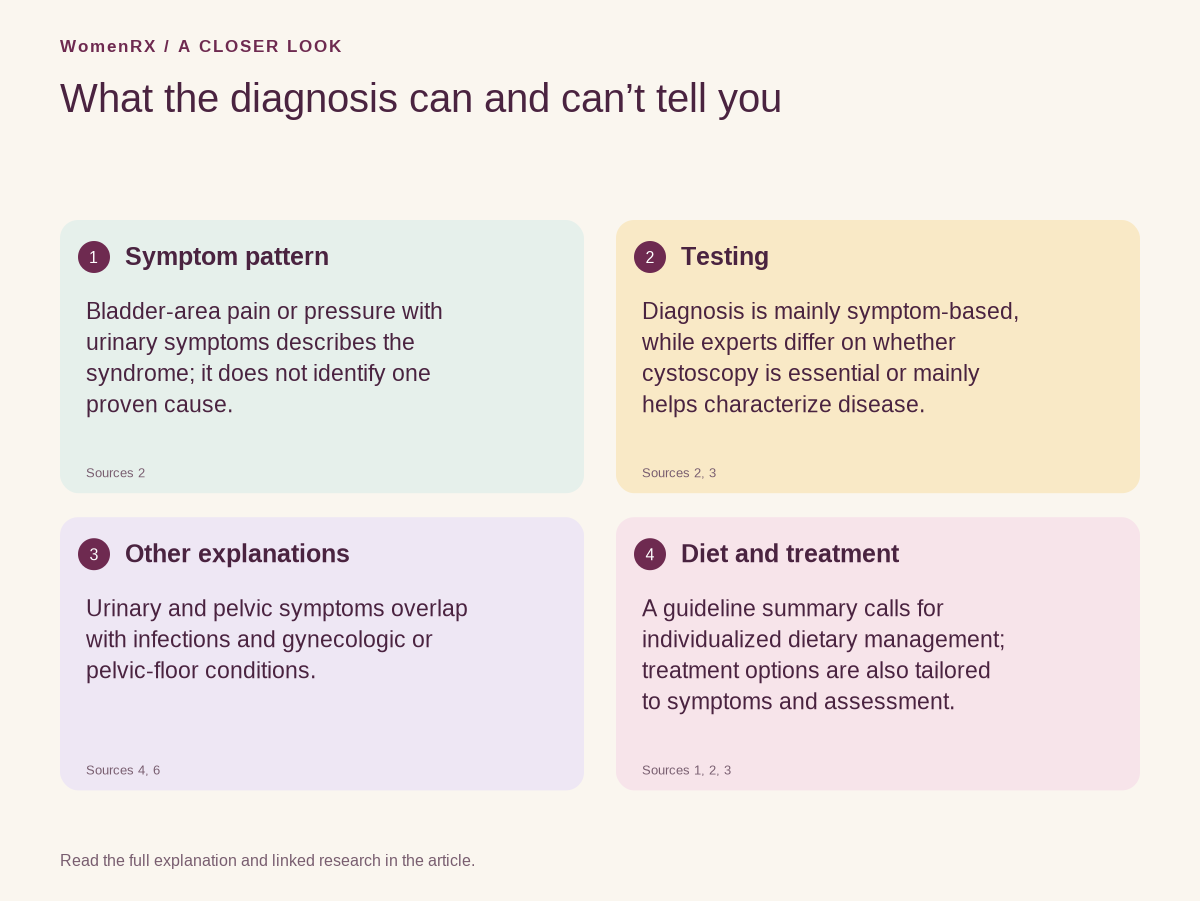
What the diagnosis can and can’t tell you
Symptom pattern: Bladder-area pain or pressure with urinary symptoms describes the syndrome; it does not identify one proven cause.2
Testing: Diagnosis is mainly symptom-based, while experts differ on whether cystoscopy is essential or mainly helps characterize disease.23
Other explanations: Urinary and pelvic symptoms overlap with infections and gynecologic or pelvic-floor conditions.46
Diet and treatment: A guideline summary calls for individualized dietary management; treatment options are also tailored to symptoms and assessment.123
Read the figure as text
These distinctions help separate the symptom label from the questions that still need individual assessment.- Symptom pattern: Bladder-area pain or pressure with urinary symptoms describes the syndrome; it does not identify one proven cause.2
- Testing: Diagnosis is mainly symptom-based, while experts differ on whether cystoscopy is essential or mainly helps characterize disease.23
- Other explanations: Urinary and pelvic symptoms overlap with infections and gynecologic or pelvic-floor conditions.46
- Diet and treatment: A guideline summary calls for individualized dietary management; treatment options are also tailored to symptoms and assessment.123
More questions, answered
Does an IC/BPS diagnosis mean the pain is imagined?
No. IC/BPS describes bladder-area pain or discomfort with urinary symptoms, and the condition can substantially affect daily life. The fact that its causes are not fully understood does not make the symptoms unreal. 2 4
Can pelvic or gynecologic pain be part of the picture?
Yes. Bladder pain can overlap with pelvic-floor and gynecologic pain conditions, including endometriosis and vulvar pain. They are distinct conditions, but more than one source of pain may need consideration. 4 6
Sources you can check
- [Update of the S2k guideline on the diagnosis and treatment of interstitial cystitis/bladder pain syndrome (IC/BPS)].Zimmermann PV, Gonsior A, Vahlensieck W, Schultz-Lampel D, Wiedemann A, Kaftan BT. · Urologie (Heidelberg, Germany) · 2026Return to first citation
- Interstitial Cystitis/Bladder Pain Syndrome: A Narrative Review of Nomenclature, Epidemiology, Pathophysiology, Diagnosis, and Management.Priporeanu T, Petre I, Dragomir RE, Stoica RI, Grigore N. · Cureus · 2026Return to first citation
- Optimizing the Diagnosis of Interstitial Cystitis/Bladder Pain Syndrome: An ESSIC Proposal.Malde S, Akiyama Y, Janssen D, Lai H, Meijlink J, Nasta L, Samarinas M, Moldwin R, Riedl C, Wyndaele JJ, Cervigni M. · European urology open science · 2026Return to first citation
- Variability in the Diagnosis and Treatment of Interstitial Cystitis/Bladder Pain Syndrome: Internet Survey.Melkonian E, Garrett AL, Kline E, Smith P, Wiesenhahn M, Petit J, Swierczynski A, Zhou C, Bauer SB, Adam R, Barbour KE, Ziniel SI, Brownstein CA. · JMIR formative research · 2025Return to first citation
- The Role of Biomarkers in the Diagnosis and Treatment of Interstitial Cystitis/Bladder Pain Syndrome: What Does Current Evidence Reveal?Chen YC, Tyagi P, Alperin M, Stern JNH, Lenore Ackerman A, Kuo HC. · Neurourology and urodynamics · 2026Return to first citation
- Gynecologic Manifestations of Interstitial Cystitis/Bladder Pain Syndrome.Whitmore KE, Pires J. · International journal of urology : official journal of the Japanese Urological Association · 2026Return to first citation