What Causes Interstitial Cystitis? What We Know
There’s no single proven cause of interstitial cystitis; the evidence points to different possible processes in different people.
Interstitial cystitis/bladder pain syndrome (IC/BPS) is a name for persistent bladder or pelvic pain and urinary symptoms when infection or another clear explanation hasn’t accounted for them. It doesn’t have one established cause. Bladder inflammation is clearer in the subgroup with Hunner lesions; other proposed mechanisms and bacterial associations remain under study, not proven explanations for everyone. 3 4 5
A symptom pattern, not one known cause
IC/BPS describes persistent pain or pressure around the bladder, often alongside urinary urgency or frequent urination, when infection or another identifiable condition does not explain the symptoms. The name covers a range of presentations, rather than pointing to one cause that has been found in every person. 3
IC/BPS affects people of different sexes. This research does not establish a cause specific to one sex or gender. 3
That distinction can help make sense of an evaluation: clinicians look at the symptoms and consider other explanations, rather than confirming IC/BPS with a test for one presumed cause. The cited review describes diagnosis as a process of exclusion. 3
One subgroup has clearer signs of bladder inflammation
Some people with IC/BPS have Hunner lesions, visible areas of inflammation on the bladder wall. Reviews describe this group as having more distinct inflammatory changes, including damage to the bladder lining and immune-cell activity. This is evidence about a subgroup, not proof that the same process causes symptoms in everyone with IC/BPS. 3 4
In people without Hunner lesions, bladder-tissue changes may be less pronounced. Researchers have proposed other processes, including altered bladder-lining protection, nerve responses, and inflammation-related signaling. These are possible pieces of the picture, not settled causes or tests that can explain an individual’s symptoms. 3
Bacteria are being studied, but aren’t a proven explanation
IC/BPS symptoms can occur without evidence of a typical urinary infection. Whether bacteria or the wider community of microbes in urine contribute to the condition remains uncertain. 3 5
One study analyzed repeated urine samples from people with IC/BPS and found no widespread relationship between the urine microbiome and pain location or severity. It did find that menopausal status and a recent urinary tract infection affected the sample’s microbial composition. That finding does not show that menopause or infection causes IC/BPS; it shows why microbial patterns need to be interpreted in context. 5
So, an infection shouldn’t be assumed to explain persistent symptoms, but neither does this research settle every question about bacteria. It leaves a narrower, more useful conclusion: microbial differences are being investigated, and current findings don’t establish them as a general cause.
Related conditions don’t prove a psychological cause
People without Hunner lesions may also report conditions such as irritable bowel syndrome, fibromyalgia, chronic fatigue syndrome, and migraine. These overlaps may point to shared or interacting pain processes, but an association does not show that one condition causes another. 3
Stress, sleep problems, or mood symptoms can also occur alongside chronic pain. Their presence does not mean the pain is imaginary or that a psychological factor has been proven to cause IC/BPS. The cause remains unclear, and symptoms deserve assessment on their own terms. 1 3
What a diagnostic evaluation can clarify
When bladder-area pain, pressure, urgency, or frequent urination persist, a clinician considers whether infection or another identifiable condition better accounts for them. A clinical history and urine assessment help examine the symptom pattern and whether infection may explain it. 3
For someone who has periods, pelvic discomfort may occur around menstruation as well as alongside urinary symptoms. Period pain can sometimes reflect another condition, such as fibroids or pelvic inflammatory disease. Describing when the pain occurs and whether urgency or frequent urination accompanies it can help a clinician consider these explanations without assuming that menstruation causes IC/BPS. 2 3
Findings such as Hunner lesions can help describe a particular bladder presentation, but they do not reveal one universal underlying cause. 3 4
A practical starting point is to describe where the discomfort is, which urinary symptoms accompany it, and how long the pattern has lasted. You can ask what other explanations are being considered and what each proposed test would help clarify. The specific evaluation depends on the situation. 3
The most grounded answer today is that IC/BPS is heterogeneous: inflammation is more evident in some bladder-centered cases, while several other mechanisms remain possible. A diagnosis can name the symptom pattern without pretending the cause is fully understood.
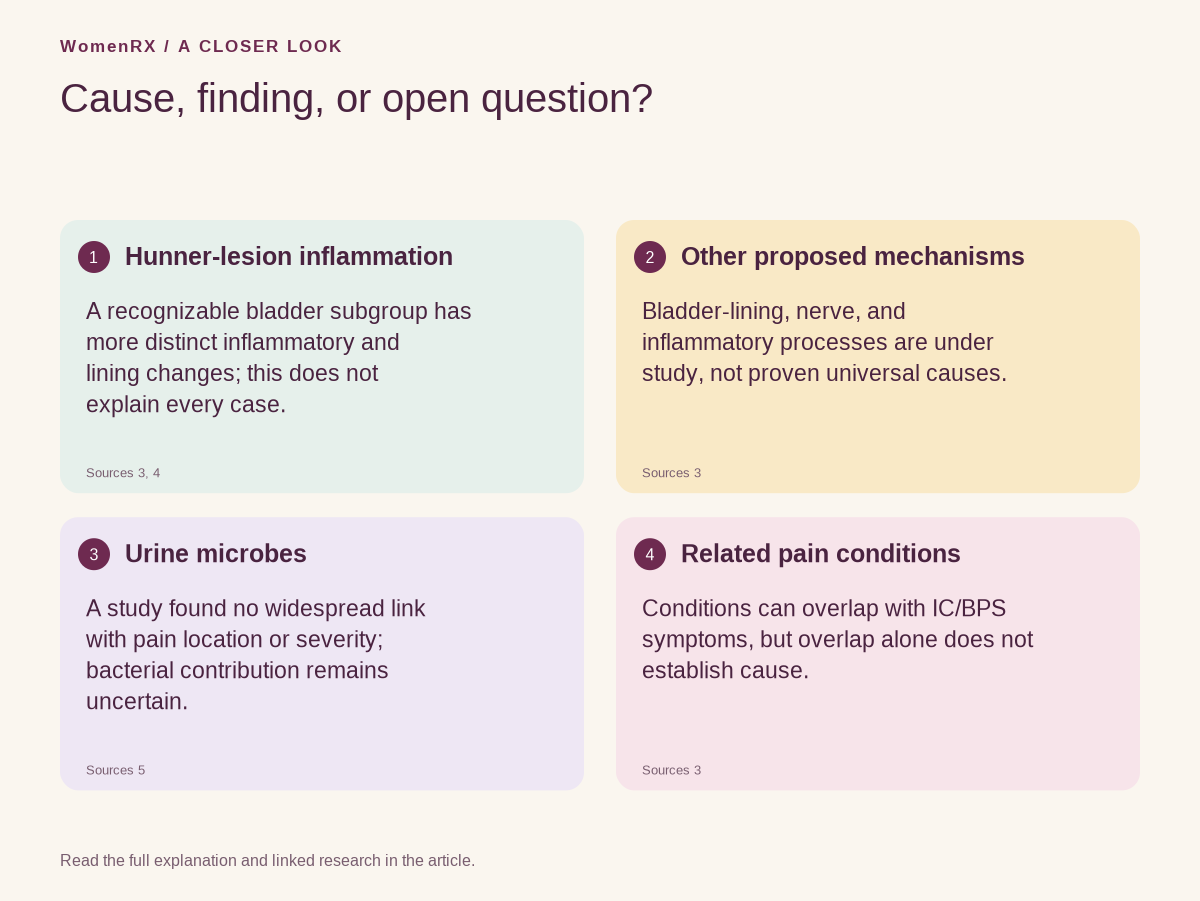
Cause, finding, or open question?
Hunner-lesion inflammation: A recognizable bladder subgroup has more distinct inflammatory and lining changes; this does not explain every case.34
Other proposed mechanisms: Bladder-lining, nerve, and inflammatory processes are under study, not proven universal causes.3
Urine microbes: A study found no widespread link with pain location or severity; bacterial contribution remains uncertain.5
Related pain conditions: Conditions can overlap with IC/BPS symptoms, but overlap alone does not establish cause.3
Read the figure as text
These distinctions separate what can be observed in some IC/BPS presentations from mechanisms and associations that are still being investigated.- Hunner-lesion inflammation: A recognizable bladder subgroup has more distinct inflammatory and lining changes; this does not explain every case.34
- Other proposed mechanisms: Bladder-lining, nerve, and inflammatory processes are under study, not proven universal causes.3
- Urine microbes: A study found no widespread link with pain location or severity; bacterial contribution remains uncertain.5
- Related pain conditions: Conditions can overlap with IC/BPS symptoms, but overlap alone does not establish cause.3
More questions, answered
Does IC/BPS mean I have a hidden urinary infection?
No. The condition is considered when persistent bladder-related symptoms aren’t explained by infection or another clear cause. Researchers are still studying whether urinary microbes contribute in some cases, but current findings don’t establish infection as the cause of IC/BPS generally. 3 5
Does menopause cause interstitial cystitis?
Current findings don’t show that menopause causes IC/BPS. In one study of people with IC/BPS, menopausal status was associated with differences in urine microbial composition, but the study did not establish that menopause caused the condition or its symptoms. 5
Sources you can check
- Pain | MedlinePlusAccessed 2026-09-25Return to first citation
- Period pain - NHSAccessed 2026-09-25Return to first citation
- Advances in Cytokines and Inflammatory Mechanisms in the Pathogenesis of Interstitial Cystitis/Bladder Pain Syndrome.Xiao Y, Zhu D, Zhou X. · Biomolecules · 2026Return to first citation
- Angiogenesis, Angiogenic Factors, and Interstitial Cystitis/Bladder Pain Syndrome (IC/BPS).Yoshimura N, Furuta A, Tobisawa Y, Igarashi T, Saito T, Ueda T. · International journal of urology : official journal of the Japanese Urological Association · 2026Return to first citation
- Urobiome Analysis in Interstitial Cystitis/Bladder Pain Syndrome Reveals Nuanced Differences Associated with Localized Pain.Reasoner SA, Francis J, Gidney M, Amponsah A, Frainey B, Schrepf A, Kelly AG, Ryden AM, Crofford LJ, Dmochowski RR, Hadjifrangiskou M, McKernan LC. · International urogynecology journal · 2026Return to first citation