How Doctors Evaluate Bladder Pain and Possible IC
Interstitial cystitis/bladder pain syndrome is usually assessed through your symptoms and targeted tests, not one test that confirms it.
When bladder-related pain, pressure, urgency, or frequency lasts for weeks and a urine culture doesn’t show a typical infection, the evaluation usually starts with your symptom history, an exam, and urine testing. These steps help identify other explanations. Cystoscopy can find bladder changes such as Hunner lesions, but whether it’s needed depends on the clinical approach and your situation. 34
Start with the pattern, not a single test
Interstitial cystitis/bladder pain syndrome (IC/BPS) describes bladder-related pain, pressure, or discomfort alongside urinary symptoms when another identifiable cause hasn’t been found. In the American Urological Association/SUFU approach summarized in a 2026 review, symptoms lasting more than six weeks are part of the working definition; that duration alone does not establish the diagnosis. 3
Your clinician may take a medical history, do a targeted physical exam, and use a voiding diary to clarify urinary patterns. A diary can help document frequency and timing, but it isn’t a stand-alone confirmation of IC/BPS. 4
What urine testing can tell you
Urine testing, including a urine culture, helps check for a urinary infection that could explain the symptoms. If testing doesn’t show a typical infection, that makes infection less likely as the explanation for that episode. It doesn’t, by itself, prove IC/BPS or rule out every other cause. The diagnosis still depends on the overall symptom pattern and evaluation. 34
When cystoscopy enters the picture
Cystoscopy lets a specialist look inside the bladder. It can identify Hunner lesions, a finding that helps distinguish one IC/BPS subtype and may affect how the condition is described and managed. A normal-looking bladder does not automatically rule out IC/BPS: in one small observational study of 35 selected women with suspected disease, 11 had a normal cystoscopy. That study cannot tell us how accurate cystoscopy is across all patients. 25
There’s a real difference in recommendations about how routinely to use the procedure. The AUA/SUFU framework summarized in the 2026 review does not require cystoscopy to diagnose every case; it reserves the procedure for situations such as suspected Hunner lesions. A separate 2026 international expert consensus proposal recommends cystoscopy as an essential part of assessment and subtype classification. That proposal is a newer consensus approach, not proof that every clinician or guideline considers cystoscopy necessary in every case. 23
So cystoscopy may be useful when the diagnosis is uncertain, when a bladder lesion is suspected, or when a specialist is trying to characterize the condition. It is not a simple yes-or-no test for all IC/BPS. 23
Other causes the evaluation may consider
Bladder symptoms and pelvic pain can have overlapping explanations. A newer international consensus proposal specifically includes pelvic-floor dysfunction among the features to recognize during IC/BPS assessment. If pain predictably comes with periods, gynecologic causes of period pain, such as fibroids or pelvic inflammatory disease, may also be relevant to consider; timing is a clue, not a diagnosis by itself. 12
Imaging may be considered when the history or exam points to a structural or other concern. One French guideline describes ultrasound as a first-line imaging option, with CT or MRI as possible second-line tests; these aren’t automatic tests for everyone with suspected IC/BPS. 4
The practical takeaway: ask what each proposed test is meant to answer. A urine culture checks for infection; an exam can look for pelvic or other pain sources; imaging can investigate selected structural concerns; and cystoscopy can inspect the bladder and identify Hunner lesions. No one result should be treated as the whole diagnosis.
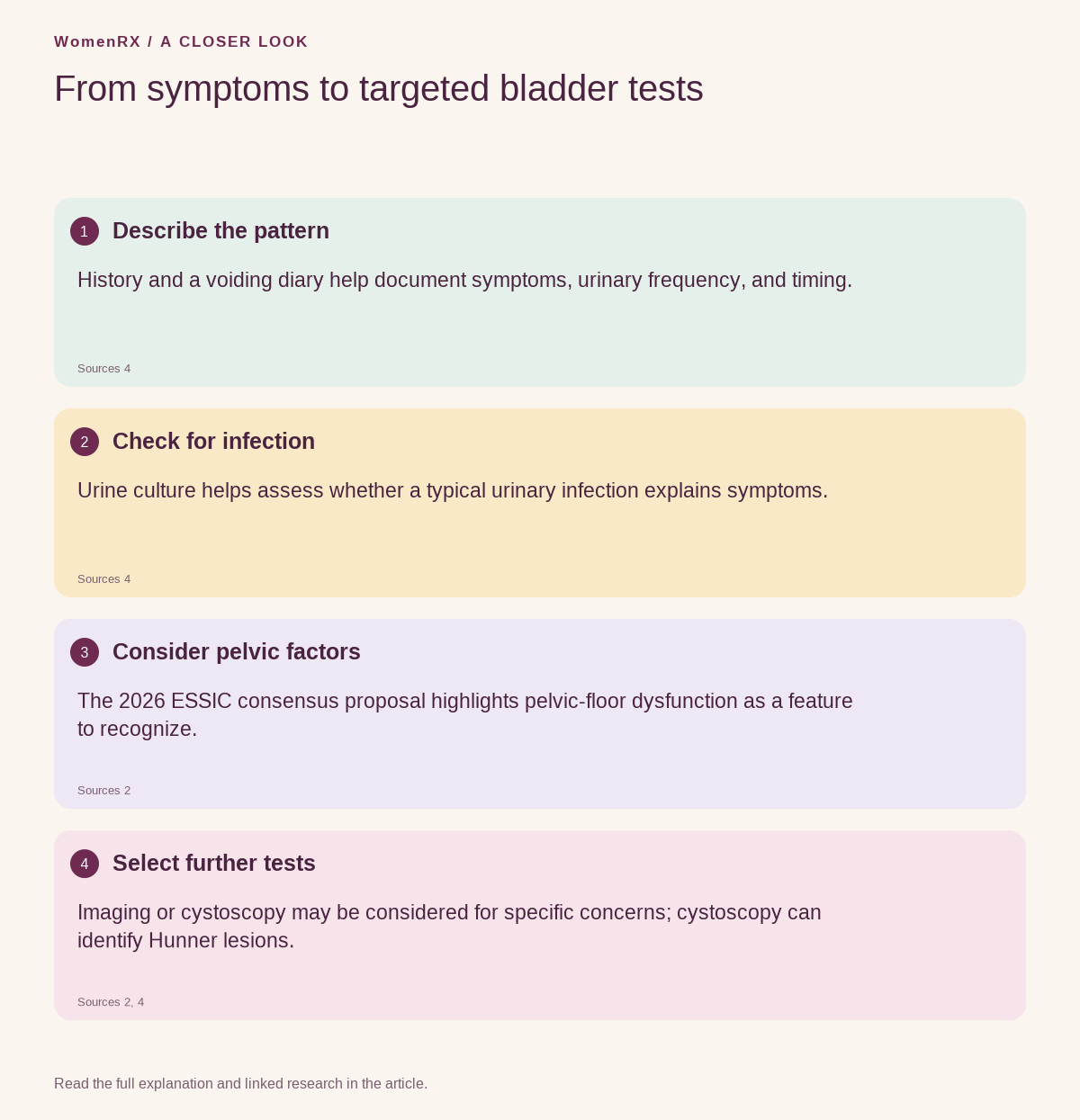
From symptoms to targeted bladder tests
Describe the pattern: History and a voiding diary help document symptoms, urinary frequency, and timing.4
Check for infection: Urine culture helps assess whether a typical urinary infection explains symptoms.4
Consider pelvic factors: The 2026 ESSIC consensus proposal highlights pelvic-floor dysfunction as a feature to recognize.2
Select further tests: Imaging or cystoscopy may be considered for specific concerns; cystoscopy can identify Hunner lesions.24
Read the figure as text
Each step addresses a different question; the pathway is individualized, and cystoscopy is not required in every diagnostic framework.- Describe the pattern: History and a voiding diary help document symptoms, urinary frequency, and timing.4
- Check for infection: Urine culture helps assess whether a typical urinary infection explains symptoms.4
- Consider pelvic factors: The 2026 ESSIC consensus proposal highlights pelvic-floor dysfunction as a feature to recognize.2
- Select further tests: Imaging or cystoscopy may be considered for specific concerns; cystoscopy can identify Hunner lesions.24
More questions, answered
Does a normal cystoscopy rule out IC/BPS?
No. A normal cystoscopy doesn’t exclude IC/BPS in the symptom-based AUA/SUFU framework summarized in a 2026 review. Cystoscopy can help identify Hunner lesions, but it isn’t a universal confirmation test. 35
Can a bladder diary diagnose IC/BPS?
No. A diary can make urinary frequency and symptom timing clearer, but it is one part of an assessment that also considers history, examination, urine testing, and other possible causes. 4
Sources you can check
- Period pain - NHSAccessed 2026-09-25Return to first citation
- Optimizing the Diagnosis of Interstitial Cystitis/Bladder Pain Syndrome: An ESSIC Proposal.Malde S, Akiyama Y, Janssen D, Lai H, Meijlink J, Nasta L, Samarinas M, Moldwin R, Riedl C, Wyndaele JJ, Cervigni M. · European urology open science · 2026Return to first citation
- Interstitial Cystitis/Bladder Pain Syndrome: A Narrative Review of Nomenclature, Epidemiology, Pathophysiology, Diagnosis, and Management.Priporeanu T, Petre I, Dragomir RE, Stoica RI, Grigore N. · Cureus · 2026Return to first citation
- Diagnosis of interstitial cystitis/bladder pain syndrome: Guidelines from the Committee of Female Urology (CUROPF) of the French Association of Urology (AFU).Meyer F, Brandon C, Saussine C, Borojeni S, Bosset PO, Campagne-Loiseau S, Cornu JN, Donon L, Even L, Florin M, Hervé F, Hurel S, Klap J, Perrouin-Verbe MA, Plassais C, Richard C, ... · The French journal of urology · 2026Return to first citation
- Role of cystoscopy as primary initial investigation in interstitial cystitis/bladder pain syndrome.Singh A, Priyadarshi S, Bansal S, Nandwani S. · Urologia · 2024Return to first citation