Can You Get Pregnant With Fibroids? Location Matters
Many women with fibroids get pregnant without problems, but a fibroid that changes the shape of the uterine cavity deserves a closer look.
Yes. Many women with fibroids get pregnant without problems. The most useful question is whether a fibroid pushes into or distorts the uterine cavity: those fibroids raise a different fertility question from fibroids on the outside of the uterus. If treatment is being considered, its possible benefit needs to be weighed against your symptoms, age, other fertility factors, and pregnancy plans. 145
Start with the fibroid’s relationship to the cavity
A fibroid diagnosis doesn’t tell you, by itself, whether getting pregnant will be difficult. Fibroids can grow in different parts of the uterus, and many women who have them get pregnant without problems. Some fibroids, though, are linked to difficulty conceiving or pregnancy loss. 1
The key distinction is often whether the fibroid changes the shape of the uterine cavity. A submucosal fibroid projects toward or into that cavity. An intramural fibroid grows within the muscular wall and may or may not affect the cavity. A subserosal fibroid grows toward the outside of the uterus. In fertility research, submucosal fibroids and fibroids that distort the cavity have been more concerning than those on the outer surface. The effect of an intramural fibroid that leaves the cavity intact is less certain. 45
That makes “How big is it?” only part of the conversation. An ultrasound can show how many fibroids there are, where they are, and how large they are. If you’re having trouble conceiving, ask whether the images also show clearly if any fibroid pushes into the cavity. A fertility evaluation may use additional imaging or a procedure that looks inside the uterus to clarify that relationship. 24
When might removing a fibroid help?
The case for removal is strongest when a submucosal fibroid is found in someone with otherwise unexplained infertility. A fertility guideline recommends removing these fibroids to improve conception and pregnancy rates. That recommendation doesn’t mean every submucosal fibroid needs removal before anyone starts trying: the question depends on the fibroid’s features and your situation. 4
For a subserosal fibroid, the same guideline does not recommend removal to improve fertility. For an intramural fibroid that does not affect the cavity, evidence that surgery improves fertility is unconvincing. A review found that results for intramural fibroids varied with how well studies assessed the cavity, and a benefit from removal wasn’t consistently shown when the cavity was carefully evaluated. 45
This is the tradeoff to make explicit if a procedure is proposed: What problem is it meant to solve, and how likely is it to improve your chance of pregnancy? Fibroid surgery has its own risks, while waiting or treating heavy bleeding may also matter to your day-to-day life. Decisions about treatment take account of symptoms, age, fibroid size and location, and whether you want to become pregnant. 14
If uterine artery embolization comes up as an option for symptoms, say clearly that future pregnancy is a goal. Pregnancies do occur afterward, but its effect on fertility remains uncertain. An older fertility guideline reported worse reproductive outcomes after embolization than after myomectomy; a more recent study found births after embolization, but followed a selected group without a myomectomy comparison. Neither finding can predict your individual outcome. 46
Fertility and pregnancy are separate questions
A fibroid’s possible effect on getting pregnant isn’t the same as its possible effect during pregnancy. Many women with fibroids have no pregnancy problems, but some fibroids may be associated with pregnancy loss or difficulties with fetal development or delivery. Those possibilities are worth discussing if you’re already pregnant or planning to be, without assuming they will happen to you. 1
Fibroids also aren’t the only possible reason pregnancy hasn’t happened. Ovulation, fallopian tubes, age-related changes, and a partner’s fertility can all matter. If you’re under 35 and have been trying for a year, or 35 or older and have been trying for six months, a fertility evaluation can look beyond the fibroids. A history of repeated pregnancy loss or other known fertility concerns is also a reason to raise the question sooner. 3
You can make the next conversation more specific with three questions: Does any fibroid distort the cavity? Is the proposed treatment for symptoms, fertility, or both? What would change about the plan if I want to carry a pregnancy? Those answers are more useful than a fibroid count alone. 14
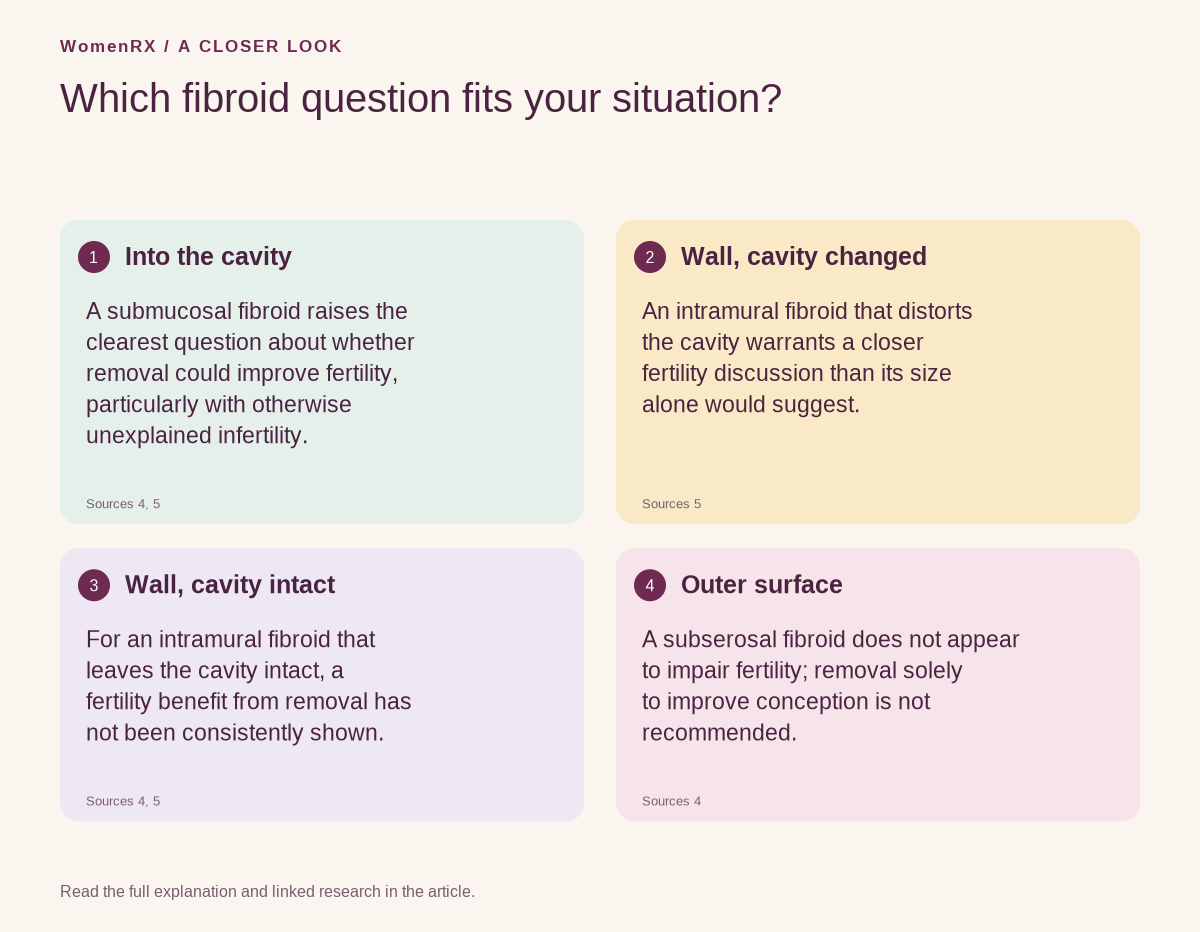
Which fibroid question fits your situation?
Into the cavity: A submucosal fibroid raises the clearest question about whether removal could improve fertility, particularly with otherwise unexplained infertility.45
Wall, cavity changed: An intramural fibroid that distorts the cavity warrants a closer fertility discussion than its size alone would suggest.5
Wall, cavity intact: For an intramural fibroid that leaves the cavity intact, a fertility benefit from removal has not been consistently shown.45
Outer surface: A subserosal fibroid does not appear to impair fertility; removal solely to improve conception is not recommended.4
Read the figure as text
Location helps frame the fertility question, but it doesn’t decide treatment on its own.- Into the cavity: A submucosal fibroid raises the clearest question about whether removal could improve fertility, particularly with otherwise unexplained infertility.45
- Wall, cavity changed: An intramural fibroid that distorts the cavity warrants a closer fertility discussion than its size alone would suggest.5
- Wall, cavity intact: For an intramural fibroid that leaves the cavity intact, a fertility benefit from removal has not been consistently shown.45
- Outer surface: A subserosal fibroid does not appear to impair fertility; removal solely to improve conception is not recommended.4
Sources you can check
- Uterine Fibroids | Fibroids | MedlinePlusAccessed 2026-09-25Return to first citation
- Fibroids - NHSAccessed 2026-09-25Return to first citation
- Infertility | Infertility Treatments | MedlinePlusAccessed 2026-09-25Return to first citation
- The management of uterine fibroids in women with otherwise unexplained infertility.Carranza-Mamane B, Havelock J, Hemmings R, REPRODUCTIVE ENDOCRINOLOGY AND INFERTILITY COMMITTEE, SPECIAL CONTRIBUTOR. · Journal of obstetrics and gynaecology Canada : JOGC = Journal d'obstetrique et gynecologie du Canada : JOGC · 2015Return to first citation
- Uterine fibroids and subfertility: an update on the role of myomectomy.Brady PC, Stanic AK, Styer AK. · Current opinion in obstetrics & gynecology · 2013Return to first citation
- Fertility outcomes after uterine artery embolization for symptomatic leiomyomas.Fabre C, Boeken T, Simon V, Dean C, Sapoval M, Pellerin O, Bats AS, Azaïs H, Koual M. · CVIR endovascular · 2025Return to first citation