Can You Get Pregnant During Perimenopause?
Irregular periods can make pregnancy harder to recognize, but they don’t mean contraception is no longer needed.
Yes. Fertility generally declines during perimenopause, but pregnancy is still possible, even when periods are irregular or far apart.3 If you don’t want to become pregnant, don’t use a skipped period as the signal to stop contraception. If you’ve had sex that could result in pregnancy, a home test can help distinguish a missed period from pregnancy.47
Why an irregular period isn’t an all-clear
Perimenopause can change the pattern of your periods. One month might look familiar; another might bring a much longer gap. Fertility generally falls with age, and some cycles during this transition don’t involve ovulation. But pregnancy remains possible, so an unpredictable cycle isn’t a reliable way to judge whether you still need contraception.13
That distinction matters if you’re trying to make sense of a missed period. A gap may be part of the menopause transition, but pregnancy is another possible explanation. Hormonal contraception can also change bleeding patterns, which makes the calendar less useful as a clue.1
What a missed period means for pregnancy testing
If you’ve had sex that could result in pregnancy, you don’t have to wait for your cycle to become predictable before testing. Home pregnancy tests are most reliable from the first day of a missed period. If you can’t tell when your next period was due, test at least 21 days after the last time you had unprotected sex.7
A negative result can be less reliable if you test too early. If it’s negative but you still think you could be pregnant, wait a few days and test again. If a second test is negative and your period still hasn’t arrived, contact a healthcare provider to discuss what else may be causing the change.7 A positive result is a reason to arrange pregnancy care or talk through your options, depending on what you want to do next.7
When can you stop contraception?
The answer depends on more than your age or how widely spaced your periods have become. Clinical guidance summarized in a review of contraception during perimenopause advises continuing reliable contraception until periods have stopped for two years if your last period was before age 50, or one year if it was after age 50.4 This is a rule based on a last period, not the first skipped period. If your last period was around your 50th birthday, get a stopping plan rather than guessing which interval applies.
There’s an important catch: if your contraceptive method changes or stops your bleeding, you may not be able to identify a natural last period from your bleeding pattern. Don’t apply the last-period rule to a period your method may be masking. Ask about a stopping plan for the method you use rather than guessing from the calendar.14
Menopausal hormone therapy is a separate consideration. It treats menopause-related symptoms,2 but it does not act as contraception.56 If you use it and could still become pregnant, your contraception plan needs its own answer.
The useful dividing line is this: declining fertility lowers the chance of pregnancy; it does not rule pregnancy out. If your period is late and pregnancy is possible, test. If you want to avoid pregnancy, keep contraception in place until you have a stopping plan that fits your bleeding history and method.347
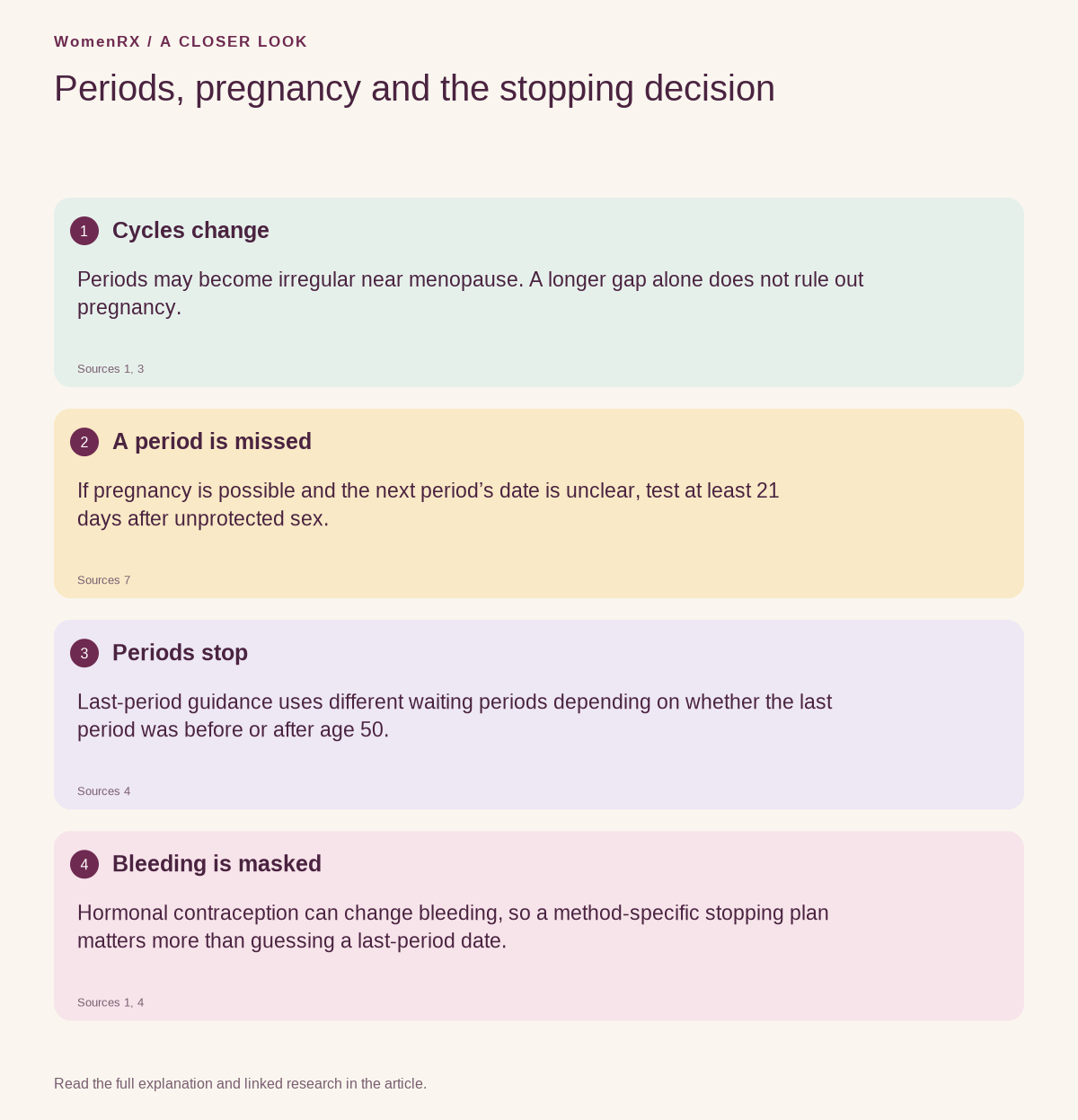
Periods, pregnancy and the stopping decision
Cycles change: Periods may become irregular near menopause. A longer gap alone does not rule out pregnancy.13
A period is missed: If pregnancy is possible and the next period’s date is unclear, test at least 21 days after unprotected sex.7
Periods stop: Last-period guidance uses different waiting periods depending on whether the last period was before or after age 50.4
Bleeding is masked: Hormonal contraception can change bleeding, so a method-specific stopping plan matters more than guessing a last-period date.14
Read the figure as text
These milestones explain why a changing cycle and a confirmed last period are not the same thing.- Cycles change: Periods may become irregular near menopause. A longer gap alone does not rule out pregnancy.13
- A period is missed: If pregnancy is possible and the next period’s date is unclear, test at least 21 days after unprotected sex.7
- Periods stop: Last-period guidance uses different waiting periods depending on whether the last period was before or after age 50.4
- Bleeding is masked: Hormonal contraception can change bleeding, so a method-specific stopping plan matters more than guessing a last-period date.14
More questions, answered
Will hormonal contraception stop a pregnancy test from working?
No. Hormones in methods such as the contraceptive pill do not stop a pregnancy test from working. Timing still matters: testing too early can produce a negative result that isn’t reliable.7
Does taking menopausal hormone therapy prevent pregnancy?
No. Menopausal hormone therapy does not act as contraception, even if it contains both estrogen and a progestogen.56
Sources you can check
- Irregular periods - NHSAccessed 2026-09-25Return to first citation
- The 2022 hormone therapy position statement of The North American Menopause Society.“The 2022 Hormone Therapy Position Statement of The North American Menopause Society” Advisory Panel. · Menopause (New York, N.Y.) · 2022Return to first citation
- Hormonal Contraception in Perimenopause: What to Consider to Guide the Choice.Fidecicchi T, Caretto M, Chen G, Simi D, Montt Guevara MM, Giannini A, Luisi S, Simoncini T. · Seminars in reproductive medicine · 2025Return to first citation
- Contraception during the perimenopause.Baldwin MK, Jensen JT. · Maturitas · 2013Return to first citation
- Pregnancy, breastfeeding and fertility while taking continuous combined HRT - NHSAccessed 2026-09-25Return to first citation
- Pregnancy, breastfeeding and fertility while taking or using sequential combined hormone replacement therapy (HRT) - NHSAccessed 2026-09-25Return to first citation
- Doing a pregnancy test - NHSAccessed 2026-09-25Return to first citation