Anxiety During Perimenopause: Possible Links and When to Get Help
Changing periods may coincide with anxiety, but the timing alone can’t show what’s causing it.
Anxiety can occur during perimenopause, and research finds associations between anxiety, hot flashes or night sweats, and sleep problems. That doesn’t prove hormone changes are the cause. Stress, a history of anxiety, a separate sleep problem, or another health issue may also matter. If anxiety is persistent, worsening, or interfering with daily life, ask about an assessment and treatment options. 2 4

A connection is possible, not certain
Perimenopause can bring several symptoms at once. In a study of 336 patients in China, researchers found different patterns of sleep disturbance, mood symptoms, hot flashes, and other complaints, rather than one uniform experience. The study was designed to describe symptom patterns; it can’t show that one symptom caused another. 3
A US systematic review of observational studies found that anxiety was more common in studies reporting frequent or severe vasomotor symptoms, meaning hot flashes and night sweats. Anxiety levels were also highest in some groups with sleep disturbance and severe hot flashes. The review says the nature of these relationships remains unclear. So the timing can be a useful clue, but it isn’t proof that perimenopause caused your anxiety. 4
Sleep may be part of the picture. Hot flashes and night sweats can coincide with disturbed sleep, and poor-quality or interrupted sleep can affect mental health and daily functioning. But sleep trouble can have other contributors too, including caffeine or alcohol, pain, health conditions, or a sleep disorder. 1 4
Prior anxiety matters as context, not as a conclusion. In one study discussed in the review, frequent vasomotor symptoms were associated with anxiety among women with both lower and higher anxiety at the start of the study. That finding doesn’t establish why anxiety developed, or predict what will happen to any one person. 4
Look beyond the menopause transition
Anxiety can be a temporary response to stress. An anxiety disorder is more likely to be considered when anxiety doesn’t go away, worsens, or gets in the way of everyday activities. Anxiety can involve hard-to-control worry as well as physical symptoms such as a rapid heartbeat, dizziness, or shortness of breath. Those symptoms deserve attention, but they don’t identify the cause on their own. 2
A useful assessment considers more than menstrual changes. A clinician may ask when anxiety began, how it affects your life, your health and medication history, and whether hot flashes or poor sleep tend to occur around the same time. Depending on your symptoms, an exam or lab tests may help check for another health problem; a psychological evaluation or referral to a mental-health professional may also be appropriate. 2
Sleep symptoms can point to a separate issue worth mentioning. For example, regularly taking a long time to fall asleep, waking often and struggling to get back to sleep, significant daytime sleepiness, loud snoring or gasping, or uncomfortable leg sensations at bedtime are reasons to raise sleep specifically. Different sleep disorders have different causes and treatments. 1
What help can address
If anxiety itself is persistent or disruptive, treatment may include psychotherapy, medication, or both. Cognitive behavioral therapy is one type of psychotherapy used for anxiety; treatment can be tailored to the person’s symptoms and needs. 2
If hot flashes or night sweats are also bothersome, discuss those as a separate treatment question. Menopause hormone therapy is an effective treatment for vasomotor symptoms, but that evidence does not establish it as a treatment for anxiety itself. 5
Before a conversation, you might jot down when anxiety and sleep changes happen, whether hot flashes or night sweats are present, and what feels harder in daily life. This isn’t a diagnostic test. It can help distinguish a pattern worth discussing from an assumption that all symptoms have one cause.
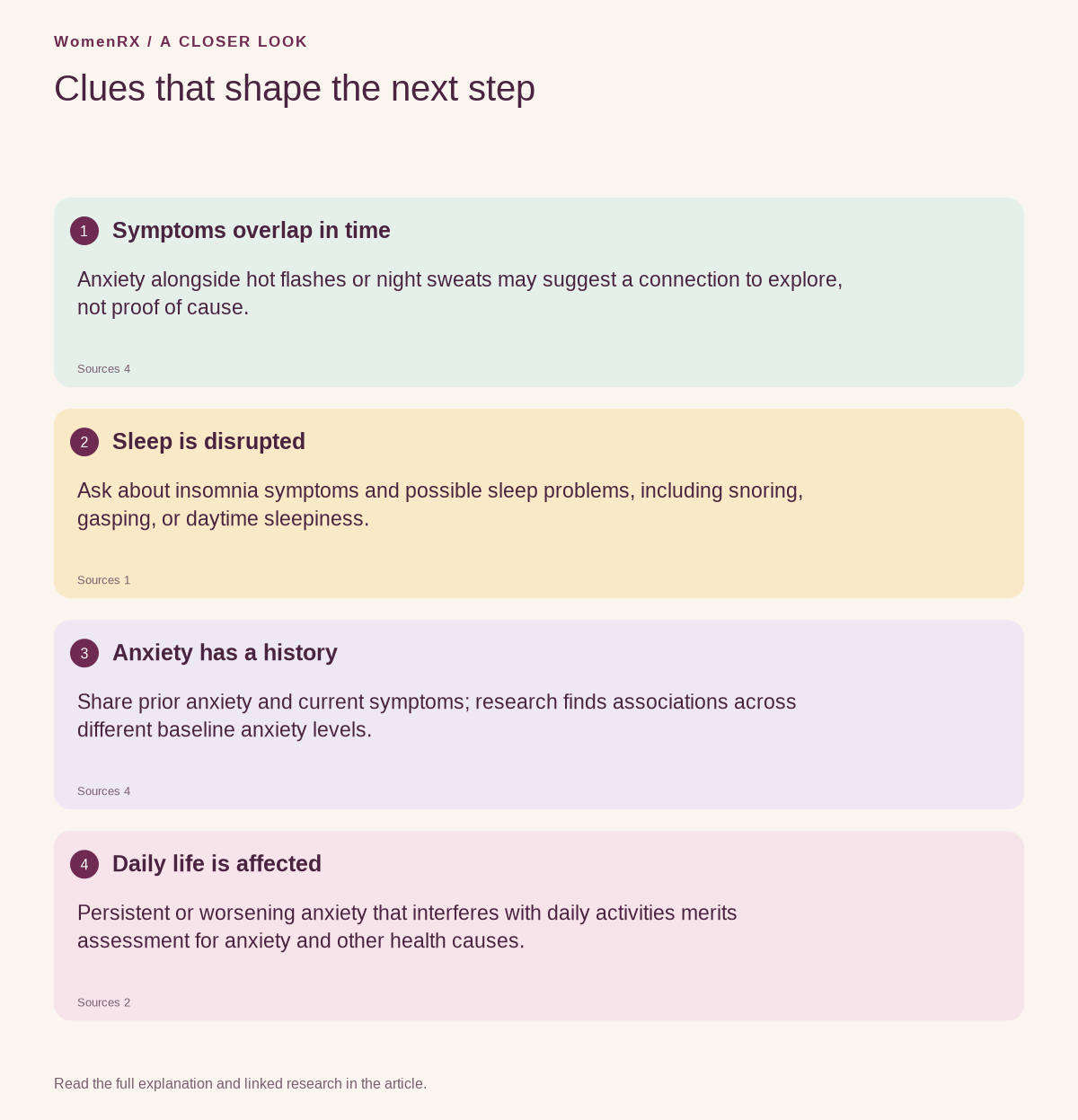
Clues that shape the next step
Symptoms overlap in time: Anxiety alongside hot flashes or night sweats may suggest a connection to explore, not proof of cause.4
Sleep is disrupted: Ask about insomnia symptoms and possible sleep problems, including snoring, gasping, or daytime sleepiness.1
Anxiety has a history: Share prior anxiety and current symptoms; research finds associations across different baseline anxiety levels.4
Daily life is affected: Persistent or worsening anxiety that interferes with daily activities merits assessment for anxiety and other health causes.2
Read the figure as text
These patterns can help organize a conversation, but none can diagnose the cause of anxiety on its own.- Symptoms overlap in time: Anxiety alongside hot flashes or night sweats may suggest a connection to explore, not proof of cause.4
- Sleep is disrupted: Ask about insomnia symptoms and possible sleep problems, including snoring, gasping, or daytime sleepiness.1
- Anxiety has a history: Share prior anxiety and current symptoms; research finds associations across different baseline anxiety levels.4
- Daily life is affected: Persistent or worsening anxiety that interferes with daily activities merits assessment for anxiety and other health causes.2
More questions, answered
Does anxiety during perimenopause mean I have an anxiety disorder?
No. Anxiety can be a response to stress. An anxiety disorder is considered when symptoms persist or worsen and interfere with daily activities; assessment also looks at health history and whether another health problem could explain symptoms. 2
Can hormone therapy treat anxiety?
The menopause hormone therapy position statement identifies treatment of bothersome hot flashes and night sweats as a use of hormone therapy. It doesn’t establish hormone therapy as a treatment for anxiety. If both symptoms are present, discuss them as related but separate concerns. 5
Sources you can check
- Sleep Disorders | MedlinePlusAccessed 2026-09-25Return to first citation
- Anxiety: MedlinePlusAccessed 2026-09-25Return to first citation
- Exploring heterogeneity of perimenopause with application of multivariable analysis approaches.Huang Z, You H, Li L, Wang S, Lyu Z, Zeng X, Zhu C, Li M, Yan H, He Y. · BMC women's health · 2024Return to first citation
- A Systematic Review of Anxiety and Depressive Symptoms Among Women Experiencing Vasomotor Symptoms Across Reproductive Stages in the US.Gibson CJ, Ajmera M, O'Sullivan F, Shiozawa A, Lozano-Ortega G, Badillo EC, Venkataraman M, Mancuso S. · International journal of women's health · 2025Return to first citation
- The 2022 hormone therapy position statement of The North American Menopause Society.“The 2022 Hormone Therapy Position Statement of The North American Menopause Society” Advisory Panel. · Menopause (New York, N.Y.) · 2022Return to first citation