New or Worsening Anxiety in Midlife: What Might Be Contributing?
Hot flashes, broken sleep, and ongoing stress can overlap with anxiety, so the pattern matters more than any one symptom.
Perimenopause may be part of the picture if anxiety appears alongside hot flashes or night sweats, but that pattern doesn’t prove hormones are the cause. Sleep disruption and ongoing stress deserve attention too. Notice when the anxiety began, what happens around it, and whether worry is becoming hard to control or interfering with daily life. 1 2 3
Notice what changed, and when
New anxiety can show up as worry, restlessness, tension, or a pounding heart. Sometimes it follows a recognizable stressor. Sometimes it seems to arrive out of nowhere. Either way, you don’t have to decide on a cause before taking it seriously, especially if it’s starting to affect work, relationships, or ordinary tasks. 1
Perimenopause is one possibility to consider, not an automatic explanation. A systematic review of observational studies of US women across reproductive stages found that anxiety was reported more often among women with frequent hot flashes or night sweats. Anxiety levels were highest in studies involving sleep disturbance and severe hot flashes. The research shows that these experiences often occur together; it doesn’t show that hormone changes caused any one woman’s anxiety. 3
A useful first question is: What else changed around the time the anxiety did? If you still have periods, consider whether your cycle pattern changed. Notice whether anxious spells coincide with hot flashes or night sweats, or whether they occur without them. The timing won’t give you a diagnosis, but it can help you describe what’s happening.
Give sleep its own place in the picture
It’s easy to fold every rough night into “menopause,” especially if night sweats are waking you. A systematic review focused on postmenopausal women found that sleep disturbances were associated with anxiety and poorer quality of life. Separately, it reported sleep disturbances even among women without vasomotor symptoms. The review doesn’t establish whether sleep disruption preceded anxiety or the reverse. 4
Think about the sequence in your own day. For example, do you feel more on edge after a night of interrupted sleep? Or does worry start at bedtime and keep you awake? You may not see a consistent pattern, and that’s useful to know too. It keeps a discussion about anxiety from overlooking sleep simply because you aren’t having night sweats.
Separate stress from the symptoms it can create
Work pressure, family demands, money worries, illness, and difficult life changes can keep stress going. Your body’s stress response can raise your heart rate and make you feel alert. That physical feeling may resemble part of an anxious spell, even when the pressure behind it is easy to name. 2
Also notice whether worry settles when a stressful moment passes or keeps returning and becomes hard to control. Anxiety disorders can involve persistent or worsening fear or worry that interferes with daily activities. Physical symptoms, including a rapid heartbeat, dizziness, and shortness of breath, can be part of anxiety, but they don’t identify its cause on their own. 1
Bring the pattern into focus
You don’t need a detailed diary. A few notes or examples can make a conversation more useful:
- Onset: When did this begin or become noticeably worse?
- What happens around it: Are there changes in periods, hot flashes, night sweats, sleep, or ongoing stress? 2 3 4
- What you feel: Is it mainly worry, a surge of physical symptoms, or both? 1
- Recent medicine changes: Did the timing coincide with starting, stopping, or changing a medicine? Note the timing rather than assuming a connection.
- Daily impact: Are you avoiding things, struggling to concentrate on responsibilities, or finding the worry hard to control? 1
If anxiety keeps returning, worsens, or limits your day, take those examples to a clinician. You can ask, “How should we think about the sleep and hot flashes alongside the anxiety, and what else might explain this change?” That leaves room to address menopausal symptoms without assuming they account for everything. Treatment for an anxiety disorder may include psychotherapy, such as cognitive behavioral therapy, medication, or both, depending on the person and the type of anxiety. 1
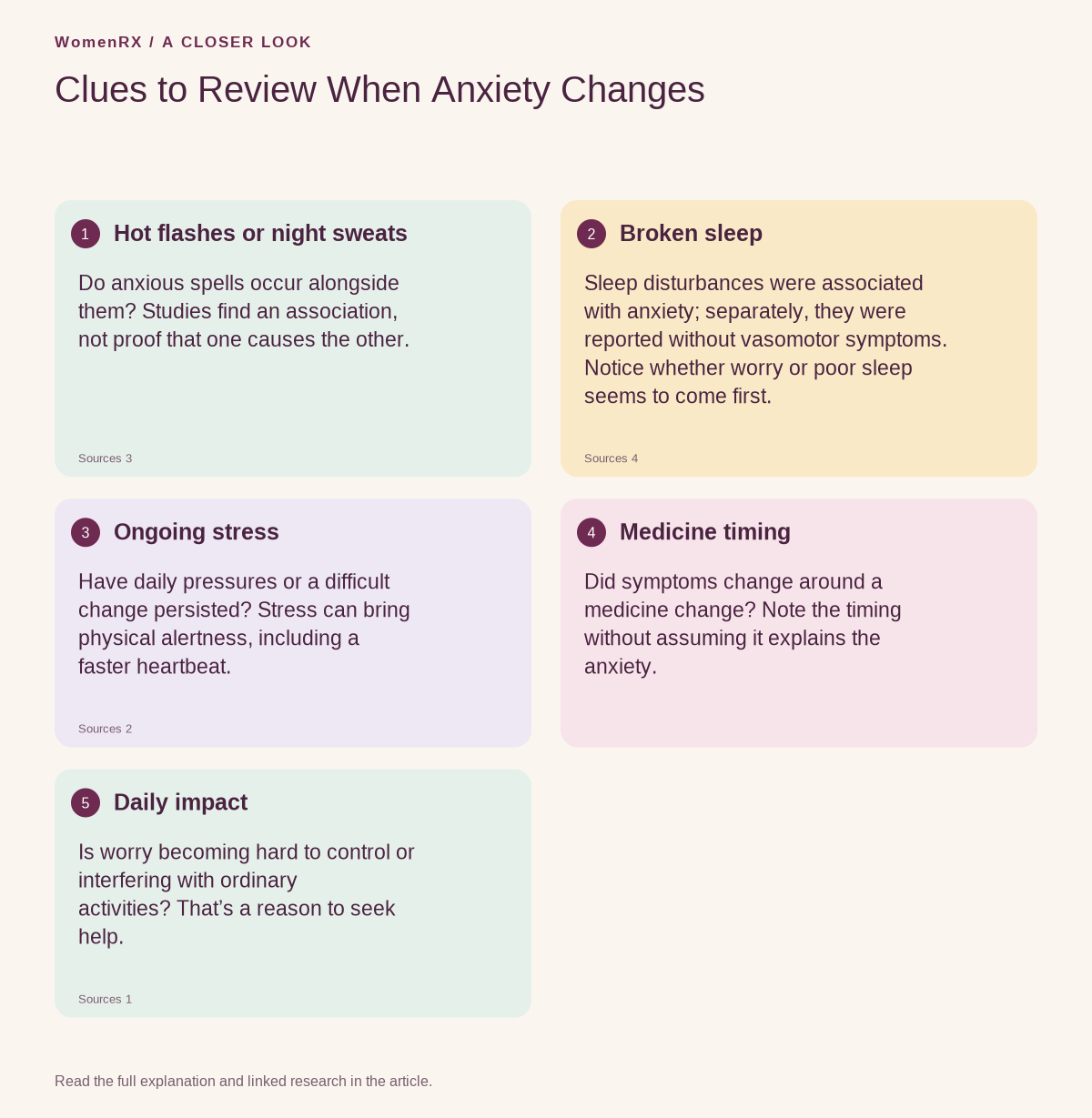
Clues to Review When Anxiety Changes
Hot flashes or night sweats: Do anxious spells occur alongside them? Studies find an association, not proof that one causes the other.3
Broken sleep: Sleep disturbances were associated with anxiety; separately, they were reported without vasomotor symptoms. Notice whether worry or poor sleep seems to come first.4
Ongoing stress: Have daily pressures or a difficult change persisted? Stress can bring physical alertness, including a faster heartbeat.2
Medicine timing: Did symptoms change around a medicine change? Note the timing without assuming it explains the anxiety.
Daily impact: Is worry becoming hard to control or interfering with ordinary activities? That’s a reason to seek help.1
Read the figure as text
These clues can overlap. Each offers a different question to consider, not a test of what caused the anxiety.- Hot flashes or night sweats: Do anxious spells occur alongside them? Studies find an association, not proof that one causes the other.3
- Broken sleep: Sleep disturbances were associated with anxiety; separately, they were reported without vasomotor symptoms. Notice whether worry or poor sleep seems to come first.4
- Ongoing stress: Have daily pressures or a difficult change persisted? Stress can bring physical alertness, including a faster heartbeat.2
- Medicine timing: Did symptoms change around a medicine change? Note the timing without assuming it explains the anxiety.
- Daily impact: Is worry becoming hard to control or interfering with ordinary activities? That’s a reason to seek help.1
Sources you can check
- Anxiety: MedlinePlusAccessed 2026-09-25Return to first citation
- Stress: MedlinePlusAccessed 2026-09-25Return to first citation
- A Systematic Review of Anxiety and Depressive Symptoms Among Women Experiencing Vasomotor Symptoms Across Reproductive Stages in the US.Gibson CJ, Ajmera M, O'Sullivan F, Shiozawa A, Lozano-Ortega G, Badillo EC, Venkataraman M, Mancuso S. · International journal of women's health · 2025Return to first citation
- Impact of sleep disturbances on health-related quality of life in postmenopausal women: a systematic review.Soares CN, Bajbouj M, Schoof N, Kishore A, Caetano C. · Menopause (New York, N.Y.) · 2026Return to first citation