Can Perimenopause Contribute to Anxiety?
Anxiety can change during perimenopause, but timing alone can’t tell you what’s causing it.
Yes. Some women report new or worsening anxiety during perimenopause, alongside hormonal and physical changes, stress, health concerns, and other life experiences. That connection is possible, not automatic: noticing anxiety at the same time as cycle or menopause symptoms doesn’t establish its cause. If it persists, worsens, or disrupts daily life, support can address anxiety while other contributors are considered. 3 1
A possible connection, not a diagnosis
New or worsening anxiety can happen during perimenopause. In interviews with 20 women ages 43 to 53 who reported this change, participants described several possible influences, including hormonal and physical changes, uncertainty, health concerns, midlife stress, and past medical history. This qualitative study offers a picture of individual experiences; it can’t tell us how common perimenopausal anxiety is or prove that hormones caused any one person’s symptoms. 3
Anxiety can also be a normal response to stress. An anxiety disorder is different: the anxiety doesn’t go away, may get worse, and can interfere with everyday activities such as work or relationships. Whether anxiety began around a change in your cycle is useful context, but it doesn’t diagnose a disorder or identify a single cause. 1
Notice patterns without treating them as proof
You might keep brief notes on when anxiety rises, cycle or menopause symptoms, sleep, and what else is happening in your life. The purpose isn’t to score yourself or prove that one symptom caused another. It’s to make the pattern easier to describe and to notice what’s affecting your day.
Consider the wider picture, too. Stress and past experiences may matter, and some physical health conditions, including thyroid problems and heart rhythm conditions, are associated with anxiety. Those are possibilities to discuss, not explanations to assume. 1 The interview study also found that women described physical changes and life circumstances alongside anxiety, rather than a single cause. 3
Choose support for the symptoms that are bothering you
If anxiety is persistent, worsening, or getting in the way of daily activities, you can seek help without first proving whether it’s related to perimenopause. A primary care clinician can consider physical health factors; a mental-health professional can assess anxiety and discuss treatment options. Psychotherapy, including cognitive behavioral therapy (CBT), medicines, or both are established treatment approaches for anxiety disorders. 1
One small case series looked at general CBT, not therapy tailored to menopause, among people in perimenopause or postmenopause. Twenty participants completed at least one session, and 16 completed all eight; anxiety scores were lower by the final session. Because there was no control group, the study can’t show how much the change was due to CBT, but it offers early support for considering this kind of therapy. 4
Menopausal hormone therapy has a different established role: the North American Menopause Society identifies it as the most effective treatment for bothersome vasomotor symptoms, such as hot flashes. That does not establish hormone therapy as a treatment for anxiety itself. If anxiety and hot flashes are both affecting you, describe each problem and discuss its treatment options separately. 2
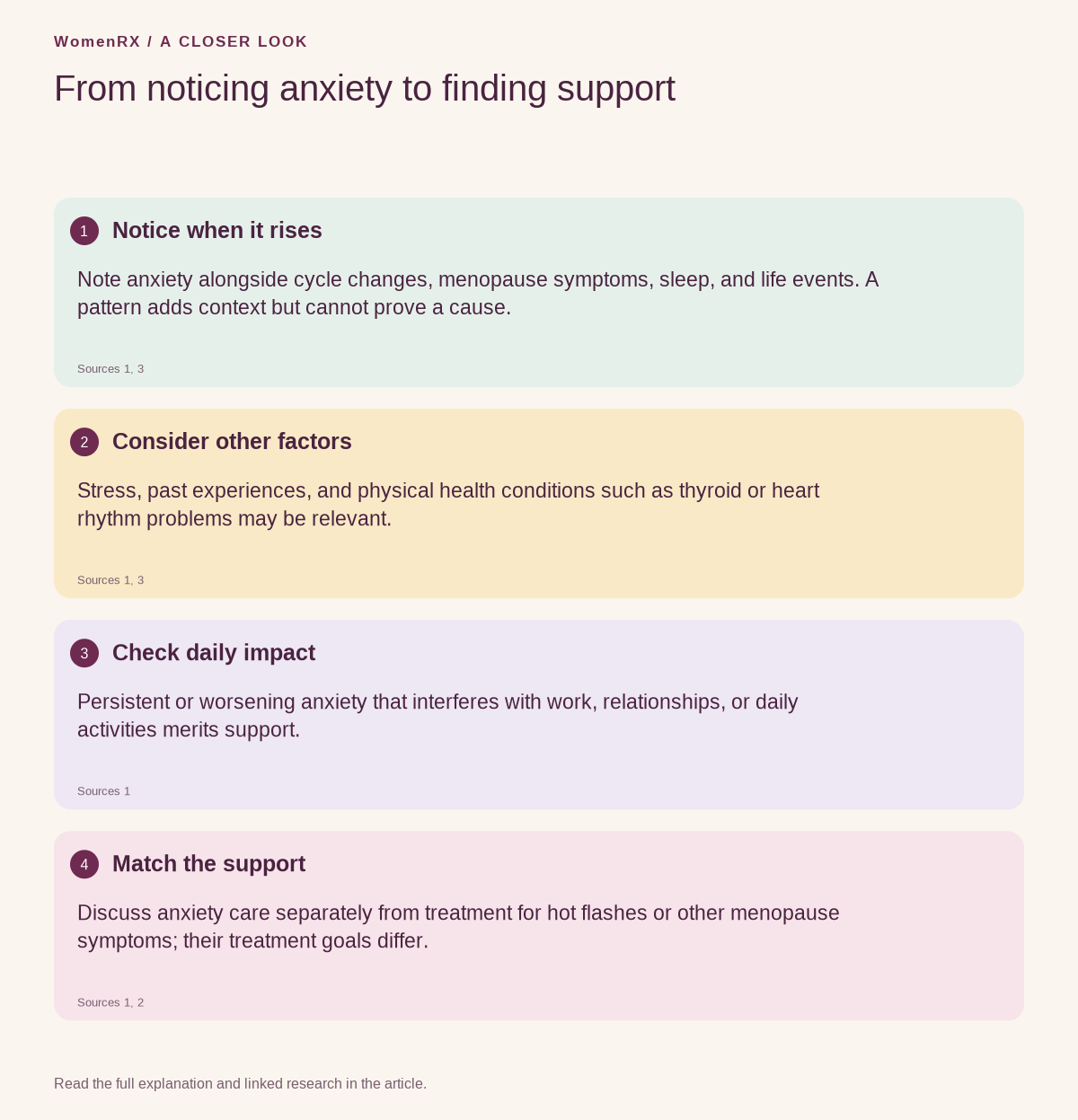
From noticing anxiety to finding support
Notice when it rises: Note anxiety alongside cycle changes, menopause symptoms, sleep, and life events. A pattern adds context but cannot prove a cause.13
Consider other factors: Stress, past experiences, and physical health conditions such as thyroid or heart rhythm problems may be relevant.13
Check daily impact: Persistent or worsening anxiety that interferes with work, relationships, or daily activities merits support.1
Match the support: Discuss anxiety care separately from treatment for hot flashes or other menopause symptoms; their treatment goals differ.12
Read the figure as text
Use timing as context, then consider how anxiety affects you and what kind of support fits. This flow is a practical guide, not a diagnostic test.- Notice when it rises: Note anxiety alongside cycle changes, menopause symptoms, sleep, and life events. A pattern adds context but cannot prove a cause.13
- Consider other factors: Stress, past experiences, and physical health conditions such as thyroid or heart rhythm problems may be relevant.13
- Check daily impact: Persistent or worsening anxiety that interferes with work, relationships, or daily activities merits support.1
- Match the support: Discuss anxiety care separately from treatment for hot flashes or other menopause symptoms; their treatment goals differ.12
More questions, answered
Does anxiety during perimenopause mean I need hormone therapy?
No. Anxiety alone doesn’t show that hormone therapy is right for you. The North American Menopause Society identifies hormone therapy as an effective treatment for bothersome vasomotor symptoms, but that is a different treatment goal from treating anxiety. 2
Sources you can check
- Anxiety: MedlinePlusAccessed 2026-09-25Return to first citation
- The 2022 hormone therapy position statement of The North American Menopause Society.“The 2022 Hormone Therapy Position Statement of The North American Menopause Society” Advisory Panel. · Menopause (New York, N.Y.) · 2022Return to first citation
- Anxiety during perimenopause: a qualitative study of lived experiences.McElhany KM, Dishman DN, Metcalf CA, Beauchamp JES. · Menopause (New York, N.Y.) · 2026Return to first citation
- Eight-session manualized cognitive behavioral therapy for anxiety and depression symptoms in perimenopause and postmenopause: a pilot study.Hantsoo L, Friedman-Wheeler DG, Lofland G, Harrison SA, Smith G, Shen W. · Menopause (New York, N.Y.) · 2026Return to first citation