How to Describe Hot Flashes at a Medical Appointment
A short account of what happens, when it happens, and what it interrupts can make your appointment more useful.
Describe what the episode feels like, where you feel it, how often it happens, and whether it interrupts sleep or daily life. Add any menstrual changes, medicines and supplements, and what you most want help with. Sudden warmth in the face, neck, or chest, sometimes with intense heat and sweating, fits a common description of a hot flash, but the description alone doesn’t establish its cause. 1
Start with what happens, not a diagnosis
You don’t have to be certain these are hot flashes before bringing them up. Menopausal vasomotor symptoms are commonly described as warmth in the face, neck, or chest, or a sudden intense feeling of heat and sweating. Tell your clinician what your episodes feel like, including anything that doesn’t fit that description. 1
A few representative examples are enough to get started. If one type of episode feels different from another, describe both rather than trying to fit them under one label. You can say, “I’m not sure these are hot flashes. Here’s what happens.” These notes can help organize the conversation, but they can’t tell you on their own whether menopause is the cause.
A short note you can fill in
Copy these prompts into your phone or jot down a few phrases. Estimates are fine, and you can leave blanks where you’re unsure.
- The sensation: “I feel , starting in . I notice sweating, flushing, or something else: ___.”
- The pattern: “It happens about ___ times during the day or night. An episode lasts about . I first noticed it .”
- The circumstances: “I’ve noticed it around ___.” If there’s no obvious pattern, say that. Noticing a possible trigger is useful context, but it doesn’t prove the trigger is the cause or that avoiding it will treat menopausal hot flashes. 3
- The effect: “It wakes me ___ / interrupts ___ / affects my day by ___.” For example, repeated sleep interruptions may matter more to you than the number of daytime episodes. In a cross-sectional study of women aged 40-60 in 12 Latin American countries, greater reported hot-flash severity was associated with lower quality-of-life scores. The study cannot show that the flashes caused that difference, but their effect on your life is worth describing. 4
- Menstrual context: “My periods have been ; my last period was , if I know.” You can say whether you think you’re approaching menopause, are past your final period, or aren’t sure. Mention pregnancy possibility if it applies, without assuming it explains the episodes.
- Medicines and supplements: Bring a current list, including prescription and over-the-counter products, vitamins, and supplements. This matters when discussing options: the patient information for fezolinetant, a nonhormonal hot-flash medicine, specifically asks for that list because medicines can affect one another. 1
- Your priority: “I’d most like help with ___.” That might be sleeping more comfortably, having fewer daytime episodes, or understanding your treatment choices.
Turn your notes into a treatment conversation
You can open with one sentence: “I’m having episodes that feel like . They happen , affect my sleep or day by , and I’d most like help with .” Ask your clinician to assess whether menopause is a plausible explanation and whether another cause needs consideration. Your notes help describe the episodes; they aren’t a test that can identify their cause.
If treatment is on your mind, your priorities and health history help focus the discussion. Menopausal hormone therapy remains the most effective treatment for vasomotor symptoms, but its benefits and risks vary with factors including age, time since menopause, treatment type, and medical history. 2
There are also evidence-supported nonhormonal options. The North American Menopause Society’s 2023 position statement recommends options including cognitive behavioral therapy, clinical hypnosis, SSRIs or SNRIs, gabapentin, and fezolinetant for menopausal vasomotor symptoms. That doesn’t mean every option will suit you. You could ask, “Given my health history and what’s bothering me most, which choices are worth discussing?” 3
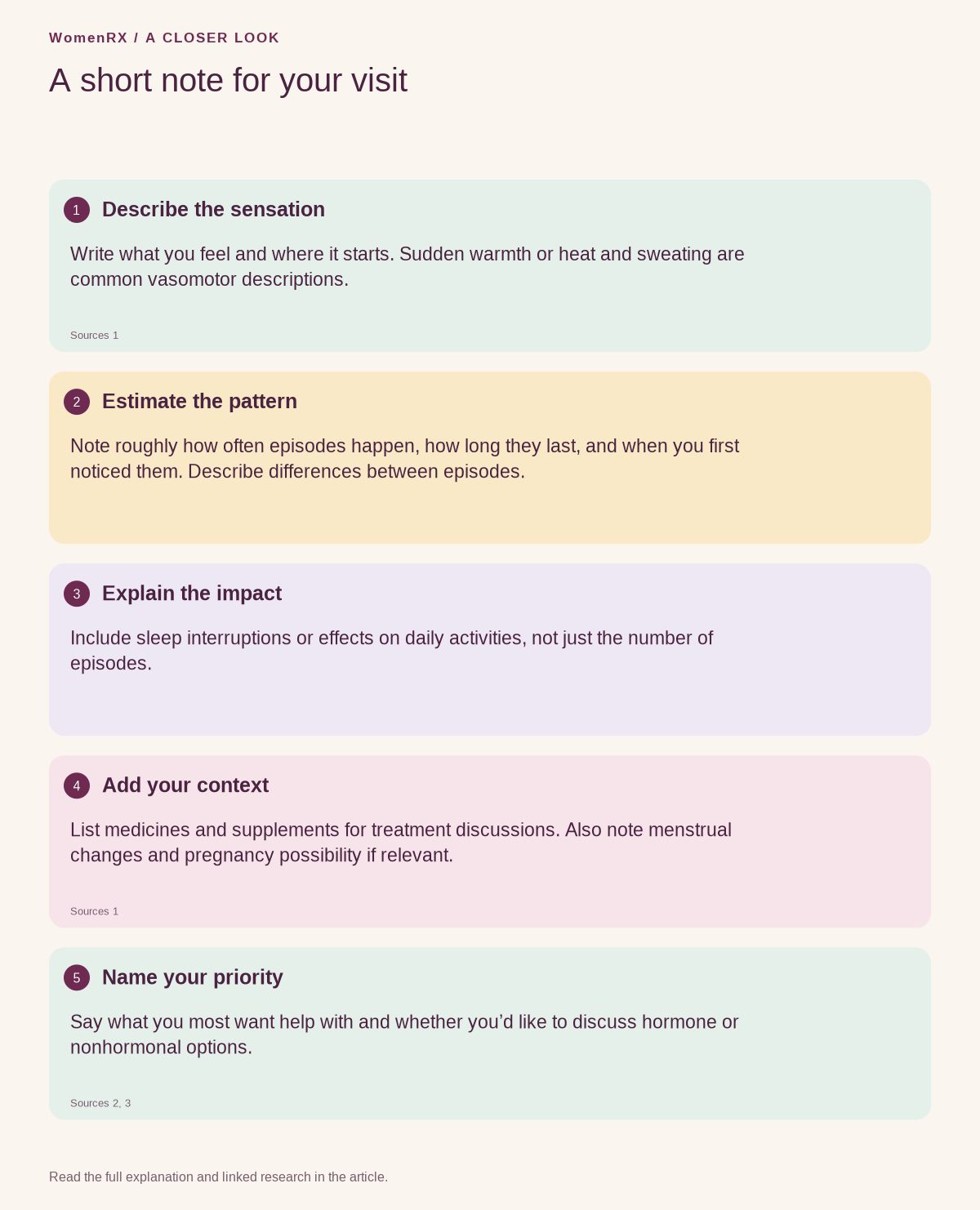
A short note for your visit
Describe the sensation: Write what you feel and where it starts. Sudden warmth or heat and sweating are common vasomotor descriptions.1
Estimate the pattern: Note roughly how often episodes happen, how long they last, and when you first noticed them. Describe differences between episodes.
Explain the impact: Include sleep interruptions or effects on daily activities, not just the number of episodes.
Add your context: List medicines and supplements for treatment discussions. Also note menstrual changes and pregnancy possibility if relevant.1
Name your priority: Say what you most want help with and whether you’d like to discuss hormone or nonhormonal options.23
Read the figure as text
Use these prompts to organize your observations and priorities. They can support a clinical assessment, but they don’t distinguish the cause or function as a diagnostic score.- Describe the sensation: Write what you feel and where it starts. Sudden warmth or heat and sweating are common vasomotor descriptions.1
- Estimate the pattern: Note roughly how often episodes happen, how long they last, and when you first noticed them. Describe differences between episodes.
- Explain the impact: Include sleep interruptions or effects on daily activities, not just the number of episodes.
- Add your context: List medicines and supplements for treatment discussions. Also note menstrual changes and pregnancy possibility if relevant.1
- Name your priority: Say what you most want help with and whether you’d like to discuss hormone or nonhormonal options.23
Sources you can check
- VEOZAH (FEZOLINETANT) TABLET, FILM COATED [ASTELLAS PHARMA US, INC.] | US prescribing information and patient instructionsAccessed 2026-09-25Return to first citation
- The 2022 hormone therapy position statement of The North American Menopause Society.“The 2022 Hormone Therapy Position Statement of The North American Menopause Society” Advisory Panel. · Menopause (New York, N.Y.) · 2022Return to first citation
- The 2023 nonhormone therapy position statement of The North American Menopause Society.Menopause (New York, N.Y.) · 2023Return to first citation
- Hot flashes: a potential marker of deterioration of health-related quality of life.Blümel JE, Vallejo MS, Chedraui P, Arteaga E, Ayala F, Bencosme A, Calle A, Costa-Paiva L, Dextre M, Díaz K, Elizalde-Cremonte A, Elizalde-Cremonte S, Escalante C, Espinoza MT, Gar... · Climacteric : the journal of the International Menopause Society · 2026Return to first citation