Perimenopause Mood Changes: How to Spot a Pattern
Noting mood alongside sleep, bleeding, hot flashes, and stress can make an unpredictable stretch easier to describe.
Mood changes can happen during perimenopause, sometimes alongside changes in bleeding, sleep, or hot flashes. A short record can help you see when symptoms overlap, though it can’t tell you what caused them. If low mood or severe mood swings are affecting daily life, seek support rather than waiting to find a cycle pattern. 1 4 5
Several things can be happening at once
You might feel unusually irritable after a broken night’s sleep, or notice a low mood around a change in bleeding. That timing is worth noticing, but it isn’t a diagnosis. Perimenopause can involve mood changes, disrupted sleep, hot flashes, and changes in bleeding, and the mix varies from person to person. 5
In an observational study of 2,066 women who reached natural menopause, hot flashes and sleep disturbances were each associated with roughly double the odds of the other. Hot flashes and frequent mood changes were also associated with about 50% to 60% higher odds of the other. The researchers used annual visits, so these findings describe overlap across the transition, not whether a particular bad night caused a mood change the next day. 4
There’s more to the picture than menopause symptoms. Ongoing stress and difficult life events can affect mood, while a person’s mental-health history may matter too. An existing mental-health condition shouldn’t be dismissed as “just hormones” because menstrual patterns are changing. 1 2
Make a record you can actually use
If you want to look for a pattern, try a few words on days you notice a change. Put mood and its effect on your day next to sleep, bleeding, and hot flashes or night waking. Add a major stressor if one occurred. You can also note when a medicine or supplement changed so you can give an accurate account of the timing, without assuming it explains your mood.
For example, “irritable; woke with hot flashes; bleeding started; stressful workday” captures more than “bad mood.” On another day, the useful observation might be “low mood; slept as usual; no bleeding.” Neither entry proves a cause. Together, entries can help you explain whether changes seem brief and tied to other events, or keep showing up without an obvious pattern.
You don’t need a perfect daily log. If writing things down makes you more preoccupied with symptoms, describing what you remember is enough. The point is to bring the whole picture into a conversation, not to assign yourself a score.
Know when the pattern isn’t the priority
Consider how much the change is affecting you, not only when it happens. Changes in sleep or eating, severe mood swings that cause relationship problems, and trouble functioning day to day can be signs that mental-health support would help. A clinician can hear about the timing of your symptoms alongside any past depression or anxiety, current stress, and changes in your usual activities. A record can help with that conversation, but it can’t distinguish a mental-health condition from perimenopause on its own. 1 2
If you have thoughts of suicide or feel unable to cope, get help right away. Don’t wait to collect more entries or see whether your next cycle is different. 2
Match the help to the problem
If hot flashes are repeatedly bothering you, say so alongside the mood change. Menopausal hormone therapy is the most effective treatment for hot flashes and other vasomotor symptoms, but that doesn’t make it the automatic treatment for every change in mood. Decisions about it depend on the individual’s symptoms and health circumstances. 3
Mood symptoms also deserve attention in their own right. Talk therapy and medicines are among the treatments for mental-health conditions. If stress is a substantial part of what you’re dealing with, physical activity or a relaxation practice may help you manage it. You don’t have to settle the question of which factor came first before asking for support with what’s making life harder now. 1 2
What a few notes might reveal
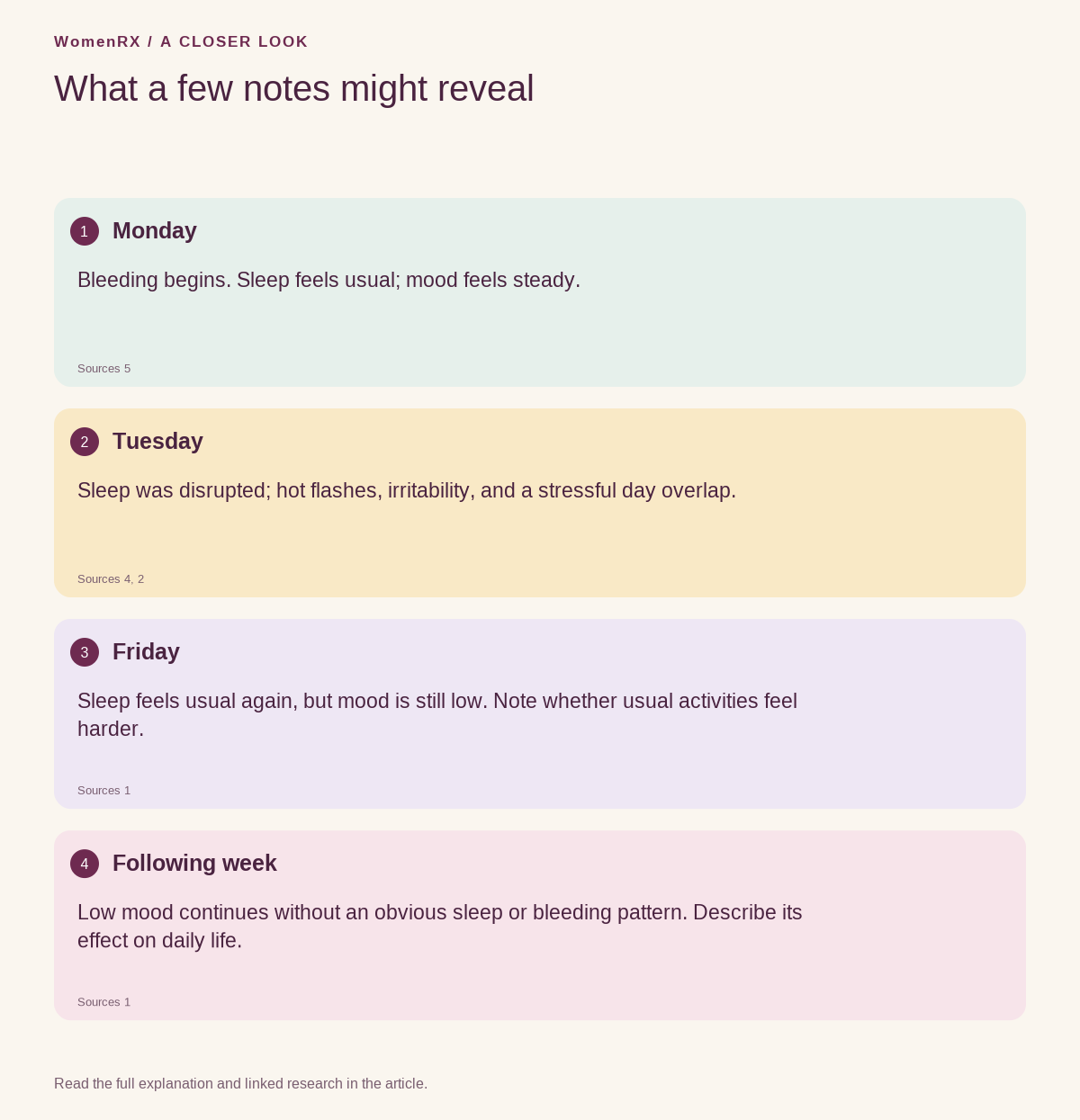
Monday: Bleeding begins. Sleep feels usual; mood feels steady.5
Tuesday: Sleep was disrupted; hot flashes, irritability, and a stressful day overlap.42
Friday: Sleep feels usual again, but mood is still low. Note whether usual activities feel harder.1
Following week: Low mood continues without an obvious sleep or bleeding pattern. Describe its effect on daily life.1
Read the figure as text
Illustrative entries, not a real person’s record or a typical perimenopause pattern. Each entry puts timing and context together.- Monday: Bleeding begins. Sleep feels usual; mood feels steady.5
- Tuesday: Sleep was disrupted; hot flashes, irritability, and a stressful day overlap.42
- Friday: Sleep feels usual again, but mood is still low. Note whether usual activities feel harder.1
- Following week: Low mood continues without an obvious sleep or bleeding pattern. Describe its effect on daily life.1
Sources you can check
- Mental Health: MedlinePlusAccessed 2026-09-25Return to first citation
- Stress: MedlinePlusAccessed 2026-09-25Return to first citation
- The 2022 hormone therapy position statement of The North American Menopause Society.“The 2022 Hormone Therapy Position Statement of The North American Menopause Society” Advisory Panel. · Menopause (New York, N.Y.) · 2022Return to first citation
- Associations between vasomotor symptoms, sleep disturbances, and frequent mood changes individually and within symptom groups across the menopausal transition and early postmenopause: observations from the Study of Women's Health Across the Nation.Maki PM, Inan Eroglu E, Janssenswillen C, Frenz AK, Heeg S, Nadimi M, Genga K, Schoof N, Moeller C, Soehngen L, Halvorson L, Dinkel-Keuthage C. · Menopause (New York, N.Y.) · 2026Return to first citation
- Hormonal Options for Perimenopause: A Clinician Toolkit.Piasta J, Zewail A. · Obstetrics and gynecology · 2026Return to first citation