Dry Mouth on GLP-1 Medicines: What Might Be Contributing?
A dry mouth can happen alongside reduced fluid intake, but the sensation alone doesn’t prove you’re dehydrated.
Dry mouth has been reported in research on GLP-1 medicines, but those reports don’t show how often it happens or prove the medicine caused it. Dry mouth means there may be too little saliva. 1 Dehydration means your body has lost more fluid than it takes in. 3 The two can overlap, so consider your fluid intake, other symptoms, and any medication changes. 4 5
First, separate the symptom from the cause
Dry mouth, or xerostomia, is a sticky or dry feeling that can make talking, chewing, swallowing, or tasting uncomfortable. It describes what your mouth feels like, not why it feels that way. Dehydration is a broader problem: your body has lost more fluid than you’re taking in. Dry mouth can be one sign of dehydration, but it can also have other causes. 1 3
There is a signal worth knowing about, but not a clear answer about cause or frequency. A 2025 analysis of reports to the FDA’s adverse-event database found a reporting signal for dry mouth with semaglutide. Such reports can flag a possible association, but they can’t show how often a side effect occurs or establish that the medicine caused it. A 2026 review also describes a small semaglutide case series involving dry mouth or reduced saliva; it had no comparison group, so it can’t establish cause and effect. These findings don’t confirm dry mouth as an established effect across the whole drug class. 4 5
Check what else changed
If your mouth started feeling dry during treatment, consider these possibilities together rather than assuming one explanation:
- You’re taking in less fluid. If nausea or other treatment-related effects have made drinking difficult, reduced intake could contribute to fluid loss. The 2026 review lists nausea and diarrhea among gastrointestinal effects in its drug comparison, but it doesn’t establish that either explains an individual person’s dry mouth. 3 4
- Another medicine may be involved. Some medicines can reduce saliva. A medication review is useful if you recently started or changed a prescription, or if you take several medicines. Don’t stop a prescribed medicine on your own. 1 2
- The dryness has another explanation. Mouth breathing at night, oral thrush, and conditions such as diabetes or Sjögren’s syndrome can be associated with persistent dry mouth. 2
Also notice whether you feel unusually thirsty, urinate less than usual, or have other signs that your fluid intake may not be keeping up. Dry mouth alone doesn’t diagnose dehydration; the broader pattern matters. 3
A focused check-in
Before contacting the clinician who prescribes your GLP-1 medicine, or a pharmacist or dentist, jot down a few specifics:
- When the dryness began, and whether it followed a medication start or change.
- Whether you’re drinking less than usual or having trouble keeping fluids down.
- Whether you’re urinating less than usual or feeling very thirsty.
- What other medicines or nonprescription products you take, including anything recently added or changed.
- Whether dry eyes, frequent urination, sore white patches, or difficulty eating or talking are also present. 1 2 3
This isn’t a diagnostic checklist. It helps make the conversation more concrete. Persistent dryness, trouble eating or speaking, dry eyes, frequent urination, or suspected medicine-related symptoms are reasons to seek an assessment. Don’t change or stop a prescription without medical advice. 1 2
What may ease the feeling
For temporary relief, try regular sips of water and sugar-free gum or candy to encourage saliva. An alcohol-free mouthwash or a product made for dry mouth may also help; a pharmacist can help you choose one. Keep up with brushing and flossing, since dry mouth can increase the risk of tooth decay. 1 2
If you have dry mouth along with signs of fluid loss, address the fluid concern too. MedlinePlus lists thirst, dry mouth, and urinating less than usual among dehydration symptoms, and recommends replacing lost fluids. If you’re struggling to drink or symptoms persist, get advice based on what’s causing the problem rather than treating mouth dryness alone. 3
What’s known for women
Reports of dry mouth with GLP-1 medicines do not establish how often it happens or whether the risk differs for women. The small semaglutide case series included mixed adults; the adverse-event reporting signal cannot measure a dry-mouth rate for women or establish a difference in risk by sex. These findings therefore can’t tell whether women experience dry mouth more or less often. 4 5
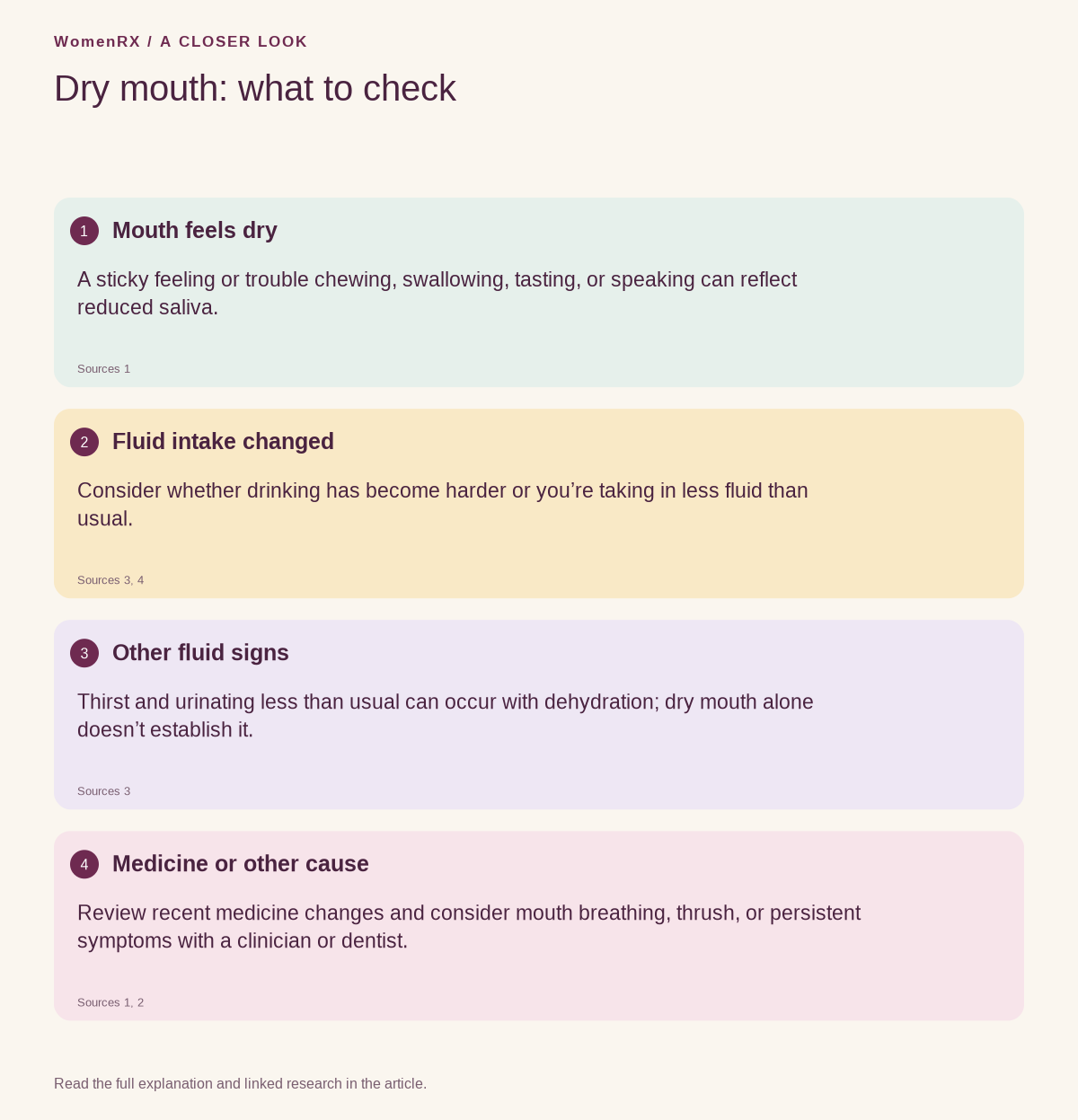
Dry mouth: what to check
Mouth feels dry: A sticky feeling or trouble chewing, swallowing, tasting, or speaking can reflect reduced saliva.1
Fluid intake changed: Consider whether drinking has become harder or you’re taking in less fluid than usual.34
Other fluid signs: Thirst and urinating less than usual can occur with dehydration; dry mouth alone doesn’t establish it.3
Medicine or other cause: Review recent medicine changes and consider mouth breathing, thrush, or persistent symptoms with a clinician or dentist.12
Read the figure as text
Dry mouth is a symptom with several possible contributors. These prompts help distinguish a mouth-only complaint from a wider fluid or medication concern.- Mouth feels dry: A sticky feeling or trouble chewing, swallowing, tasting, or speaking can reflect reduced saliva.1
- Fluid intake changed: Consider whether drinking has become harder or you’re taking in less fluid than usual.34
- Other fluid signs: Thirst and urinating less than usual can occur with dehydration; dry mouth alone doesn’t establish it.3
- Medicine or other cause: Review recent medicine changes and consider mouth breathing, thrush, or persistent symptoms with a clinician or dentist.12
More questions, answered
Does dry mouth mean I’m dehydrated?
Not necessarily. Dry mouth can be a dehydration symptom, but medicines and other causes can also reduce saliva. Consider it alongside thirst, fluid intake, and changes in urination. 1 3
Should I stop my GLP-1 medicine if my mouth is dry?
Don’t stop or change a prescribed medicine on your own. Ask the prescriber or a pharmacist to review the timing of the dryness and your full medication list. 2
Sources you can check
- Dry Mouth: MedlinePlusAccessed 2026-09-25Return to first citation
- Dry mouth - NHSAccessed 2026-09-25Return to first citation
- Dehydration: MedlinePlusAccessed 2026-09-25Return to first citation
- GLP-1 Receptor Agonists in Periodontology: Mechanisms, Clinical Evidence, and Implications for Care.Sufaru IG, Vasiliu BC, Hancianu M, Stratul SI, Tatarciuc MS, Iovan G, Tatarciuc D, Rudnic I, Hanu D, Paduraru S, Solomon SM. · Biomolecules · 2026Return to first citation
- Otolaryngologic Side Effects of GLP-1 Receptor Agonists.Khan FI, Vazquez SG, Mehdi Z, Somawardana I, Dongre R, Razmi S, Rashidi K, Shenoi J, Khan N, Dhanda A, Takashima M, Ahmed OG. · The Laryngoscope · 2025Return to first citation