Muscle-Building Supplements: What Helps Beyond Training and Food?
Creatine monohydrate has promising results in postmenopausal women who strength train, while protein powders are most useful as a convenient food option, not a shortcut.
Supplements aren’t required to build muscle: resistance training is the foundation. A review of postmenopausal-women trials found small average lean-mass and leg-press gains with creatine monohydrate; benefits were evident in trials combining it with resistance training. Protein powder can make adding protein convenient. Evidence for an extra muscle-mass benefit from supplements across women is less conclusive, and BCAAs and HMB have weaker or less applicable evidence. 2 3 4 5
Start with what the supplement is adding
A supplement can support muscle-building, but it doesn’t replace the work of resistance training or make up for a plan that isn’t meeting your needs. The useful question is not “What’s the best muscle supplement?” It’s “What, if anything, is missing from my training and food?”
For protein powder, that may be convenience: it’s a way to add protein when a meal or snack isn’t practical. The women’s research doesn’t establish that adding a protein supplement automatically builds more muscle. For creatine monohydrate, the evidence is more specific: studies in postmenopausal women suggest a modest added benefit when it’s paired with resistance training. 2 3
Creatine monohydrate: the clearest women-specific signal, with limits
A systematic review and meta-analysis of seven randomized trials in postmenopausal women found that creatine monohydrate was associated with an average 0.37 kg greater gain in lean mass than control groups. In three trials reporting leg-press strength, the average difference was 7.5 kg. The review included studies with and without resistance training, but these pooled figures aren’t estimates of the supplement’s added effect during training alone. The studies lasted from 12 to 104 weeks, with a median duration of 38 weeks. These are averages across small groups of trials, not a promise of a particular result for you. 2
The same review found that results varied with the study setup: benefits were evident in trials combining at least 5 g/day of creatine monohydrate with resistance training, while trials using 3 g/day or less without training found no measurable effect. This doesn’t establish one ideal routine for every woman. It does underline the key point: the training context matters when interpreting the results. 2
A broader review of 14 trials in women across reproductive stages found no significant overall benefit for muscle-mass measures when different supplements were grouped together with exercise. It did find small improvements in some strength measures, including bench press and handgrip. Because that analysis combined protein, amino acids, and creatine monohydrate, it can’t tell you how much of the result came from creatine monohydrate alone. 3
Creatine monohydrate’s safety findings are reassuring but bounded. In the postmenopausal-women review, reported adverse events were mild and similar to placebo, and kidney-related lab measures did not change. The trials excluded severe comorbid conditions, so those findings don’t establish safety for someone with kidney disease or other significant health conditions. 2
Protein powder: a convenient option, not a separate category of muscle
The women’s review included trials of whole-protein supplements such as whey and soy, as well as other nutritional supplements. It did not find a significant overall improvement in muscle-mass measures from supplementation plus exercise. Since the analysis combined different products, study populations, and exercise programs, it can’t settle whether a specific protein product helps a particular woman whose food intake is inadequate. 3
A review comparing nutrition strategies alongside resistance training in healthy older adults reported benefits from protein supplementation for strength and muscle mass compared with training alone. That finding is for healthy older adults overall, not a women-specific result; it also doesn’t guarantee the same effect for younger trainees. 5
In practice, compare a powder with the food you’d otherwise have. If it fills a real convenience gap, it may be useful. If you already have a routine that works for you, adding a tub of powder isn’t automatically an upgrade. Whey and soy appeared in the women’s trial review, but that review does not establish one as better for building muscle. 3
BCAAs and HMB: less convincing reasons to add another tub
Branched-chain amino acids (BCAAs) are often marketed as a muscle-building add-on. In a meta-analysis of trials involving older adults with sarcopenia, BCAA-rich supplements combined with resistance training improved one muscle-index measure, but did not significantly improve total lean mass, handgrip strength, or several measures of physical function. The results don’t establish a benefit for younger women or women without sarcopenia. 4
A review of healthy older adults also found no significant improvement in muscle strength or mass from HMB plus resistance training compared with training alone. That evidence is not specific to women, but it offers little reason to treat HMB as a proven upgrade for a generally healthy woman who strength trains. 5
A practical label check
Before buying, pause over the label and ask:
- What is the main ingredient? Check whether you’re choosing protein, creatine monohydrate, or a multi-ingredient blend. Don’t assume they do the same job.
- What does one serving provide? Compare the amount of the named ingredient, not just the large number on the front of the package. For context, benefits in the postmenopausal-women review were evident in trials combining at least 5 g/day of creatine monohydrate with resistance training. That’s a description of the studied conditions, not a target for everyone. 2
- What else is included? Read the ingredient list for sweeteners, flavorings, or other added ingredients you may want to avoid.
- Does a health condition change the decision? If you have kidney disease, ask your kidney care team before adding a supplement. The creatine monohydrate trials’ kidney findings don’t establish safety for people with kidney disease. 1 2
- Does this solve a real problem? A powder may make a rushed day easier. An add-on with uncertain benefit may simply add cost and complexity.
These are product-comparison questions, not proof that a label can guarantee results. The studies don’t show that a supplement can replace resistance training, and the women’s evidence doesn’t support treating every product marketed for muscle as equally effective.
What each supplement adds to training
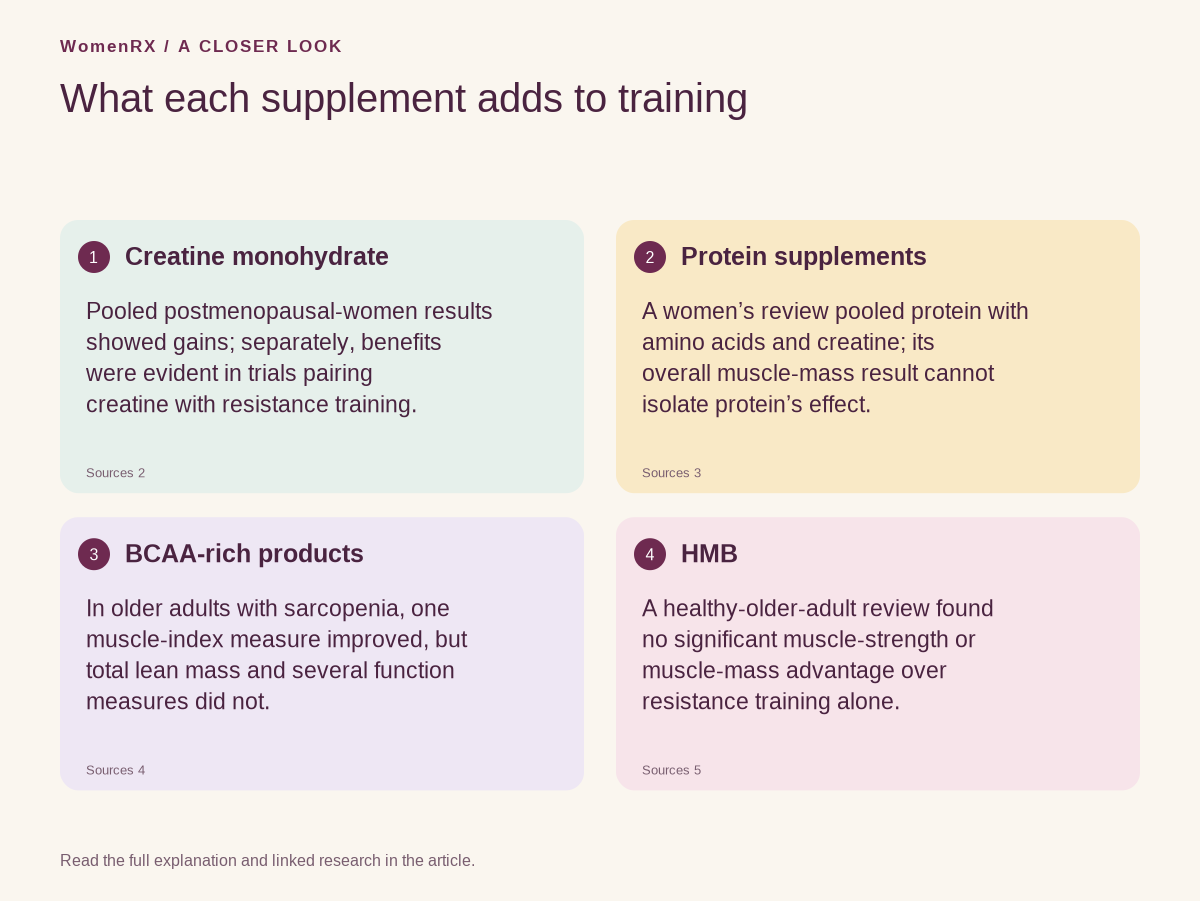
Creatine monohydrate: Pooled postmenopausal-women results showed gains; separately, benefits were evident in trials pairing creatine with resistance training.2
Protein supplements: A women’s review pooled protein with amino acids and creatine; its overall muscle-mass result cannot isolate protein’s effect.3
BCAA-rich products: In older adults with sarcopenia, one muscle-index measure improved, but total lean mass and several function measures did not.4
HMB: A healthy-older-adult review found no significant muscle-strength or muscle-mass advantage over resistance training alone.5
Read the figure as text
Compare the studied form, training context, and population behind each finding.- Creatine monohydrate: Pooled postmenopausal-women results showed gains; separately, benefits were evident in trials pairing creatine with resistance training.2
- Protein supplements: A women’s review pooled protein with amino acids and creatine; its overall muscle-mass result cannot isolate protein’s effect.3
- BCAA-rich products: In older adults with sarcopenia, one muscle-index measure improved, but total lean mass and several function measures did not.4
- HMB: A healthy-older-adult review found no significant muscle-strength or muscle-mass advantage over resistance training alone.5
More questions, answered
Do creatine monohydrate findings apply to every stage of a woman’s life?
The clearest women-specific creatine monohydrate findings here come from trials in postmenopausal women. A broader review included women across reproductive stages, but combined multiple kinds of supplements, so it can’t show a creatine monohydrate-specific effect at each life stage. 2 3
What if I have kidney disease?
The creatine monohydrate review’s reassuring kidney-lab findings came from trials that excluded severe comorbid conditions, so they don’t establish safety for people with kidney disease. Kidney disease can affect how well the kidneys filter blood. Ask your kidney care team about a supplement before adding it. 1 2
Sources you can check
- Chronic Kidney Disease | Kidney Disease | CKD | MedlineplusAccessed 2026-09-25Return to first citation
- Creatine monohydrate for lean mass, strength, and bone density in postmenopausal women: a systematic review and meta-analysis.Naddafha S, Antonio J, Kreider RB, Stout JR. · Journal of the International Society of Sports Nutrition · 2026Return to first citation
- Nutritional Supplementation Combined with Exercise for Musculoskeletal Health in Women: A Systematic Review and Meta-Analysis Evaluating Proteins, Amino Acids, and Creatine across Reproductive Stages.Chen KH, Yeh TP, Lin SC, Liu PJ, Bai D, Chen IH. · International journal of medical sciences · 2026Return to first citation
- Effects of branched-chain amino acid-rich nutritional supplements combined with resistance training on body composition and body function in older patients with sarcopenia.Li H, Zhang R, Ma Y, He J, Li G, Sun J, DuanyingLi. · Archives of gerontology and geriatrics · 2026Return to first citation
- The impact of nutritional intervention and resistance training on muscle strength and mass in healthy older adults-a comparative analysis.Ma Y, Yan R, Li Y, Li D, Sun X, Chen T, Liu X. · Frontiers in nutrition · 2025Return to first citation