Whole30 or Mediterranean-Style Eating: Which Fits Your Life?
Whole30 offers a defined elimination and reintroduction program; Mediterranean-style eating offers a more flexible pattern studied in clinical trials.
Whole30 is a structured food-elimination program, not simply another name for eating whole foods. Mediterranean-style eating keeps foods such as beans, whole grains, and yogurt in the picture. If your goal is lasting weight management, compare what you can realistically keep doing, not just what you can follow for a few weeks. Research on Mediterranean-style interventions cannot tell us that Whole30 produces the same results. 834
The central difference is what happens to everyday foods
The Original Whole30 starts with 30 days of elimination, followed by at least 10 days of reintroducing food groups one at a time. During elimination, it excludes grains, legumes, dairy, added sweeteners, and alcohol, among other foods and prepared versions of them. It allows foods including vegetables, fruit, eggs, seafood, meat, and fats. The program does not require calorie counting and asks participants not to weigh themselves during the elimination phase. These are program rules, not findings that every excluded food causes symptoms. 8
Mediterranean-style eating is a pattern rather than a 30-day challenge. It emphasizes vegetables, fruit, legumes, whole grains, nuts, and olive oil, with room for foods such as fish and dairy. You can adapt those principles to foods you already cook rather than recreating a particular region’s menu. A review of adaptations to South Asian food traditions, for example, describes using locally familiar grains, legumes, vegetables, proteins, and fats while accounting for affordability and cooking customs. 42
That makes the contrast concrete: lentil soup, oatmeal, or plain yogurt can fit a Mediterranean-style meal, but legumes, grains, and dairy are excluded during Whole30’s elimination phase. Whole30 does have a planned reintroduction phase, so its initial exclusions aren’t meant to describe every meal forever. 84
What the research can and can’t settle
Mediterranean-style interventions have been studied for outcomes beyond whether someone can finish a challenge. In a Spanish randomized trial of adults ages 55 to 75 with metabolic syndrome and overweight or obesity, a group offered an energy-reduced Mediterranean diet plus physical activity and behavioral support had greater reductions in weight and waist circumference than a group offered advice to eat an unrestricted Mediterranean diet. That result belongs to the combined intervention; it doesn’t show what the food pattern alone would do, and neither group followed Whole30. The trial abstract does not report results separately for women and men, so it cannot show whether the intervention’s effects differed by sex. 3
Women are represented in some Mediterranean-style research, but that still doesn’t establish a best diet for women as a whole. For example, a secondary analysis of a 12-week trial included 88 Chinese women without diabetes who had fatty liver disease. Greater Mediterranean-diet adherence was associated with improvements in liver fat and blood lipids after accounting for weight change. Because this was an adherence analysis in a specific group, it cannot predict an individual woman’s weight loss or compare her results with Whole30. 4
The Whole30 program describes its own rules and participant experiences. Those descriptions are useful for knowing what participation involves, but they are not a clinical comparison with Mediterranean-style eating. Neither approach needs to win a universal contest for you to make a useful choice: the cited clinical findings about Mediterranean-style interventions and the different practical demands of the two approaches are both relevant. 834
Compare the burden before you compare the appeal
Think through a normal grocery trip, a workday lunch, and a meal with other people. Whole30’s elimination rules mean checking whether familiar staples and prepared foods fit, then making room for a separate reintroduction phase. Mediterranean-style eating leaves more ways to use staples such as beans and whole grains, though changing how you shop or cook can still take effort. These differences don’t establish which one costs less: your bill depends on the foods you choose, what’s already in your kitchen, and what you can buy locally. 824
If you want to try a change, decide what success would look like after the initial enthusiasm fades. For example, could you make lunches you like without a separate set of rules for eating with family? Would a defined elimination and reintroduction project answer a question you actually have, or would adding vegetables and beans to familiar meals serve your goal better? Neither option requires calling an ordinary meal a failure.
If weight management is your goal, remember that a diet label alone doesn’t determine weight change. MedlinePlus notes that portion control can be part of weight loss. It also warns that fad or crash diets that severely restrict calories or food types rarely lead to permanent weight loss; that statement is not a finding about Whole30. You can also choose neither named approach and make changes to meals you already enjoy. 5
One Mediterranean-style trial described here excluded pregnant and lactating women, so its findings do not address those stages. NIDDK provides separate guidance on healthy habits during pregnancy. 67
If you have a history of an eating disorder, an elimination challenge is not a requirement for working on your eating goals. MedlinePlus notes that weight-management plans can account for health conditions and may include counseling. 1
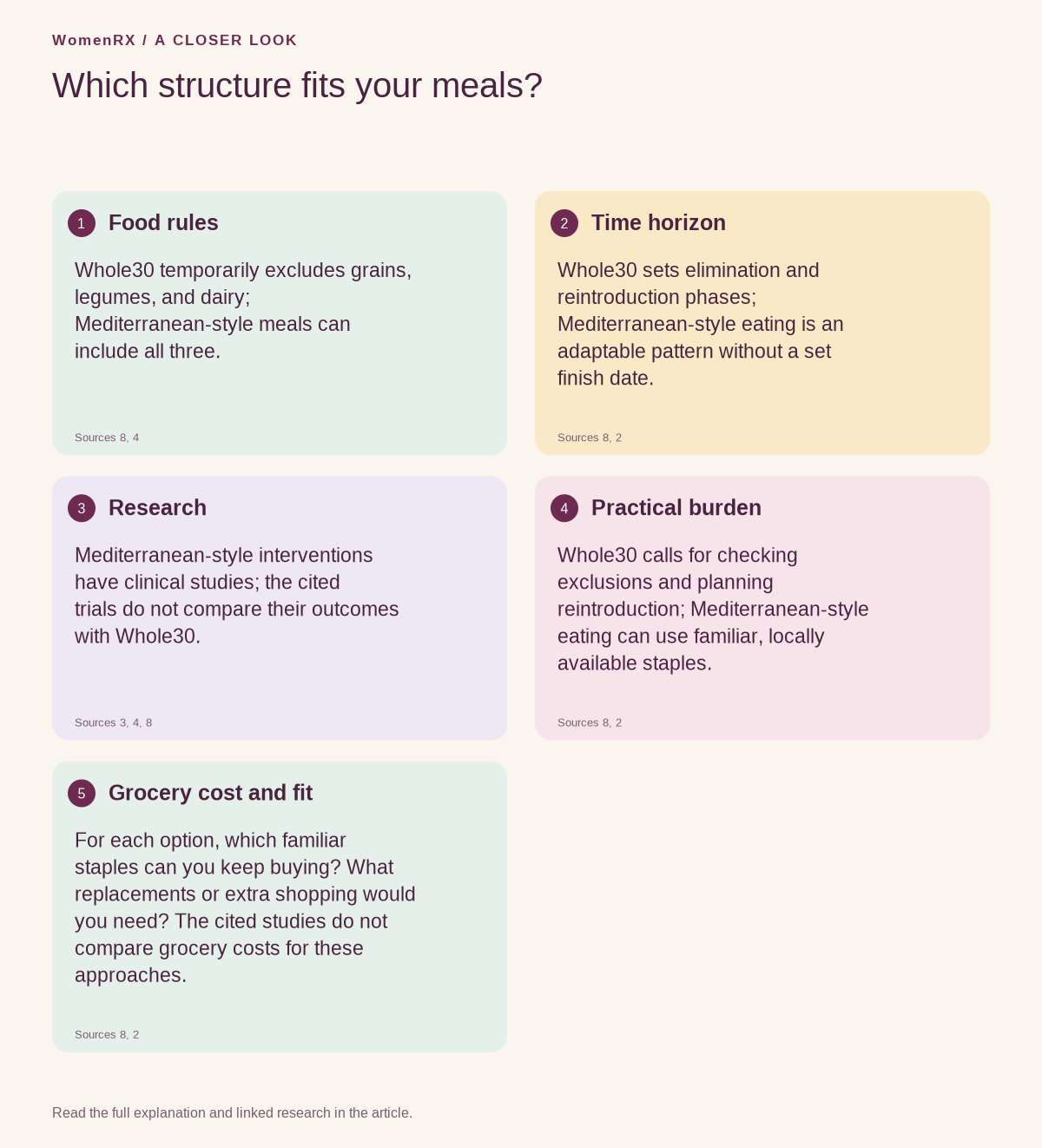
Which structure fits your meals?
Food rules: Whole30 temporarily excludes grains, legumes, and dairy; Mediterranean-style meals can include all three.84
Time horizon: Whole30 sets elimination and reintroduction phases; Mediterranean-style eating is an adaptable pattern without a set finish date.82
Research: Mediterranean-style interventions have clinical studies; the cited trials do not compare their outcomes with Whole30.348
Practical burden: Whole30 calls for checking exclusions and planning reintroduction; Mediterranean-style eating can use familiar, locally available staples.82
Grocery cost and fit: For each option, which familiar staples can you keep buying? What replacements or extra shopping would you need? The cited studies do not compare grocery costs for these approaches.82
Read the figure as text
Five distinctions to consider before choosing a trial, a flexible pattern, or neither.- Food rules: Whole30 temporarily excludes grains, legumes, and dairy; Mediterranean-style meals can include all three.84
- Time horizon: Whole30 sets elimination and reintroduction phases; Mediterranean-style eating is an adaptable pattern without a set finish date.82
- Research: Mediterranean-style interventions have clinical studies; the cited trials do not compare their outcomes with Whole30.348
- Practical burden: Whole30 calls for checking exclusions and planning reintroduction; Mediterranean-style eating can use familiar, locally available staples.82
- Grocery cost and fit: For each option, which familiar staples can you keep buying? What replacements or extra shopping would you need? The cited studies do not compare grocery costs for these approaches.82
More questions, answered
Does Whole30 allow beans or yogurt after the first month?
Its reintroduction phase brings excluded groups back one at a time, including legumes and dairy, with a return to elimination-phase eating between groups. That is different from a permanent rule that beans and yogurt must always be avoided. 8
Is Mediterranean-style eating automatically a weight-loss diet?
No. A Mediterranean-style pattern describes food choices; it does not automatically limit portions or calories. In one trial, the group offered an energy-reduced version alongside physical activity and behavioral support lost more weight than the group offered unrestricted Mediterranean-diet advice. Those added components matter when interpreting the result. 3
Sources you can check
- Obesity: MedlinePlusAccessed 2026-09-25Return to first citation
- South Asia-specific adaptation of Mediterranean diet principles: a mixed-methods review for practical and sustainable dietary habits.Spadaccini D, Chandran A, Gonçalves Correia FP, Janji H, Ciamparini C, Tini S, Caputo M, Marzullo P, Aimaretti G, Prodam F. · Frontiers in nutrition · 2025Return to first citation
- Comparison of an Energy-Reduced Mediterranean Diet and Physical Activity Versus an Ad Libitum Mediterranean Diet in the Prevention of Type 2 Diabetes : A Secondary Analysis of a Randomized Controlled Trial.Ruiz-Canela M, Corella D, Martínez-González MÁ, Babio N, Martínez JA, Forga L, Alonso-Gómez ÁM, Wärnberg J, Vioque J, Romaguera D, López-Miranda J, Estruch R, Santos-Lozano JM, Ser... · Annals of internal medicine · 2025Return to first citation
- Adherence to a "MediterrAsian" diet is associated with weight loss-independent improvements in liver fat and lipid profile, but not glucoregulation or inflammation: secondary analysis of a randomized controlled trial.Chooi YC, Magkos F, Yaligar J, Michael N, Sadananthan SA, Kway YM, Velan SS, Lim KJ, Lai X, Wong LH, Chong YS, Loo EXL, Eriksson JG. · Frontiers in nutrition · 2025Return to first citation
- Weight-Loss Diets | Diets | MedlinePlusAccessed 2026-09-25Return to first citation
- The effect of polyphenols on DNA methylation-assessed biological age attenuation: the DIRECT PLUS randomized controlled trial.Yaskolka Meir A, Keller M, Hoffmann A, Rinott E, Tsaban G, Kaplan A, Zelicha H, Hagemann T, Ceglarek U, Isermann B, Shelef I, Blüher M, Stumvoll M, Li J, Haange SB, Engelmann B, Ro... · BMC medicine · 2023Return to first citation
- Healthy Eating & Physical Activity for Life - NIDDKAccessed 2026-09-25Return to first citation
- Original Whole30 Rules , The Whole30® ProgramAccessed 2026-09-25Return to first citation