Keto vs. Mediterranean Eating: What Matters Most?
Keto produced more weight loss in one short trial, while Mediterranean-style eating leaves more room for foods such as fruit, beans, and whole grains.
Keto sharply limits carbohydrates to bring about ketosis; Mediterranean-style eating emphasizes a mix of plant foods, olive oil, and other familiar foods without the same carbohydrate rule. In one three-month trial, people assigned to calorie-restricted keto lost more weight than those assigned to a calorie-restricted Mediterranean diet. That result doesn’t establish which approach works better for women over time or which is better for heart health. 6710
The difference shows up at the grocery store
Keto is defined by a metabolic goal: eating very little carbohydrate so your body produces more ketones. A Mediterranean-style diet is a food pattern rather than a target for ketosis. It typically centers plant foods and olive oil, includes foods such as fish and poultry, and limits red meat. 67
That distinction changes ordinary meals. For example, a lunch of lentils, vegetables, olive oil, and whole-grain bread fits naturally into Mediterranean-style eating. On a ketogenic diet, the lentils and bread would usually need to be severely limited or replaced to keep carbohydrates low. Keto can still include vegetables and thoughtfully chosen fats, but its carbohydrate limit narrows the options for beans, whole grains, and most fruit. These are differences in what the patterns allow, not a verdict on every meal someone might make within either one. 68
What the head-to-head weight-loss trial found
A randomized trial assigned 160 adults with obesity to five dietary approaches, including a ketogenic diet and a Mediterranean diet. Both of those diets restricted calories. After three months, the keto group had lost 3.78 kg more weight, on average, than the Mediterranean group; 140 participants completed the trial. About 71% of participants were women, but the reported comparison does not give a separate result for women. 10
That’s a meaningful short-term comparison, not proof that keto is the better long-term choice. The trial compared two calorie-restricted plans in adults with obesity and lasted three months. It cannot tell you whether the weight-loss difference would persist after a year, whether it would apply equally at different life stages, or what would happen if either plan were followed without the trial’s calorie restriction. 10
A quick drop on the scale also isn’t the whole goal. Body weight includes water, muscle, bone, and fat. If you’re comparing approaches for your health, it’s reasonable to consider how you feel and function, as well as relevant health measures such as cholesterol, rather than treating the scale as the only outcome. 3
Heart health and food quality are separate questions
The head-to-head trial assessed cardiometabolic risk factors, but its reported summary does not establish a winner on those outcomes. Its weight-loss result shouldn’t be turned into a claim that keto is better for cholesterol, blood pressure, or long-term heart health. Nor does this trial show that Mediterranean eating produces greater weight loss. 10
Food choices matter within either label. A weight-loss eating plan should go easy on saturated fat, trans fat, sodium, and added sugars. That makes the details of a keto plan worth examining: “low carb” alone doesn’t tell you what kinds of fats or other foods are taking the place of bread, beans, and fruit. Mediterranean-style eating offers a different starting point by making plant foods and olive oil central, but its name alone doesn’t determine portions or guarantee weight loss. 97
Which one can you live with?
If a firm carbohydrate rule helps you make choices and you enjoy the foods that remain, keto may appeal to you. Its trade-off is that everyday staples, family meals, and eating out may require more changes. If keeping beans, fruit, or whole grains in your routine matters more, Mediterranean-style eating offers room for them without requiring ketosis. Those are practical differences to weigh against the short-term trial result, not claims that one plan is universally easier to follow. 68210
A useful test is to picture a normal week, not an ideal one: Which approach lets you eat satisfying, varied meals within your preferences, cultural traditions, and budget? A healthy eating plan needs to provide enough energy and nutrients, and it doesn’t have to ban every favorite food. For long-term weight management, changes you can continue matter more than a rule you can follow only briefly. 21
There are also situations where this isn’t simply a preference call. A clinical review identifies particular caution with ketogenic eating for people taking glucose-lowering medicines, including insulin, sulfonylureas, and SGLT2 inhibitors, and for people with certain kidney, liver, or other health conditions. If one of those applies to you, the diet and your treatment plan need to be considered together rather than changed independently. 6
Pregnancy and breastfeeding change the question again. Evidence about ketogenic dietary therapy during pregnancy and lactation remains limited even in its more closely supervised use for epilepsy; that research does not establish the safety of keto for weight loss in either setting. If you’re pregnant or breastfeeding, get advice tailored to your nutritional needs and circumstances before pursuing a restrictive weight-loss diet. 45
**** Keto has a short-term weight-loss advantage in one direct trial. Mediterranean-style eating offers a less carbohydrate-restrictive food pattern. The better next choice depends on your health context and on which way of eating you can make nourishing and workable beyond three months. 10672
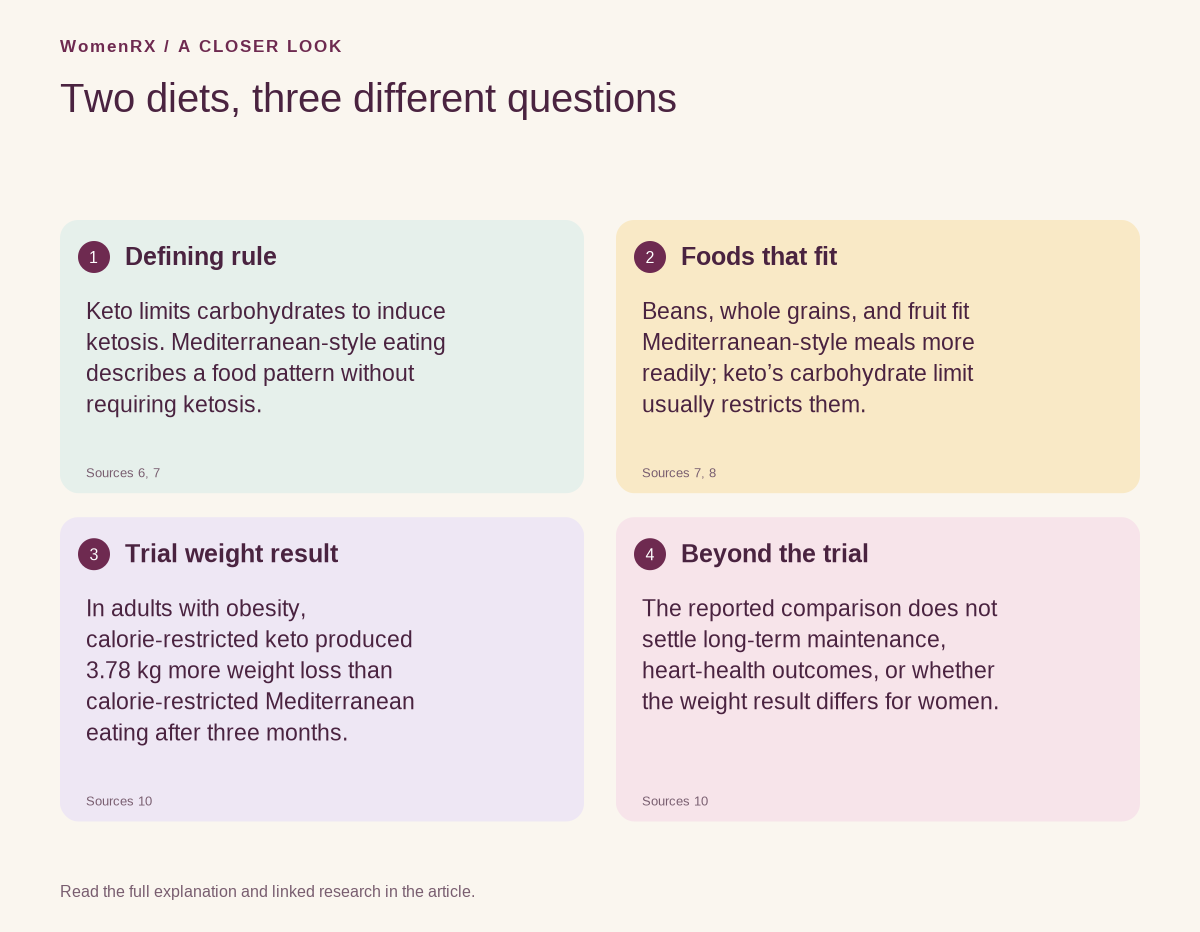
Two diets, three different questions
Defining rule: Keto limits carbohydrates to induce ketosis. Mediterranean-style eating describes a food pattern without requiring ketosis.67
Foods that fit: Beans, whole grains, and fruit fit Mediterranean-style meals more readily; keto’s carbohydrate limit usually restricts them.78
Trial weight result: In adults with obesity, calorie-restricted keto produced 3.78 kg more weight loss than calorie-restricted Mediterranean eating after three months.10
Beyond the trial: The reported comparison does not settle long-term maintenance, heart-health outcomes, or whether the weight result differs for women.10
Read the figure as text
Compare the food rule, the measured weight result, and what still depends on the individual.- Defining rule: Keto limits carbohydrates to induce ketosis. Mediterranean-style eating describes a food pattern without requiring ketosis.67
- Foods that fit: Beans, whole grains, and fruit fit Mediterranean-style meals more readily; keto’s carbohydrate limit usually restricts them.78
- Trial weight result: In adults with obesity, calorie-restricted keto produced 3.78 kg more weight loss than calorie-restricted Mediterranean eating after three months.10
- Beyond the trial: The reported comparison does not settle long-term maintenance, heart-health outcomes, or whether the weight result differs for women.10
More questions, answered
Does the trial show keto works better specifically for women?
No separate women’s result is reported in the trial comparison. Women made up about 71% of its 160 participants, but that does not tell us whether the average difference between diets was the same for women and men. The trial also does not resolve questions specific to perimenopause or postmenopause. 10
Sources you can check
- Dietary Supplements for Weight Loss - Health Professional Fact SheetAccessed 2026-09-25Return to first citation
- Nutrition: MedlinePlusAccessed 2026-09-25Return to first citation
- Body Weight: MedlinePlusAccessed 2026-09-25Return to first citation
- ILAE dietary treatments task force special report: Maternal ketogenic diet exposure in epilepsy pregnancy registries-A call to action.Kverneland M, De Giorgis V, Healy L, Faltersack K, McDonald TJW, Armeno M, Cervenka MC, Devlin A. · Epilepsia open · 2026Return to first citation
- Ketogenic diet therapy for epilepsy during pregnancy and lactation: An international survey exploring clinician perspectives.Faltersack K, McDonald TJW, De Giorgis V, Barron B, Cervenka MC, Devlin A, Healy LA, Kverneland M, van der Louw E, Lu M, Zanaboni MP, Armeno M, Felton EA. · Epilepsia open · 2025Return to first citation
- The ketogenic diet is not for everyone: contraindications, side effects, and drug interactions.Dyńka D, Rodzeń Ł, Rodzeń M, Łojko D, Karakuła-Juchnowicz H, Ede G, Grzywacz Ż, Antosik K, Sethi S, Unwin D. · Annals of medicine · 2026Return to first citation
- Dietary Interventions and Testosterone Levels in Obese Men: A Systematic Review Comparing the Mediterranean Diet, Ketogenic Diet, and Intermittent Fasting.La Vignera S, Condorelli RA. · Nutrients · 2026Return to first citation
- Effects of the Mediterranean Diet, Ketogenic Diet, and Intermittent Fasting on Iron Metabolism and Iron Deficiency Risk in Adults with Obesity: A Systematic Literature Review.La Vignera S, Condorelli R. · Nutrients · 2026Return to first citation
- Weight-Loss Diets | Diets | MedlinePlusAccessed 2026-09-25Return to first citation
- Effect of a ketogenic diet, time-restricted eating, or alternate-day fasting on weight loss in adults with obesity: a randomized clinical trial.Martínez-Montoro JI, Bandera B, Gutiérrez-Bedmar M, Gómez-Pérez AM, Macías-González M, Moreno-Indias I, Tinahones FJ. · BMC medicine · 2025Return to first citation