Paleo or Mediterranean: Which Trade-offs Matter Most?
Both patterns can put vegetables at the center of a meal, but they differ sharply on grains, legumes, dairy, and the health outcomes studied.
Mediterranean eating leaves room for legumes, whole grains, and dairy, while strict Paleo excludes them. The cited Mediterranean cardiovascular-outcome findings concern adults who already have cardiovascular disease; they do not show which pattern better prevents a first cardiovascular event or whether Mediterranean eating outperforms Paleo. Paleo may appeal if you prefer firm food rules, but excluding grains, legumes, and dairy means thinking more carefully about what replaces them. Neither pattern guarantees weight loss, and the findings discussed here don’t establish a uniquely female benefit for either one. 567
The difference shows up in an ordinary meal
Picture a plate with fish and vegetables. Either pattern could accommodate it. Add a side of lentils and whole-grain bread, and the meal still fits Mediterranean eating but not a strict Paleo pattern. Add yogurt, and the distinction remains: Mediterranean eating includes moderate amounts of dairy, while Paleo excludes it. Mediterranean eating typically emphasizes olive oil, fruits, vegetables, legumes, whole grains, nuts, and fish, with less red or processed meat. Paleo approaches vary, but excluding grains, legumes, and dairy is a defining feature of the strict version studied in this research. 57
That’s more than a difference in labels. If beans, oats, or yogurt are regular, convenient foods for you, Mediterranean eating lets you keep them. If clear exclusions make meal choices simpler for you, Paleo’s rules may feel appealing. Neither preference is a clinical outcome, and this evidence does not show that one pattern is easier for women to maintain.
Weight management and heart health aren’t the same test
For weight management, the name of a diet matters less than whether it helps you make changes you can sustain. The NIH Office of Dietary Supplements describes a healthy dietary pattern, reduced calorie intake, and physical activity as foundations of long-term weight loss. That doesn’t mean either Paleo or Mediterranean eating automatically creates a calorie reduction. 1
The cardiovascular evidence answers a different question. A systematic review of Paleo among other dietary approaches found encouraging blood-pressure and metabolic results, but its authors cautioned that differences in study quality and adherence measures make comparisons difficult and called for better long-term studies. It did not compare Paleo with Mediterranean eating. 3
For Mediterranean eating, a review pooled 13 prospective studies involving 54,034 adults who already had cardiovascular disease. Across follow-up periods of two to ten years, greater adherence was associated with lower all-cause mortality and fewer recurrent cardiovascular events. These were observational studies: they strengthen the case for studying and using the pattern in heart health, but they cannot prove that the diet alone caused the difference. Nor can their results be used as a head-to-head verdict against Paleo. 6
For adults with established cardiovascular disease, the cited Mediterranean cohort findings address mortality and recurrent events. They do not establish a benefit for preventing a first event in people without cardiovascular disease or show that Mediterranean eating outperforms Paleo. 6 If your main goal is weight loss, don’t mistake evidence about heart events for a promise about the scale.
What you remove matters as much as what you add
Paleo’s exclusions create a practical nutrition question: what will take the place of foods you used to eat? A review of carbohydrate-restricted diets included two Paleo trials and found that intakes of several micronutrients declined across the diet types studied. In one Paleo trial, the proportion of participants with moderate iodine deficiency rose from 15% to 73% after six months. That finding does not mean every Paleo diet causes iodine deficiency, but it makes nutritional adequacy worth considering rather than assuming that a diet of whole foods covers everything. 4
Grains and legumes also contribute a particular kind of fiber. In a cross-sectional study, long-term self-reported Paleo followers had lower resistant-starch intake than controls eating a diet typical of national recommendations. Strict Paleo followers also had higher levels of TMAO, a blood marker associated with cardiovascular disease. Because researchers compared existing eaters rather than assigning diets, this does not show that Paleo causes heart disease. It does show why replacing a bean-and-whole-grain meal with something nutritionally similar deserves thought. 5
For example, if you stop eating yogurt and oatmeal at breakfast, a useful next question is not simply, “Is my new breakfast Paleo?” It’s, “Which foods now provide the nutrients and variety that breakfast used to contribute?” That is a planning question, not a finding that Paleo is harder to follow.
A useful way to choose
Start with the foods you already rely on. If legumes, whole grains, and some dairy help you put together satisfying meals, Mediterranean eating makes room for them without requiring a strict menu. If you prefer a Paleo-style plate, pay particular attention to how you’ll maintain variety when those food groups are out. Both can include vegetables; the meaningful difference is the set of foods available to build the rest of your routine. 57
Neither pattern has been shown by the findings discussed here to work uniquely well for women, or to have different outcomes in pregnancy, postpartum, perimenopause, or postmenopause. If cholesterol is part of your decision, it’s worth knowing that risk of high cholesterol rises after menopause; that fact alone does not establish which of these diets is best at that life stage. 2
What changes when you choose a pattern
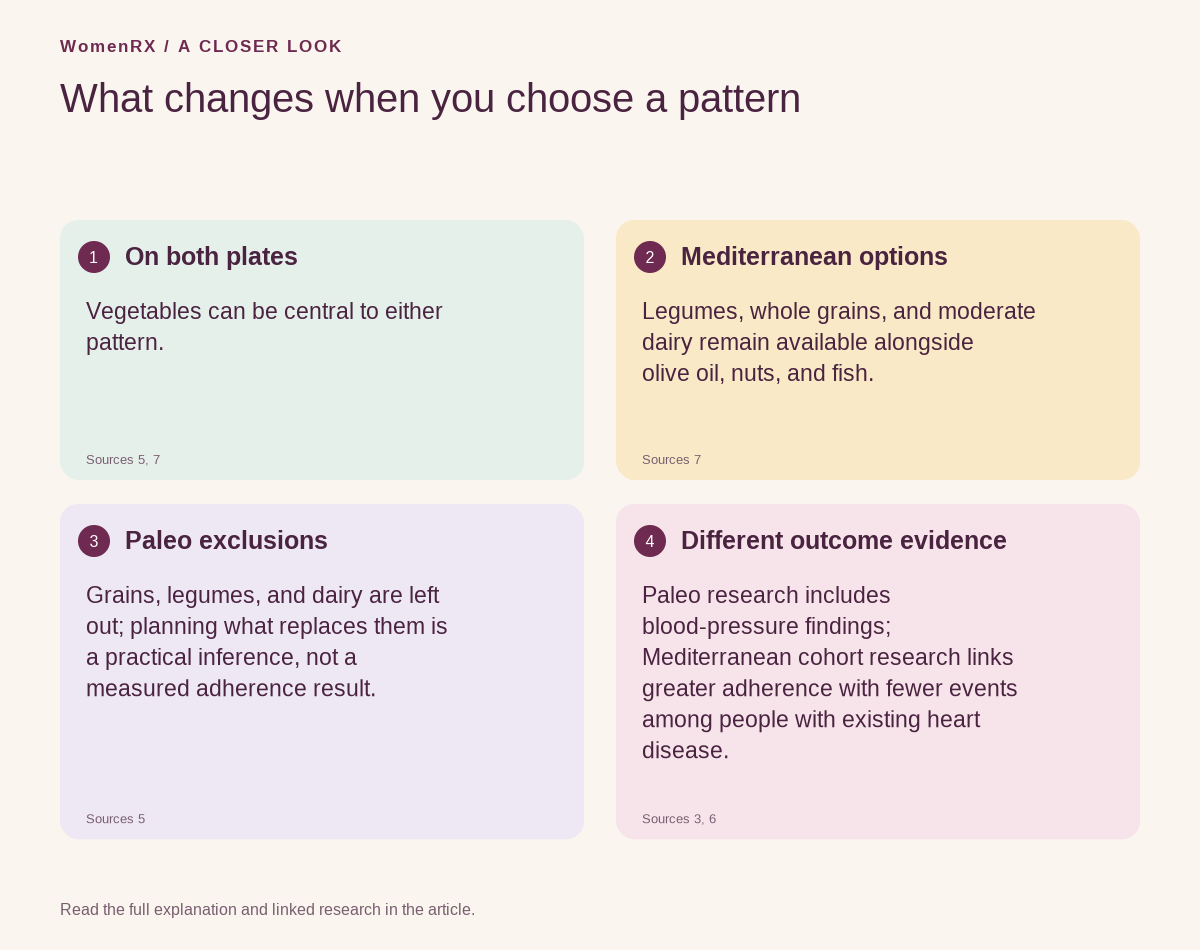
On both plates: Vegetables can be central to either pattern.57
Mediterranean options: Legumes, whole grains, and moderate dairy remain available alongside olive oil, nuts, and fish.7
Paleo exclusions: Grains, legumes, and dairy are left out; planning what replaces them is a practical inference, not a measured adherence result.5
Different outcome evidence: Paleo research includes blood-pressure findings; Mediterranean cohort research links greater adherence with fewer events among people with existing heart disease.36
Read the figure as text
The food rules differ more clearly than the research outcomes can be compared.- On both plates: Vegetables can be central to either pattern.57
- Mediterranean options: Legumes, whole grains, and moderate dairy remain available alongside olive oil, nuts, and fish.7
- Paleo exclusions: Grains, legumes, and dairy are left out; planning what replaces them is a practical inference, not a measured adherence result.5
- Different outcome evidence: Paleo research includes blood-pressure findings; Mediterranean cohort research links greater adherence with fewer events among people with existing heart disease.36
Sources you can check
- Dietary Supplements for Weight Loss - Health Professional Fact SheetAccessed 2026-09-25Return to first citation
- High cholesterol - NHSAccessed 2026-09-25Return to first citation
- Exploring Non-pharmacological Hypertension Management: DASH, Paleolithic, and Ketogenic Diet Comparisons: A Systematic Review.Wal P, Rath D, Verma N, Wal A, Bhukta P, Natania A, Ved A, Samathoti P, Gasmi A. · Current hypertension reviews · 2026Return to first citation
- Impacts of carbohydrate-restricted diets on micronutrient intakes and status: A systematic review.Churuangsuk C, Griffiths D, Lean MEJ, Combet E. · Obesity reviews : an official journal of the International Association for the Study of Obesity · 2019Return to first citation
- Long-term Paleolithic diet is associated with lower resistant starch intake, different gut microbiota composition and increased serum TMAO concentrations.Genoni A, Christophersen CT, Lo J, Coghlan M, Boyce MC, Bird AR, Lyons-Wall P, Devine A. · European journal of nutrition · 2020Return to first citation
- The role of the Mediterranean diet in secondary cardiovascular disease prevention: a systematic review and meta-analysis of cohort studies.Gitsi E, Anastasiou C, Yannakoulia M, Vlachopoulos C, Marques-Vidal P, Estruch R, Panagiotakos D. · Nutrition, metabolism, and cardiovascular diseases : NMCD · 2026Return to first citation
- Efficacy of Mediterranean diet interventions on children and adolescents affected by overweight or obesity: a systematic review and meta-analysis.Rapti I, Markozannes G, Papathanasiou O, Veroni A, Zachariades C, Tseretopoulou X, Kotanidou EP, Serbis A, Koutras V, Rizos EC, Ntzani E. · Frontiers in nutrition · 2026Return to first citation