Mediterranean or DASH: Which Pattern Fits Your Goals?
Both emphasize plant foods, but DASH has the clearer evidence for lowering blood pressure.
Choose DASH if blood-pressure reduction is your main goal: trials summarized in a research paper found lower systolic and diastolic pressure compared with control diets. 3 Mediterranean eating shares DASH’s emphasis on plants, but gives a more prominent role to olive oil, nuts, beans, and fish. 2 The findings here don’t settle which pattern prevents more cardiovascular events or works better specifically for women. 2 4 5 6
The shared foundation, and the difference
Neither pattern is a single menu. Both emphasize vegetables, fruit, and whole grains, while limiting red meat and sweets. The main practical difference is emphasis: DASH specifically features low-fat dairy and is designed around blood-pressure goals. Mediterranean-style eating puts olive oil, nuts and seeds, beans, and fish near the center, with poultry in smaller amounts and red or processed meat limited. 2
That gives you a useful way to choose. If low-fat dairy foods suit you and you want a pattern built with blood pressure in mind, DASH may feel more straightforward. If you prefer olive oil, nuts, beans, and fish as everyday staples, the Mediterranean pattern may fit better. These are examples of how the patterns can feel different in a kitchen, not rules that every person must follow.
What the blood-pressure evidence says
DASH has the more direct blood-pressure case. A paper focused on older adults summarizes a meta-analysis of 30 randomized trials involving 5,545 participants: compared with control diets, DASH lowered both systolic and diastolic blood pressure. The paper also reports that adding sodium restriction increased the effect. 3
Real-world studies offer a less definitive picture. In a study of 371 older adults in Spain, greater DASH adherence was associated with lower average blood pressure. Among the 218 participants with hypertension, moderate adherence was associated with lower odds of uncontrolled blood pressure. Because this was an observational analysis, it can’t show that DASH caused the difference. 3 A separate cross-sectional study of 226 adults with hypertension found no significant association between DASH or Mediterranean diet scores and blood pressure after adjusting for other factors. 2
Mediterranean-style eating may also align with better blood-pressure measures, though the findings are less direct. In a U.S. cross-sectional analysis of Hispanic/Latine adults, higher alignment with either DASH or Mediterranean-style eating was associated with lower average blood pressure. That finding describes an association, not proof that either diet caused the difference. 6 A small post hoc analysis of a lifestyle trial found improvements in blood pressure during intensive lifestyle treatment, but it doesn’t establish that a Mediterranean score, by itself, caused those changes. 5
So if lowering blood pressure is the deciding factor, DASH has the clearer trial evidence. That doesn’t mean Mediterranean eating has no effect, or that these findings demonstrate superiority of one pattern over the other in a head-to-head comparison.
Blood pressure isn’t the same as heart-attack prevention
Blood pressure is one part of cardiovascular health, but a lower reading or a change in a risk score is not the same as evidence that a diet prevents heart attacks or strokes. The research cited in this comparison includes blood-pressure measurements, lipid measures, and calculated cardiovascular-risk scores; it does not provide a direct comparison of heart attacks or strokes between these two patterns. 4 5
There are other measured differences worth knowing. In a post hoc analysis of a lifestyle trial involving 61 people with stage 1 hypertension, higher Mediterranean diet scores were associated with greater reductions in total cholesterol, LDL cholesterol, and triglycerides among those receiving intensive lifestyle treatment. The treatment involved more than a dietary pattern, so those associations don’t isolate the effect of Mediterranean eating. 5 In a network analysis of 26 randomized trials involving 2,255 adults with metabolic syndrome, DASH was associated with reduced waist circumference compared with control diets; the analysis also identified Mediterranean eating as effective for fasting blood glucose. Those findings concern different measures, not a direct test of which pattern is better for cardiovascular events. 4
The same distinction matters for weight: a smaller waist measurement is not necessarily weight loss. These findings don’t establish which pattern leads to more weight loss. If weight change is one of your goals, use preferences and everyday practicality to choose between them rather than assuming that the name of the pattern predicts a result. 4
Make the choice workable
Try comparing the foods you already enjoy with each pattern’s emphasis. For example, if you regularly cook with olive oil and like beans, nuts, and fish, Mediterranean-style meals may feel natural. If low-fat dairy, whole grains, fruits, and vegetables are already familiar, DASH may be an easier starting point. You can also borrow compatible features from both: vegetables and whole grains form a shared base, while beans and fish reflect Mediterranean priorities. 2
The cited findings don’t establish that either pattern works better for women specifically. One study in adults with hypertension adjusted its analysis for sex but reported overall results, not separate results for women. The cited studies also don’t provide a pregnancy-specific comparison. If you’re pregnant and managing high blood pressure, don’t assume that findings from general adult diet studies answer questions about pregnancy-related hypertension. 2
If you take blood-pressure medicine, a change in eating pattern is a possible addition to care, not a reason to stop prescribed treatment. MedlinePlus notes that lifestyle changes and medicine may both be needed to control high blood pressure. 1
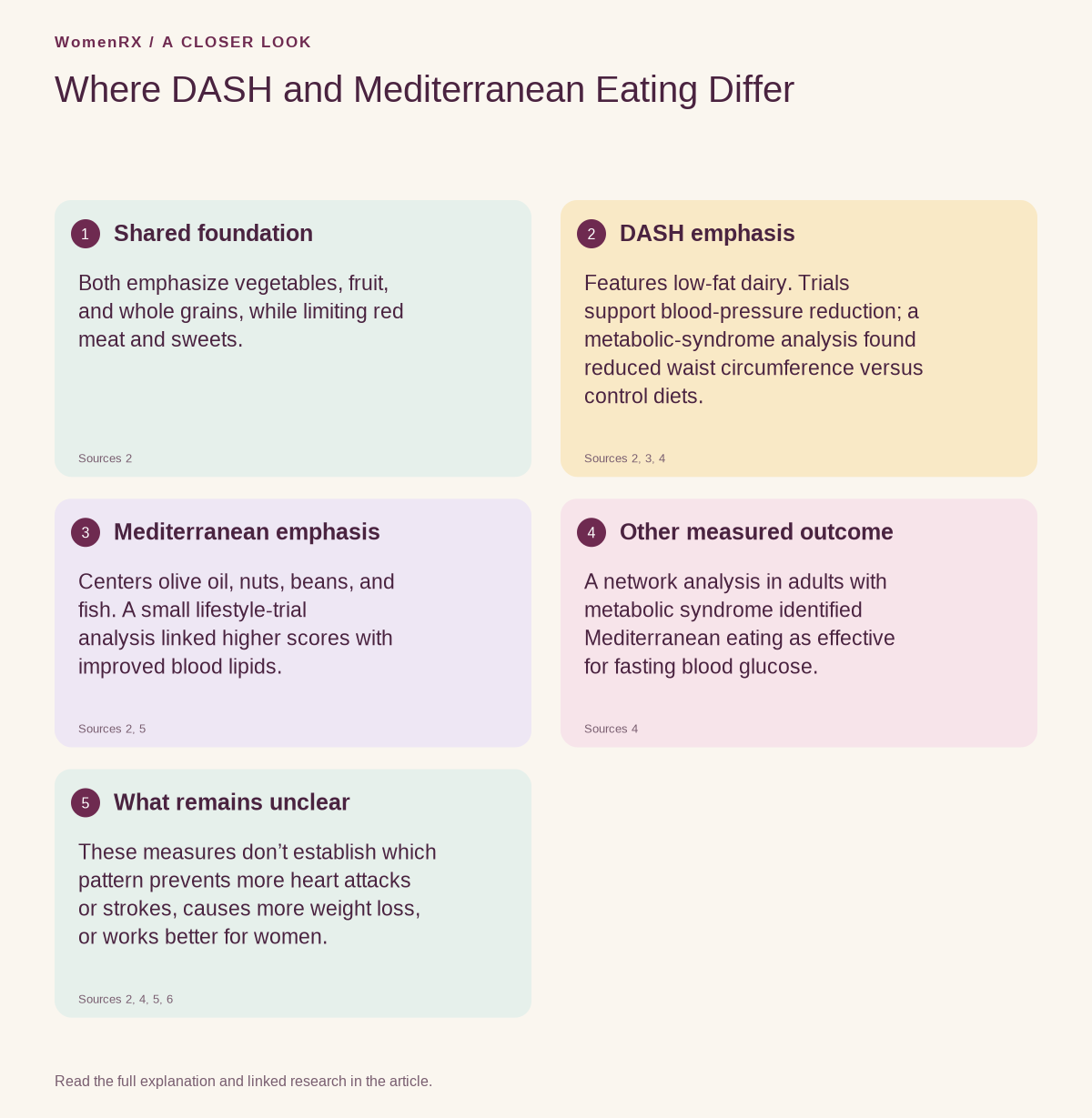
Where DASH and Mediterranean Eating Differ
Shared foundation: Both emphasize vegetables, fruit, and whole grains, while limiting red meat and sweets.2
DASH emphasis: Features low-fat dairy. Trials support blood-pressure reduction; a metabolic-syndrome analysis found reduced waist circumference versus control diets.234
Mediterranean emphasis: Centers olive oil, nuts, beans, and fish. A small lifestyle-trial analysis linked higher scores with improved blood lipids.25
Other measured outcome: A network analysis in adults with metabolic syndrome identified Mediterranean eating as effective for fasting blood glucose.4
What remains unclear: These measures don’t establish which pattern prevents more heart attacks or strokes, causes more weight loss, or works better for women.2456
Read the figure as text
Both patterns share a plant-forward base. Their signature foods and the outcomes measured in studies offer different ways to weigh your goals.- Shared foundation: Both emphasize vegetables, fruit, and whole grains, while limiting red meat and sweets.2
- DASH emphasis: Features low-fat dairy. Trials support blood-pressure reduction; a metabolic-syndrome analysis found reduced waist circumference versus control diets.234
- Mediterranean emphasis: Centers olive oil, nuts, beans, and fish. A small lifestyle-trial analysis linked higher scores with improved blood lipids.25
- Other measured outcome: A network analysis in adults with metabolic syndrome identified Mediterranean eating as effective for fasting blood glucose.4
- What remains unclear: These measures don’t establish which pattern prevents more heart attacks or strokes, causes more weight loss, or works better for women.2456
More questions, answered
Can I combine Mediterranean and DASH features?
Yes. Their shared emphasis on vegetables, fruit, and whole grains makes it practical to draw from both. For example, you might use olive oil and include fish while also choosing low-fat dairy foods if those fit your preferences. 2
Does this comparison show which diet prevents heart attacks?
No. The studies cited above measure outcomes such as blood pressure, lipids, waist circumference, or cardiovascular-risk scores, rather than directly comparing heart attacks or strokes between the two patterns. 4 5
Sources you can check
- Blood Pressure Medicines | MedlinePlusAccessed 2026-09-25Return to first citation
- Adherence to dietary approaches to stop hypertension (DASH), Mediterranean diet, and plant-based dietary pattern with systolic and diastolic blood pressure: A cross-sectional analysis.Hassanzadeh-Rostami Z, Moazen M, Ranjbar Zahedani M, Masoumi SJ. · Caspian journal of internal medicine · 2025Return to first citation
- Blood Pressure Control Is Associated with Moderate, but Not Necessarily High, Adherence to the DASH Diet in Older Adults.Luengo-Dilla R, Ortega-Hernández A, Álvarez-González M, Gutiérrez-Corral J, Modrego J, Torrego-Ellacuría M, de la Torre-Rodríguez S, Jeidane-Bentefrit I, García-García J, Fragua-Gi... · Nutrients · 2026Return to first citation
- Network meta-analysis of the effects of different dietary patterns on patients with metabolic syndrome.Lv J, Jiao S, Li W, Ding S, Ma L, Zhang Q. · Frontiers in nutrition · 2025Return to first citation
- Impact of Dietary Patterns on the Lipidemic Profile and the Cardiovascular Risk in Stage 1 Hypertension: A Post Hoc Analysis of the HINTreat Trial.Vamvakis A, Lazaridis A, Grammatikopoulou MG, Malliora A, Tsiroukidou K, Tzimos C, Blasio AD, Izzicupo P, Gkaliagkousi E. · Nutrients · 2025Return to first citation
- Understanding Alignment to the Mediterranean-Style and DASH Eating Patterns and Assessing Associations with Cardiometabolic Clinical Outcomes Among Hispanic/Latine Adults in the United States: An NHANES Analysis.Crusan A, Overcash F. · Healthcare (Basel, Switzerland) · 2026Return to first citation