Is the Mediterranean Diet a Good Fit After 40?
For women, the strongest evidence points to heart-health associations; weight change is less predictable and depends on the overall eating pattern.
A Mediterranean-style pattern can be a flexible way to eat, built mainly around vegetables, fruit, legumes, nuts, grains, and olive oil, with smaller amounts of fish, dairy, eggs, and meat. In women, higher adherence is associated with lower cardiovascular disease incidence, but the research doesn’t establish a uniquely stronger benefit after 40 or by menopause status. Weight loss isn’t guaranteed. 2 3
A pattern, not a prescribed menu
The Mediterranean diet is better understood as a way of organizing meals than as one exact menu. In the studies reviewed in menopausal women, it generally emphasized vegetables, fruit, legumes, nuts, olives and olive oil, and less-refined grains. Fish, white meat, eggs, and dairy were eaten in moderate amounts, while red and processed meat were less common. The details varied across studies, so the label doesn’t mean every version is identical. 2
For example, a practical meal might pair beans or fish with vegetables and a grain, with olive oil used in cooking or dressing. That’s an illustration of the pattern, not a required recipe. Whether it fits you also depends on what you enjoy, can afford, and can sustain.
What the heart evidence says for women
The clearest women-specific evidence concerns cardiovascular outcomes. A systematic review and meta-analysis pooled 16 prospective cohort studies involving 722,495 women without previous cardiovascular disease. Women with higher Mediterranean-diet adherence had lower incidence of cardiovascular disease than women with lower adherence (hazard ratio 0.76, 95% confidence interval 0.72 to 0.81). Higher adherence was also associated with lower total mortality and coronary heart disease. These are associations from observational studies, not proof that the diet alone caused the difference. 3
That review was designed to report results for women, but its abstract doesn’t establish a separate result for women over 40 or compare outcomes by menopause status. So it supports a heart-health association in women overall, not a special effect that begins at 40 or at menopause. 3
There is also a smaller body of intervention research specifically involving menopausal women. A systematic review found seven eligible studies and described potential improvements in outcomes including weight, blood pressure, triglycerides, total cholesterol, and LDL cholesterol. The studies used different designs and examined different outcomes. That makes this useful as women-specific context, but not a basis for promising that an individual woman will see a particular change. 2
Weight outcomes need a separate answer
Heart-health evidence and weight-loss evidence aren’t interchangeable. A pattern can be associated with better cardiovascular outcomes without reliably producing weight loss. The menopausal-women review reports weight reductions among the outcomes studied, but the interventions and comparisons varied. Those findings don’t tell you how much weight you would lose by adopting your own version of the pattern. 2 3
Weight change depends on the whole eating pattern and how it affects energy intake over time; it isn’t guaranteed by choosing a diet label. 1 If weight change is your goal, consider whether the version you’re considering changes your usual portions or food choices in a way you can maintain, rather than expecting a particular food, such as olive oil, fish, or nuts, to produce weight loss on its own. Results for the overall eating pattern don’t show whether any single food accounts for the outcomes. 2
A simple way to decide if it fits
Think of the pattern as a set of choices you can adapt, not a pass-or-fail plan:
- Start with foods you already like. The pattern includes a range of plant foods and doesn’t require one fixed set of dishes. 2
- Choose changes you can keep. For example, you might add beans to a meal you already make or serve vegetables alongside a familiar grain. These are practical examples, not tested prescriptions.
- Keep your goal clear. If your priority is heart health, the women’s cohort evidence is relevant, though it is observational. If your priority is weight loss, the menopause-focused studies report some weight reductions, but they don’t predict your result. 3 2
- Don’t assume menopause changes the result. Studies in menopausal women offer some direct evidence, but the available review doesn’t establish that the pattern works differently before versus after menopause. 2
A Mediterranean-style pattern is a reasonable option if its foods and flexibility suit you. Its heart-health case in women is more convincing than any promise of weight loss, and the evidence doesn’t support treating it as a uniquely effective diet for women over 40.
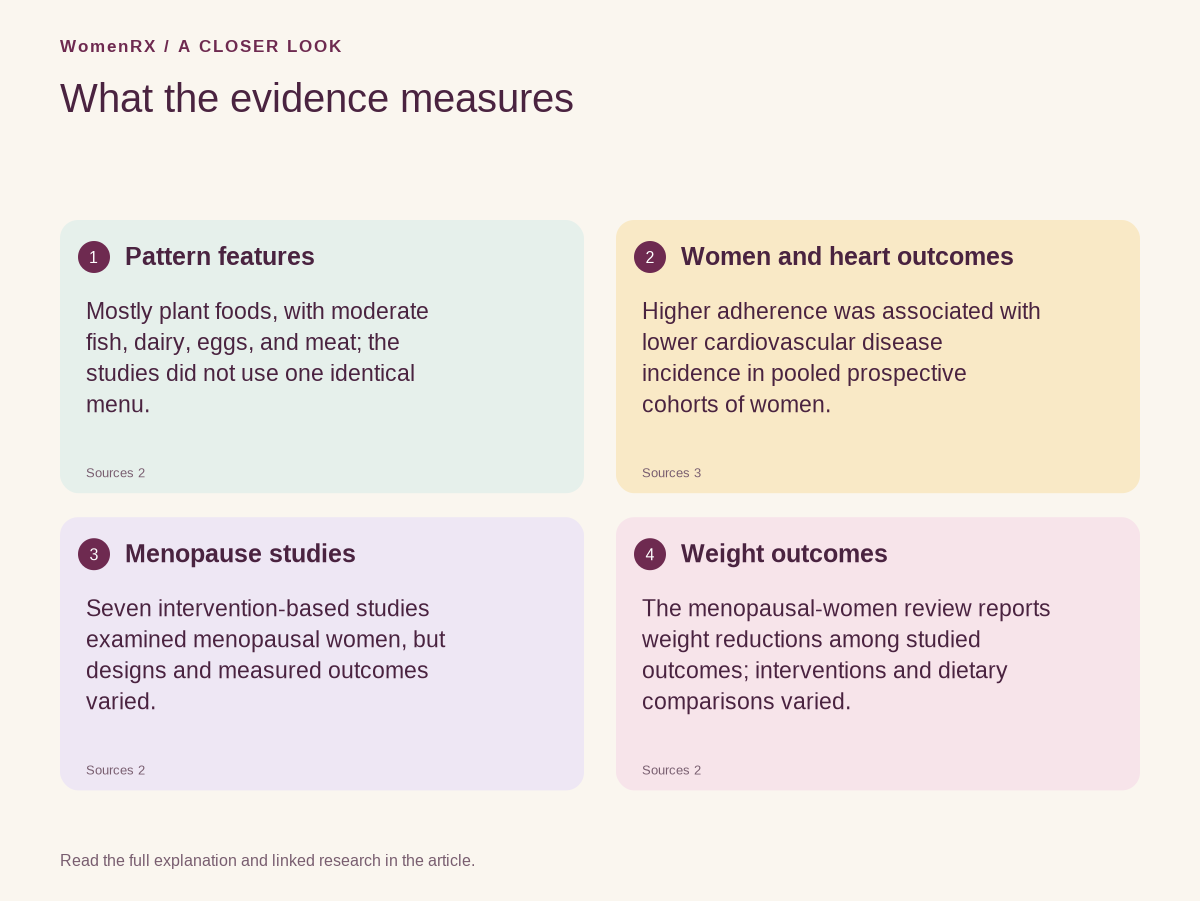
What the evidence measures
Pattern features: Mostly plant foods, with moderate fish, dairy, eggs, and meat; the studies did not use one identical menu.2
Women and heart outcomes: Higher adherence was associated with lower cardiovascular disease incidence in pooled prospective cohorts of women.3
Menopause studies: Seven intervention-based studies examined menopausal women, but designs and measured outcomes varied.2
Weight outcomes: The menopausal-women review reports weight reductions among studied outcomes; interventions and dietary comparisons varied.2
Read the figure as text
These findings answer different questions: what the pattern includes, how adherence relates to heart outcomes in women, and what interventions in menopausal women have measured.- Pattern features: Mostly plant foods, with moderate fish, dairy, eggs, and meat; the studies did not use one identical menu.2
- Women and heart outcomes: Higher adherence was associated with lower cardiovascular disease incidence in pooled prospective cohorts of women.3
- Menopause studies: Seven intervention-based studies examined menopausal women, but designs and measured outcomes varied.2
- Weight outcomes: The menopausal-women review reports weight reductions among studied outcomes; interventions and dietary comparisons varied.2
More questions, answered
Does the Mediterranean diet work differently after menopause?
Research has examined the pattern in menopausal women, but the review of those studies doesn’t establish that its effects differ from those in women who are still cycling. 2
Does a Mediterranean-style diet guarantee weight loss?
No. A review of studies in menopausal women reports weight reductions among the outcomes studied, but your weight change depends on the eating pattern you follow over time. 2 1
Sources you can check
- Obesity: MedlinePlusAccessed 2026-09-25Return to first citation
- Systematic review of mediterranean diet interventions in menopausal women.Gonçalves C, Moreira H, Santos R. · AIMS public health · 2024Return to first citation
- Primary prevention of cardiovascular disease in women with a Mediterranean diet: systematic review and meta-analysis.Pant A, Gribbin S, McIntyre D, Trivedi R, Marschner S, Laranjo L, Mamas MA, Flood V, Chow CK, Zaman S. · Heart (British Cardiac Society) · 2023Return to first citation