Mediterranean-Style Eating: What the Evidence Shows
The strongest findings depend on the outcome studied, and the practical fit matters as much as the name of the eating pattern.
Mediterranean-style eating has trial evidence in people with cardiovascular disease and in older adults at elevated diabetes risk, but those findings don’t prove the same benefit for every woman or life stage. One large intervention combined the pattern with calorie reduction, physical activity, and weight-management support. Neither trial reports comparative grocery costs or outcomes by reproductive life stage. 2 4
The answer depends on what you mean by “works”
Mediterranean-style eating isn’t one fixed menu. In the research, it’s a dietary pattern that includes foods such as fruits, vegetables, nuts, and olive oil. Different studies ask different questions: whether the pattern relates to fewer cardiovascular events, whether a more intensive version helps prevent diabetes, and whether people can make the approach work in everyday life. Those outcomes shouldn’t be lumped together. 1 4
The evidence is encouraging, but it doesn’t establish that every version has the same effect, that one ingredient explains the results, or that the findings apply equally to women at every age.
Cardiovascular outcomes: promising, with an important distinction
In a seven-year randomized study of 1,002 people who already had cardiovascular disease, participants were assigned to a Mediterranean or low-fat diet. Within both groups, people with higher adherence had fewer major cardiovascular events than people with lower adherence. Because the reported comparison is between levels of adherence within each assigned diet, it doesn’t show that the Mediterranean diet was superior to the low-fat diet. It does suggest that sticking with either pattern was associated with better outcomes in this group. 2
A separate analysis nested within the PREDIMED trial found that a urine signature reflecting several food-derived compounds was associated with lower cardiovascular risk. That’s an observational association within trial participants, not proof that the compounds caused the lower risk or that a particular food is a treatment. 1
These findings are most directly relevant to people with existing cardiovascular disease or to the study populations examined. They don’t, by themselves, tell a healthy woman her personal risk reduction.
Diabetes prevention: the tested approach was a package
A six-year analysis in Spain followed adults aged 55 to 75 with metabolic syndrome and overweight or obesity, but no previous diabetes or cardiovascular disease. The group assigned to an energy-reduced Mediterranean diet, more physical activity, and behavioral weight-management support had a 9.5% six-year diabetes risk, compared with 12.0% in the group given advice to follow a Mediterranean diet without a prescribed energy reduction. The intervention combined several elements, so its result can’t be attributed to the diet alone. 4
This is evidence for that bundled program in that specific group, not a promise that adopting the eating pattern alone will prevent diabetes. The reported findings don’t include a women-specific result or outcomes by reproductive life stage. They therefore can’t answer whether the effect differs before, during, or after menopause. 4
Fit is part of the question
A pattern that depends on unfamiliar or unaffordable foods may be hard to keep up. This research doesn’t compare grocery bills, so it can’t tell you whether this approach costs more or less than another way of eating. It also doesn’t establish a single culturally appropriate version for everyone.
There is a practical reason to adapt rather than copy a menu literally: a trial protocol in India is testing a version designed around locally available foods and cultural acceptability. Because it’s a protocol, it describes the plan being tested, not proven results. 5
In a qualitative study, 25 adults aged 63 to 76 who had taken part in a Mediterranean-diet trial discussed their experience. Participants described wanting more personalized guidance. Their feedback doesn’t tell us which adaptation improves health, but it does underline that advice can feel different from a routine that actually fits someone’s circumstances. 3
A short fit worksheet
Use these questions to judge whether the pattern is workable for you. They’re planning prompts, not a validated test.
- What would it replace? Name one food or routine you’d like to change, rather than trying to redo every meal at once.
- What foods do you already enjoy? Start with familiar options that fit the broad pattern, such as fruits, vegetables, nuts, or olive oil. These foods are represented in the research, but no single one explains the overall findings. 1
- What’s the budget reality? Set the amount you can spend and identify which options fit it. The research doesn’t establish a least-cost shopping list or compare prices.
- What needs to work in your household? Consider taste, culture, cooking time, and whether other people share meals with you. A locally adapted approach is being tested, but its results aren’t yet established. 5
- What might change over time? Revisit the plan when your schedule, food budget, preferences, or health priorities change. The reported trial findings don’t show whether effects differ across menstrual, perimenopausal, or postmenopausal stages. 4
For example, if a food often mentioned in Mediterranean menus isn’t affordable or appealing, the useful next question is not whether you’ve failed the pattern. It’s which familiar, accessible choices let you build a routine you can maintain. The evidence supports studying whole dietary patterns; it doesn’t establish a required shopping list or a specific product as essential.
What the evidence can and can’t tell you
The clearest clinical outcome here is a diabetes-prevention benefit from an intensive program that combined dietary change with activity and behavioral support in older adults with metabolic syndrome and excess weight. Cardiovascular evidence includes a long-term trial in people with existing disease, but the reported adherence comparison doesn’t establish that one assigned diet outperformed the other. A biomarker analysis adds an association, not proof of cause. 1 2 4
The reported results don’t provide women-specific effects or comparisons across reproductive life stages. That is a meaningful limit, not proof that no such research exists. For your own decision, weigh the outcome you care about against the study population, and consider whether the pattern can fit your food preferences and budget over time.
What each study can tell you
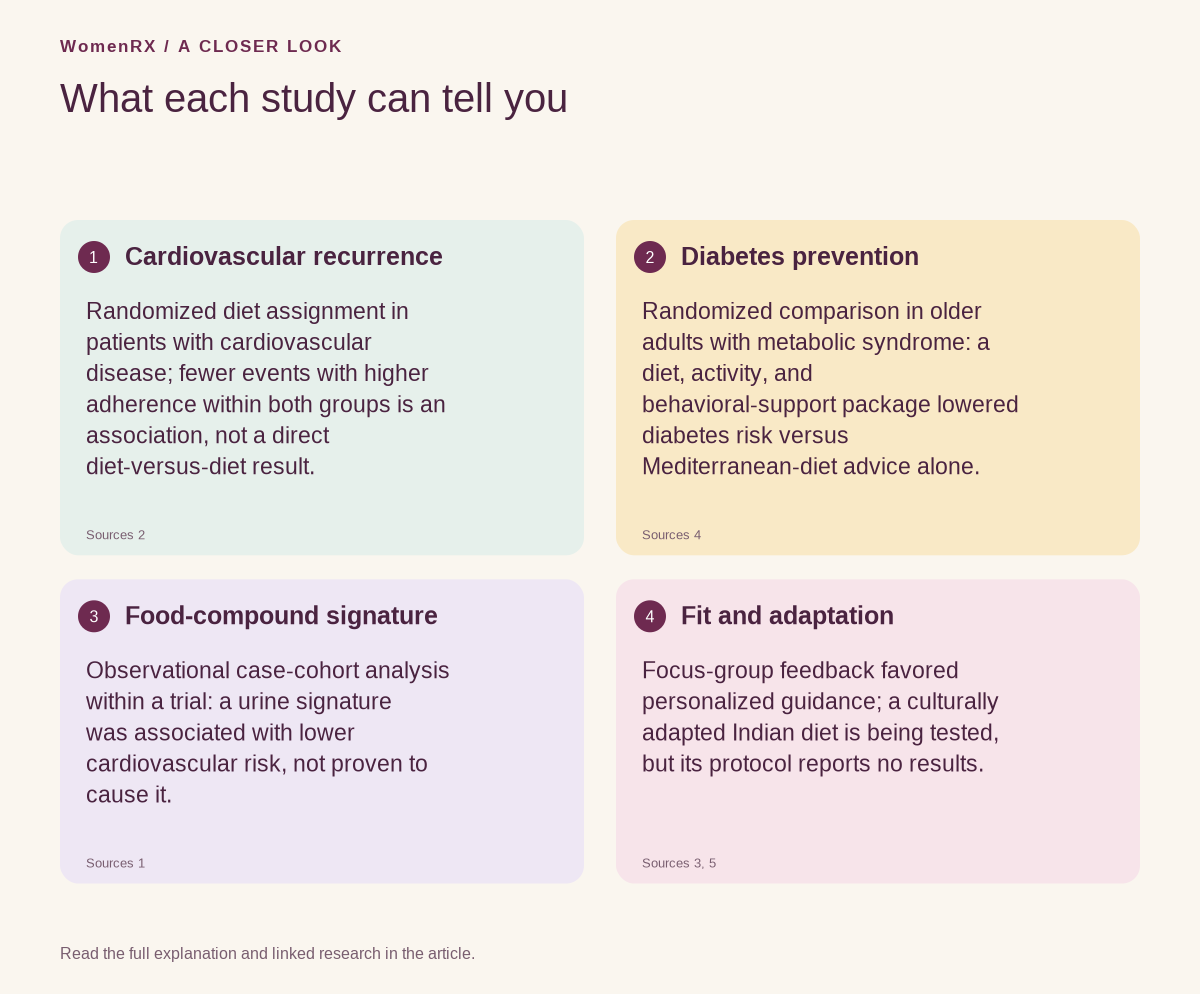
Cardiovascular recurrence: Randomized diet assignment in patients with cardiovascular disease; fewer events with higher adherence within both groups is an association, not a direct diet-versus-diet result.2
Diabetes prevention: Randomized comparison in older adults with metabolic syndrome: a diet, activity, and behavioral-support package lowered diabetes risk versus Mediterranean-diet advice alone.4
Food-compound signature: Observational case-cohort analysis within a trial: a urine signature was associated with lower cardiovascular risk, not proven to cause it.1
Fit and adaptation: Focus-group feedback favored personalized guidance; a culturally adapted Indian diet is being tested, but its protocol reports no results.35
Read the figure as text
The outcome, population, and comparison shape how far each finding can be applied.- Cardiovascular recurrence: Randomized diet assignment in patients with cardiovascular disease; fewer events with higher adherence within both groups is an association, not a direct diet-versus-diet result.2
- Diabetes prevention: Randomized comparison in older adults with metabolic syndrome: a diet, activity, and behavioral-support package lowered diabetes risk versus Mediterranean-diet advice alone.4
- Food-compound signature: Observational case-cohort analysis within a trial: a urine signature was associated with lower cardiovascular risk, not proven to cause it.1
- Fit and adaptation: Focus-group feedback favored personalized guidance; a culturally adapted Indian diet is being tested, but its protocol reports no results.35
More questions, answered
Does this evidence show that Mediterranean-style eating is better than a low-fat diet?
Not in the reported seven-year adherence analysis. Higher adherence was associated with fewer recurrent cardiovascular events in both assigned diet groups, but that comparison doesn’t establish that the Mediterranean diet was superior to the low-fat diet. 2
Is there evidence that the benefits are different for women?
The reported trial findings don’t include women-specific effects or results by reproductive life stage. They can’t tell us whether outcomes differ across those stages. 2 4
Sources you can check
- Urinary polyphenol signature of the Mediterranean diet is associated with lower cardiovascular disease risk: the PREDIMED trial.Domínguez-López I, Galkina P, Fernández-Duval G, Pozzoli C, Razquin C, Jáuregui O, Salas-Salvadó J, Tojal-Sierra L, Fitó M, Corella D, Fiol M, Lapetra J, Gómez-Gracia E, Pintó X, R... · BMC medicine · 2025Return to first citation
- Incidence of major adverse cardiovascular events decreases with greater adherence to both Mediterranean and low-fat dietary patterns in secondary prevention patients: a randomized controlled trial.Delgado-Lista J, Alcala-Diaz JF, Torres-Peña JD, Quintana-Navarro GM, Arenas Larriva AP, Fuentes F, Garcia-Rios A, Yubero-Serrano EM, Rangel-Zuñiga OA, Camargo A, Rodriguez-Cantale... · European journal of internal medicine · 2026Return to first citation
- Patient and public involvement in a randomized study: a qualitative study of participants' experiences in a Mediterranean Diet trial.Cano-Ibáñez N, Martínez-Ruiz V, Amezcua-Prieto C, Bouzalmate-Hajjaj A, Bueno-Cavanillas A, Masso-Guijarro P. · Journal of public health (Oxford, England) · 2025Return to first citation
- Comparison of an Energy-Reduced Mediterranean Diet and Physical Activity Versus an Ad Libitum Mediterranean Diet in the Prevention of Type 2 Diabetes : A Secondary Analysis of a Randomized Controlled Trial.Ruiz-Canela M, Corella D, Martínez-González MÁ, Babio N, Martínez JA, Forga L, Alonso-Gómez ÁM, Wärnberg J, Vioque J, Romaguera D, López-Miranda J, Estruch R, Santos-Lozano JM, Ser... · Annals of internal medicine · 2025Return to first citation
- The Impact of Indian Adapted Mediterranean Diet (IAMD) on Dietary Inflammatory Index in Patients with Coronary Artery Disease: Protocol for a Randomized Controlled Trial.Mantoo MR, Chauhan S, Shekar R, Pp A, Suresh M, Khan S, Basha A, Yadav S, Agstam S, Kumar S, Parakh N, Ali K, Bhushan S, Bakshi N, Singh A, Ghosh-Jerath S, Roy A. · BMC cardiovascular disorders · 2026Return to first citation