Low-Glycemic Eating: What It Can and Can’t Tell You
Glycemic index can offer a clue about carbohydrate quality, but a food’s GI isn’t a score for an entire meal or a weight-loss guarantee.
A lower-glycemic eating pattern may help with blood sugar: a review of randomized trials in people with type 2 diabetes found that low-GI diets improved fasting glucose compared with control diets, but did not report a significant low-GI benefit for HbA1c. GI alone can’t predict a mixed meal’s effect, and these findings don’t establish that low-GI eating causes more weight loss. 13
GI is a comparison, not a meal score
The glycemic index (GI) compares how a carbohydrate-containing food affects blood glucose with the effect of a reference food, when comparable amounts of carbohydrate are considered. It’s a way to describe the carbohydrate, not a measure of a food’s calories, overall nutrition, or suitability for every person. 3
Glycemic load (GL) brings the amount of carbohydrate into the picture as well as its GI. In practical terms, the GI of a food and the amount eaten answer different questions: GI is about the carbohydrate’s relative effect; GL also reflects how much carbohydrate is in the portion. That makes GL a more complete estimate of the glycemic effect of a serving, but it still isn’t a full prediction of your blood sugar after a meal. 23
Why a meal can differ from its ingredients
A GI number compares a carbohydrate-containing food with a reference food at an equivalent carbohydrate amount. What you eat is often a combination of foods, and the blood-glucose response to carbohydrates can vary with their type, amount, processing, and the presence of other nutrients. So a GI value for one ingredient can’t tell you exactly what will happen after a mixed meal. 3
For example, if you’re comparing two lunches, don’t stop at the GI number for the grain or bread. Consider the carbohydrate portion and how the food is prepared, then look at the whole combination of foods. This is a way to interpret the number, not a formula for calculating your individual response. 3
A practical comparison can stay simple:
- Start with the carbohydrate portion. A lower GI doesn’t cancel out the effect of eating more carbohydrate; GL accounts for amount as well as GI. 23
- Notice food form and processing. Processing is one factor that can affect a carbohydrate’s glucose response. A GI value shouldn’t be treated as a permanent label that predicts every preparation. 3
- Consider the whole meal. Other nutrients can affect the response to carbohydrate, so an isolated food value doesn’t describe the whole plate. 3
- Keep foods in context. GI isn’t a measure of calories or a complete ranking of food quality. Use it as one clue, not a reason to ban foods. 3
What the blood-sugar evidence shows
A 2023 network meta-analysis compared dietary approaches in 42 randomized trials involving 4,809 people with type 2 diabetes. The trials lasted at least six months. Low-GI diets were among the approaches that significantly reduced fasting glucose compared with a control diet; the analysis did not report a significant low-GI benefit for HbA1c in its results. 1
That finding is useful, but it doesn’t mean every lower-GI choice will improve your readings, or that GI is the only feature of a helpful eating pattern. The review compared whole diets, and its results don’t isolate the effect of a single food swap. The results presented here don’t tell us whether the effect differs for women. 1
Blood sugar and weight are separate questions
The low-GI trial review supports a possible benefit for fasting glucose in people with type 2 diabetes. It does not establish that choosing lower-GI foods leads to more weight loss than other eating patterns. GI describes a glucose response, not a food’s calorie content or the total effect of a diet on body weight. 13
A separate review of research on PCOS describes possible metabolic benefits from lower-GI or lower-GL eating, but also calls for more research on long-term effects, weight management, and comparisons with other dietary approaches. That is not enough to promise weight loss from following a low-GI diet. 2
What the evidence means for women
For women with PCOS, GI and GL may be relevant to a broader discussion of nutrition and metabolic health. The PCOS review describes potential benefits, while emphasizing that further research is needed. It doesn’t establish a single best GI target, prove that a low-GI pattern works the same for every person with PCOS, or show that its effects on weight are superior to other approaches. 2
The reported type 2 diabetes results don’t tell us whether the effect differs for women. And the studies summarized here don’t establish whether low-GI eating has a particular benefit in gestational diabetes or differs across pregnancy, postpartum, perimenopause, or postmenopause. It’s best not to assume that a finding in people with type 2 diabetes applies equally to those situations. 1
If your main goal is blood sugar, GI can be one consideration alongside the full eating pattern and your own glucose results. If your main goal is weight management, these findings don’t support choosing a diet solely because its GI is low. You can compare carbohydrate amount, processing, and meal combinations without treating any one number as a rule.
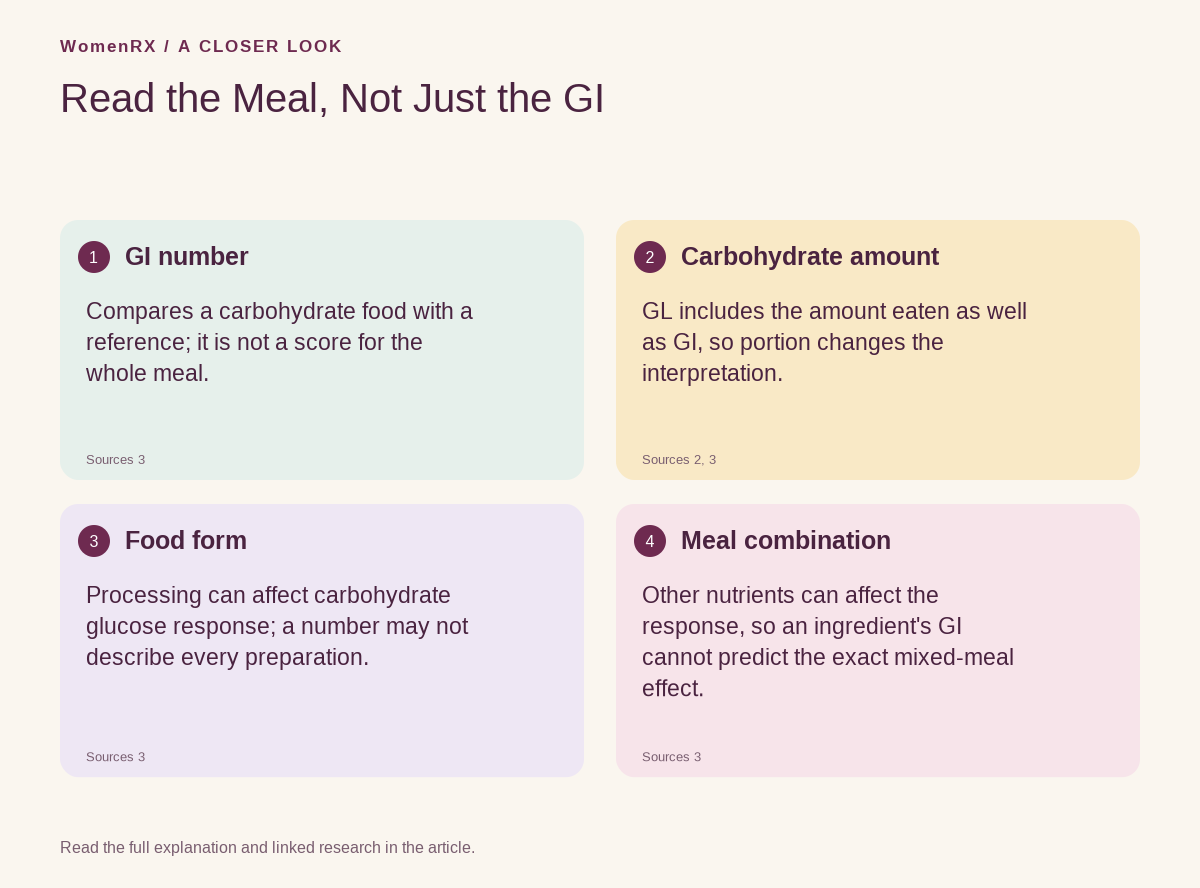
Read the Meal, Not Just the GI
GI number: Compares a carbohydrate food with a reference; it is not a score for the whole meal.3
Carbohydrate amount: GL includes the amount eaten as well as GI, so portion changes the interpretation.23
Food form: Processing can affect carbohydrate glucose response; a number may not describe every preparation.3
Meal combination: Other nutrients can affect the response, so an ingredient's GI cannot predict the exact mixed-meal effect.3
Read the figure as text
GI compares a carbohydrate food with a reference food at an equivalent carbohydrate amount. These distinctions show why portion, preparation, and the rest of the meal matter when interpreting that number.- GI number: Compares a carbohydrate food with a reference; it is not a score for the whole meal.3
- Carbohydrate amount: GL includes the amount eaten as well as GI, so portion changes the interpretation.23
- Food form: Processing can affect carbohydrate glucose response; a number may not describe every preparation.3
- Meal combination: Other nutrients can affect the response, so an ingredient's GI cannot predict the exact mixed-meal effect.3
Sources you can check
- Effect of Dietary Approaches on Glycemic Control in Patients with Type 2 Diabetes: A Systematic Review with Network Meta-Analysis of Randomized Trials.Jing T, Zhang S, Bai M, Chen Z, Gao S, Li S, Zhang J. · Nutrients · 2023Return to first citation
- Glycemic Index and Glycemic Load Estimates in the Dietary Approach of Polycystic Ovary Syndrome.Manta A, Paschou SA, Isari G, Mavroeidi I, Kalantaridou S, Peppa M. · Nutrients · 2023Return to first citation
- Dietary Approach of Patients with Hormone-Related Cancer Based on the Glycemic Index and Glycemic Load Estimates.Peppa M, Manta A, Mavroeidi I, Nastos C, Pikoulis E, Syrigos K, Bamias A. · Nutrients · 2023Return to first citation