Low-Glycemic Eating in Midlife: What It Can and Can’t Do
A low-glycemic approach may suit some health goals, but a food’s GI number alone can’t predict weight loss or your personal blood-sugar response.
Low-glycemic eating uses glycemic index (GI) to compare foods’ blood-glucose effects; glycemic load (GL) also accounts for how much carbohydrate you eat. In a small trial of women with excess body weight, a low-GI diet improved HbA1c more than a low-energy diet, but that doesn’t promise the same result for you. The evidence doesn’t establish a reliable weight-loss advantage for women over 40. 3 5 6
GI and GL answer different questions
The glycemic index, or GI, compares the rise in blood glucose after eating a set amount of carbohydrate from a food. Glycemic load, or GL, adds the amount of carbohydrate in the portion to that comparison. So GI describes a food’s relative effect per gram of carbohydrate; GL better reflects that effect together with how much carbohydrate is eaten. 3
In practice, a low-GI approach means choosing foods or meals with lower GI values. If you’re comparing two foods, you can look at their GI values, then consider how much carbohydrate you’d eat in your usual portion. The food with the lower GI won’t necessarily give that portion the lower GL if its carbohydrate amount is larger. Fiber is worth considering separately, too; GI and GL don’t describe every quality of a food. One trial in women defined low GI as below 55, but that was the study’s definition, not a universal target for every meal or person. 3 6
As a simple illustration, two meals could include foods with similar GI values but different amounts of carbohydrate. Their GLs could therefore differ. Neither number, by itself, describes a whole eating pattern or tells you whether it will lead to weight loss.
Weight loss is a separate outcome
A directly relevant trial in women followed 46 participants with excess body weight for 12 weeks. Participants followed either a low-GI diet or a low-energy diet. Both approaches improved measured outcomes, and the study reported advantages for the low-GI group on some measures, including waist circumference and HbA1c. But this was a small, short study, and the comparison doesn’t show that lowering GI alone reliably causes weight loss or works better for every woman. 5
A second small trial followed 26 healthy women aged 65 or older on low-GI diets with different protein amounts. Their average weight was 1.7 kg lower after six months, with no significant difference between the protein groups. Because both groups followed low-GI diets and there was no comparison group eating differently, this result can’t isolate the effect of low GI on weight. The participants were also older than many women who mean “midlife.” 6
Taken together, these studies don’t support treating a low GI number as a weight-loss plan on its own. For weight, the overall eating pattern matters. MedlinePlus describes weight loss in terms of taking in fewer calories than the body uses, while also emphasizing nutrient-rich foods and activity. 1 A low-GI approach may be one way to structure food choices, but these studies don’t establish it as superior for women over 40.
Blood sugar and longer-term health aren’t the same claim
For blood-glucose control, the 12-week trial of 46 women with excess body weight reported a greater reduction in HbA1c, a measure of longer-term blood glucose, with the low-GI diet than with the low-energy diet. That’s a measured benefit in this comparison, not proof that GI alone caused it or that every woman will see the same change. In the separate trial of 26 healthy women aged 65 or older, glucose-related measures remained unchanged after six months on low-GI diets. Both groups in that trial ate low-GI diets, so it couldn’t test low GI against a higher-GI alternative. 5 6
A meta-analysis of observational studies found a small association between higher GI and metabolic syndrome, but not between GL and metabolic syndrome. Because most included studies were cross-sectional and the findings are associations, they don’t show that a low-GI diet prevents metabolic syndrome or treats high blood sugar. 4
A large study of 47,513 women, with an average baseline age of 48.5, examined diet and healthy aging over time. It found associations between carbohydrate measures and the chance of meeting its definition of healthy aging, but it did not test a low-GI diet or weight-loss intervention. Its findings also illustrate why GI and GL shouldn’t be treated as interchangeable measures: their associations with this broad outcome differed, and the GL association was attenuated after accounting for fiber. 3
This is not strong, menopause-specific evidence that one GI target improves health for all women over 40. A low-GI approach might be relevant if you’re choosing among foods for blood-glucose management, but it should be one part of your plan, not a promise of a particular glucose result. If you have diabetes, keep using your glucose-monitoring and treatment plan; don’t change medication based on a diet claim. 2
A more useful way to read a low-GI claim
Ask what outcome was measured. A study of blood glucose doesn’t automatically prove weight loss; a study of body weight doesn’t establish better diabetes control. Also check who took part: evidence from women over 65 doesn’t automatically apply to women in their 40s or 50s, and a study of women doesn’t necessarily report results by menopause status.
If you’re considering low-GI eating, use the numbers as one lens rather than a pass-or-fail score for foods. The women’s cohort study linked higher intake of high-quality carbohydrates and fiber with healthy aging, but that was an observational association, not proof of a treatment effect. 3 The practical question is whether the eating pattern supports your particular goal and is workable for you, not whether every food has a low number.
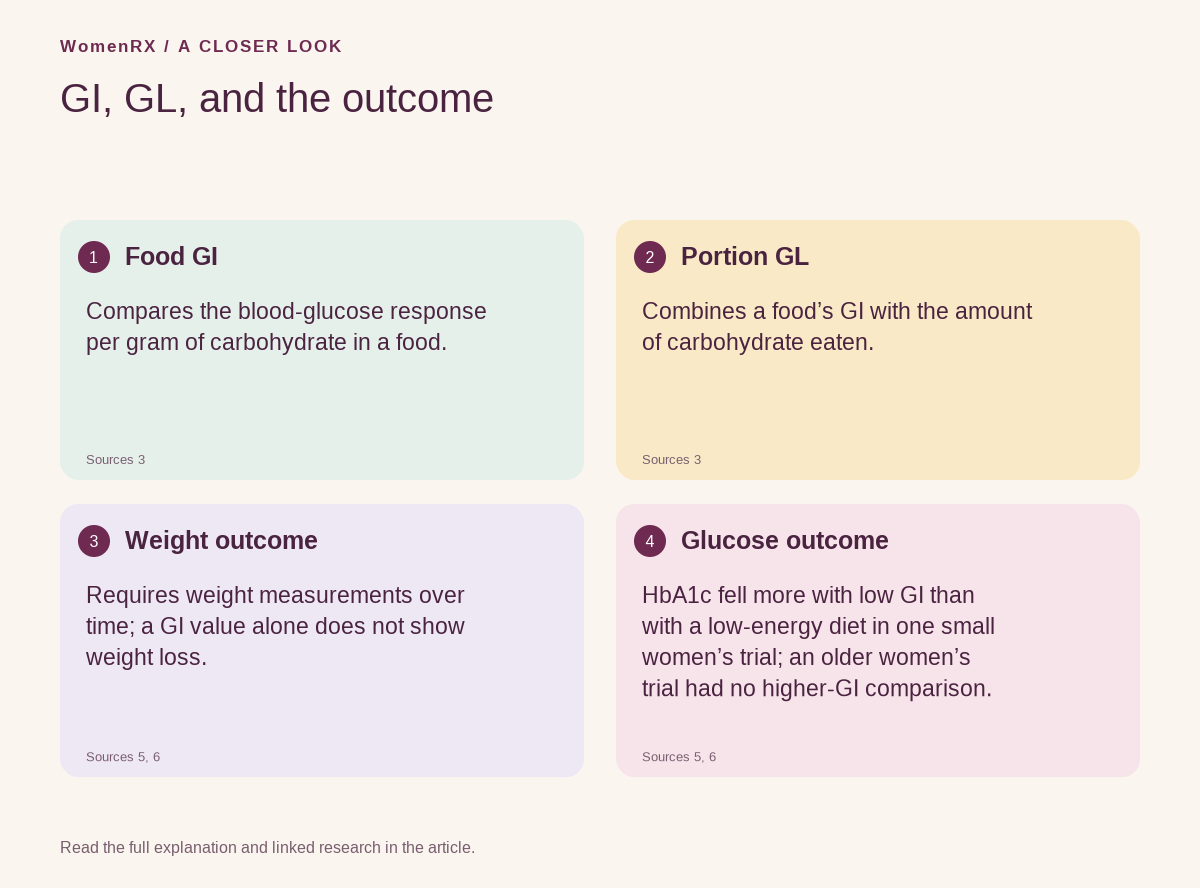
GI, GL, and the outcome
Food GI: Compares the blood-glucose response per gram of carbohydrate in a food.3
Portion GL: Combines a food’s GI with the amount of carbohydrate eaten.3
Weight outcome: Requires weight measurements over time; a GI value alone does not show weight loss.56
Glucose outcome: HbA1c fell more with low GI than with a low-energy diet in one small women’s trial; an older women’s trial had no higher-GI comparison.56
Read the figure as text
These measures and findings address different questions, so one can’t stand in for another.- Food GI: Compares the blood-glucose response per gram of carbohydrate in a food.3
- Portion GL: Combines a food’s GI with the amount of carbohydrate eaten.3
- Weight outcome: Requires weight measurements over time; a GI value alone does not show weight loss.56
- Glucose outcome: HbA1c fell more with low GI than with a low-energy diet in one small women’s trial; an older women’s trial had no higher-GI comparison.56
More questions, answered
Does low-GI eating work differently after menopause?
These studies don’t establish a menopause-specific advantage. One small study involved healthy postmenopausal women aged 65 or older, but compared two low-GI diets with different protein amounts, not low-GI eating with another diet. 6
Does a low GI mean a food won’t raise blood sugar?
No. GI compares relative glucose responses per gram of carbohydrate, while GL also accounts for the amount of carbohydrate. Neither measure guarantees an individual response or replaces a diabetes care plan. 3 2
Sources you can check
- Weight Control: MedlinePlusAccessed 2026-09-25Return to first citation
- Diabetes | Type 1 Diabetes | Type 2 Diabetes | MedlinePlusAccessed 2026-09-25Return to first citation
- Dietary Carbohydrate Intake, Carbohydrate Quality, and Healthy Aging in Women.Ardisson Korat AV, Duscova E, Shea MK, Jacques PF, Sebastiani P, Wang M, Mahdavi S, Eliassen AH, Willett WC, Sun Q. · JAMA network open · 2025Return to first citation
- Glycemic index, but not glycemic load, is associated with an increased risk of metabolic syndrome: Meta-analysis of observational studies.Askari M, Dehghani A, Abshirini M, Raeisi T, Alizadeh S. · International journal of clinical practice · 2021Return to first citation
- The Effect of a Low-Energy and Low-Glycemic Diet on Adipose Tissue Metabolism and Energy Expenditure in Women with Excess Body Weight.Lange E, Pałkowska-Goździk E. · Nutrients · 2025Return to first citation
- Effects of a high-protein, low-glycemic-index diet on body weight and waist circumference in late postmenopausal women: a randomized controlled trial.Silva TR, Lago SC, Fighera TM, Spritzer PM. · Archives of endocrinology and metabolism · 2024Return to first citation