What Diet Can and Can’t Do for Your Skin
Diet may play a supporting role in acne, but evidence for dry skin and other skin goals is much thinner.
For acne, a lower-glycemic eating pattern has been tested in clinical studies, but results are mixed: one trial found no statistically significant added improvement in acne counts when it was paired with benzoyl peroxide, while a small study in females reported improvement with dietary counseling. Most evidence about dairy and overall eating patterns is observational, so it can’t show that a particular food causes or clears acne. 5 6 7
Start with the skin concern, not a “skin food” list
Diet research is most developed for acne, especially questions about glycemic load and dairy. Even there, it doesn’t support a dependable food-based fix. Evidence about dry skin is different: severe essential-fatty-acid deficiency can cause rough, scaly skin, but that isn’t proof that adding omega-3 foods or supplements treats everyday dryness. 3 6
That distinction matters. A food can contain nutrients the body needs without being a demonstrated treatment for a skin condition. And a study can find that a dietary habit goes along with a skin outcome without proving that changing the habit will change the skin.
Acne: some trial evidence, but not a guaranteed result
Low-glycemic-load eating has been tested as an acne intervention. In a randomized trial of 84 people with acne, both groups used topical benzoyl peroxide; one group also followed a low-glycemic-load diet. Acne counts fell in both groups over 12 weeks, but the difference between groups was not statistically significant. The trial therefore didn’t establish an added acne-count benefit from the diet. Its abstract doesn’t report participants’ sex, so the result can’t be interpreted as women-specific. 7
A separate small study included 50 females aged 15 to 35 and reported that acne severity improved alongside dietary counseling and lower intake of high-glycemic-load foods. Its small size and the study’s reporting make it a less certain basis for predicting what will happen for an individual. Taken together, these trials make a lower-glycemic pattern a possible area of interest, not a replacement for acne treatment or a promise of clearer skin. 5
There’s a plausible reason researchers study this pattern: a systematic review describes possible links between glycemic intake, insulin-related hormones, and acne. But the same review characterized the effect as modest, and most included studies were observational rather than interventions. A biological explanation is not the same as proof that changing your diet will clear acne. 6
If you want to try a dietary adjustment, a reasonable way to think about it is as an optional, sustainable change alongside your usual care, not a strict elimination plan. The studies don’t establish one food list that works for everyone, or show that a low-glycemic diet works equally well across women’s life stages.
Dairy and Mediterranean-style eating: associations, not proof
Research linking dairy with acne is mixed. A systematic review found that the association may vary with sex, ethnicity, and cultural dietary habits; it did not establish that dairy causes acne in every person who eats it. That’s not strong grounds for automatically cutting out a whole food group. 6
A 2025 review of five case-control studies, with 765 participants in total, found no statistically significant association between Mediterranean-diet adherence and acne development. It did find a correlation between greater adherence and lower acne severity, but the evidence was rated low quality and the studies varied considerably. Because these were observational studies, they can’t show that adopting the diet would reduce someone’s acne. 4
The practical takeaway is to be cautious about turning associations into rules. If you notice a consistent personal pattern, you can pay attention to it, but the research doesn’t justify assuming that dairy, a particular fruit, or a single “anti-inflammatory” food is the cause of your breakouts.
Dryness and visible skin changes need a different evidence bar
Essential-fatty-acid deficiency, whether involving omega-3 or omega-6 fatty acids, can cause rough, scaly skin, but classical deficiency is described as virtually nonexistent in healthy people in the United States. This finding concerns deficiency, not whether omega-3 supplements or a specific diet improve common dry skin. 3
For other appearance goals, be careful about what a study actually measured. For example, a study of college students found that a dietary-pattern score was associated with skin carotenoid measurements. That’s a relationship with a skin biomarker, not evidence that the diet prevented wrinkles, treated acne, or made skin look better. 8
Acne can have more than one influence
Acne is not simply a reflection of what you eat. Hormonal changes around menstrual cycles or pregnancy can contribute to acne episodes, and acne can continue into adult life. These influences can overlap with diet, and the available dietary research doesn’t tell you which factor is driving an individual woman’s breakouts. 1 6
Diet is best treated as one possible supporting factor, not a way to diagnose the cause. Acne can be controlled with treatment. If it is causing scarring, includes deep nodules or cysts, or is making you feel very low or anxious, don’t rely on diet changes alone; those are reasons to seek care. 1 2
What diet studies can tell you
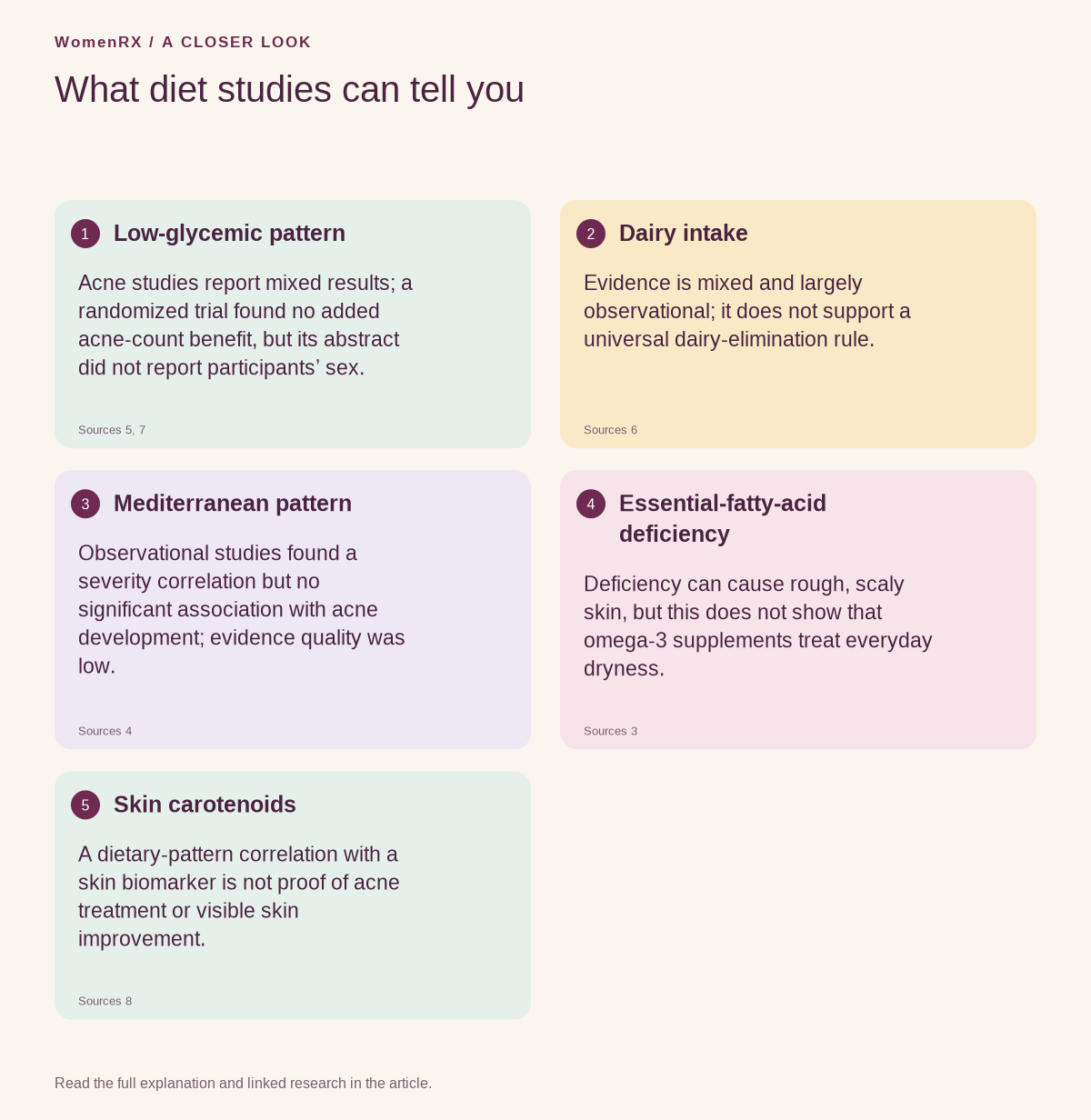
Low-glycemic pattern: Acne studies report mixed results; a randomized trial found no added acne-count benefit, but its abstract did not report participants’ sex.57
Dairy intake: Evidence is mixed and largely observational; it does not support a universal dairy-elimination rule.6
Mediterranean pattern: Observational studies found a severity correlation but no significant association with acne development; evidence quality was low.4
Essential-fatty-acid deficiency: Deficiency can cause rough, scaly skin, but this does not show that omega-3 supplements treat everyday dryness.3
Skin carotenoids: A dietary-pattern correlation with a skin biomarker is not proof of acne treatment or visible skin improvement.8
Read the figure as text
These findings differ in both the skin outcome measured and how confidently they can support a dietary decision.- Low-glycemic pattern: Acne studies report mixed results; a randomized trial found no added acne-count benefit, but its abstract did not report participants’ sex.57
- Dairy intake: Evidence is mixed and largely observational; it does not support a universal dairy-elimination rule.6
- Mediterranean pattern: Observational studies found a severity correlation but no significant association with acne development; evidence quality was low.4
- Essential-fatty-acid deficiency: Deficiency can cause rough, scaly skin, but this does not show that omega-3 supplements treat everyday dryness.3
- Skin carotenoids: A dietary-pattern correlation with a skin biomarker is not proof of acne treatment or visible skin improvement.8
More questions, answered
Should I cut out dairy to improve acne?
Not automatically. The research is mixed and doesn’t establish that dairy causes acne for everyone. If you suspect a personal connection, consider the overall pattern rather than treating a general association as proof. 6
Do omega-3 supplements treat dry skin?
Research supports a narrower point: essential-fatty-acid deficiency can cause rough, scaly skin. It does not establish that omega-3 supplements improve common dry skin in people without a deficiency. 3
Sources you can check
- Acne - NHSAccessed 2026-09-25Return to first citation
- Acne - Treatment - NHSAccessed 2026-09-25Return to first citation
- Omega-3 Fatty Acids - Health Professional Fact SheetAccessed 2026-09-25Return to first citation
- The mediterranean diet and acne vulgaris: a systematic review and meta-analysis.Taha S, Shakhshir M, Zyoud SH. · Nutrition & metabolism · 2025Return to first citation
- Effect of a Low-Glycemic-Load Diet and Dietary Counseling on Acne Vulgaris Severity Among Female Patients Aged 15 to 35 Years.Raza Q, Hina RE, Nawaz S, Safdar M, Imran K, Ashraf U, Imran MS. · Cureus · 2024Return to first citation
- Diet and acne: A systematic review.Meixiong J, Ricco C, Vasavda C, Ho BK. · JAAD international · 2022Return to first citation
- A randomized controlled trial of topical benzoyl peroxide 2.5% gel with a low glycemic load diet versus topical benzoyl peroxide 2.5% gel with a normal diet in acne (grades 1-3).Pavithra G, Upadya GM, Rukmini MS. · Indian journal of dermatology, venereology and leprology · 2019Return to first citation
- Moderate MIND diet adherence and positive correlation between weekly egg intake and skin carotenoid scores in college students.Hill C, Foster VR, Patel AB, Ribay GD, Sadlo MK, Senthilkumar N, Moreno ML, Colee J, Dahl WJ. · Nutrition research (New York, N.Y.) · 2026Return to first citation